
Filter
2972 Publications
Showing 2261-2270 of 2972 resultsRNA granules have been likened to liquid droplets whose dynamics depend on the controlled dissolution and condensation of internal components. The molecules and reactions that drive these dynamics in vivo are not well understood. In this study, we present evidence that a group of intrinsically disordered, serine-rich proteins regulate the dynamics of P granules in C. elegans embryos. The MEG (maternal-effect germline defective) proteins are germ plasm components that are required redundantly for fertility. We demonstrate that MEG-1 and MEG-3 are substrates of the kinase MBK-2/DYRK and the phosphatase PP2A(PPTR-½). Phosphorylation of the MEGs promotes granule disassembly and dephosphorylation promotes granule assembly. Using lattice light sheet microscopy on live embryos, we show that GFP-tagged MEG-3 localizes to a dynamic domain that surrounds and penetrates each granule. We conclude that, despite their liquid-like behavior, P granules are non-homogeneous structures whose assembly in embryos is regulated by phosphorylation.
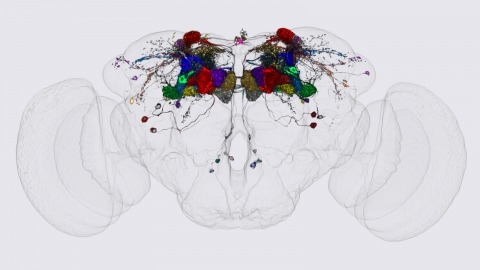
We identified the neurons comprising the Drosophila mushroom body (MB), an associative center in invertebrate brains, and provide a comprehensive map describing their potential connections. Each of the 21 MB output neuron (MBON) types elaborates segregated dendritic arbors along the parallel axons of ∼2000 Kenyon cells, forming 15 compartments that collectively tile the MB lobes. MBON axons project to five discrete neuropils outside of the MB and three MBON types form a feedforward network in the lobes. Each of the 20 dopaminergic neuron (DAN) types projects axons to one, or at most two, of the MBON compartments. Convergence of DAN axons on compartmentalized Kenyon cell-MBON synapses creates a highly ordered unit that can support learning to impose valence on sensory representations. The elucidation of the complement of neurons of the MB provides a comprehensive anatomical substrate from which one can infer a functional logic of associative olfactory learning and memory.
Iterative multi-photon adaptive compensation technique (IMPACT) has been developed for wavefront measurement and compensation in highly scattering tissues. Our previous report was largely based on the measurements of fixed tissue. Here we demonstrate the advantages of IMPACT for in vivo imaging and report the latest results. In particular, we show that IMPACT can be used for functional imaging of awake mice, and greatly improve the in vivo neuron imaging in mouse cortex at large depth (~660 microns). Moreover, IMPACT enables neuron imaging through the intact skull of adult mice, which promises noninvasive optical measurements in mouse brain.
Rat or mouse liver is the most frequently used tissue for mitochondrial preparations because it is readily available, easy to homogenize, and replete with mitochondria. A motor-driven Teflon and glass Potter-Elvehjem homogenizer is the best choice for homogenizing liver, but if one is not available, this tissue is soft enough that a Dounce homogenizer with a loose (A) pestle can also be used. The yield and purity of the mitochondrial preparation will be influenced by the method and speed of preparation and the age and physiological condition of the animal.
The number of mitochondria per cell varies substantially from cell line to cell line. For example, human HeLa cells contain at least twice as many mitochondria as smaller mouse L cells. This protocol starts with a washed cell pellet of 1-2 mL derived from ∼10⁹ cells grown in culture. The cells are swollen in a hypotonic buffer and ruptured with a Dounce or Potter-Elvehjem homogenizer using a tight-fitting pestle, and mitochondria are isolated by differential centrifugation.
Mitochondrial fractions isolated from tissue culture cells or tissue such as liver after differential centrifugation can be purified further by density gradient centrifugation. Here we describe the use of sucrose for this purpose because it is commonly used and inexpensive and the resulting mitochondria preparations are useful for many purposes.
BACKGROUND: The popular view on insect sociality is that of a harmonious division of labor among two morphologically distinct and functionally non-overlapping castes. But this is a highly derived state and not a prerequisite for a functional society. Rather, caste-flexibility is a central feature in many eusocial wasps, where adult females have the potential to become queens or workers, depending on the social environment. In non-swarming paper wasps (e.g., Polistes), prospective queens fight one another to assert their dominance, with losers becoming workers if they remain on the nest. This aggression is fueled by juvenile hormone (JH) and ecdysteroids, major factors involved in caste differentiation in most eusocial insects. We tested whether these hormones have conserved aggression-promoting functions in Synoeca surinama, a caste-flexible swarm-founding wasp (Epiponini) where reproductive competition is high and aggressive displays are common. RESULTS: We observed the behavioral interactions of S. surinama females in field nests before and after we had removed the egg-laying queen(s). We measured the ovarian reproductive status, hemolymph JH and ecdysteroid titers, ovarian ecdysteroid content, and analyzed the cuticular hydrocarbon (CHC) composition of females engaged in competitive interactions in both queenright and queenless contexts. These data, in combination with hormone manipulation experiments, revealed that neither JH nor ecdysteroids are necessary for the expression of dominance behaviors in S. surinama. Instead, we show that JH likely functions as a gonadotropin and directly modifies the cuticular hydrocarbon blend of young workers to match that of a reproductive. Hemolymph ecdysteroids, in contrast, are not different between queens and workers despite great differences in ovarian ecdysteroid content. CONCLUSIONS: The endocrine profile of S. surinama shows surprising differences from those of other caste-flexible wasps, although a rise in JH titers in replacement queens is a common theme. Extensive remodeling of hormone functions is also evident in the highly eusocial bees, which has been attributed to the evolution of morphologically defined castes. Our results show that hormones which regulate caste-plasticity can lose these roles even while caste-plasticity is preserved.
Single molecule-based superresolution imaging has become an essential tool in modern cell biology. Because of the limited depth of field of optical imaging systems, one of the major challenges in superresolution imaging resides in capturing the 3D nanoscale morphology of the whole cell. Despite many previous attempts to extend the application of photo-activated localization microscopy (PALM) and stochastic optical reconstruction microscopy (STORM) techniques into three dimensions, effective localization depths do not typically exceed 1.2 µm. Thus, 3D imaging of whole cells (or even large organelles) still demands sequential acquisition at different axial positions and, therefore, suffers from the combined effects of out-of-focus molecule activation (increased background) and bleaching (loss of detections). Here, we present the use of multifocus microscopy for volumetric multicolor superresolution imaging. By simultaneously imaging nine different focal planes, the multifocus microscope instantaneously captures the distribution of single molecules (either fluorescent proteins or synthetic dyes) throughout an ∼4-µm-deep volume, with lateral and axial localization precisions of ∼20 and 50 nm, respectively. The capabilities of multifocus microscopy to rapidly image the 3D organization of intracellular structures are illustrated by superresolution imaging of the mammalian mitochondrial network and yeast microtubules during cell division.
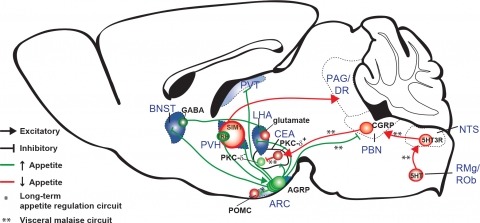
New tools for mapping and manipulating molecularly defined neural circuits have improved understanding of how the central nervous system regulates appetite. Studies focused on AGRP neurons, a starvation-sensitive hypothalamic population, have identified multiple circuit elements that can elicit or suppress feeding behavior. Distinct axon projections of this neuron population point to different circuits that regulate long-term appetite, short-term feeding, or visceral malaise-mediated anorexia. Here, we review recent studies examining these neural circuits that control food intake. © 2014 S. Karger AG, Basel.
Successful neurological rehabilitation depends on accurate diagnosis, effective treatment, and quantitative evaluation. Neural coding, a technology for interpretation of functional and structural information of the nervous system, has contributed to the advancements in neuroimaging, brain-machine interface (BMI), and design of training devices for rehabilitation purposes. In this review, we summarized the latest breakthroughs in neuroimaging from microscale to macroscale levels with potential diagnostic applications for rehabilitation. We also reviewed the achievements in electrocorticography (ECoG) coding with both animal models and human beings for BMI design, electromyography (EMG) interpretation for interaction with external robotic systems, and robot-assisted quantitative evaluation on the progress of rehabilitation programs. Future rehabilitation would be more home-based, automatic, and self-served by patients. Further investigations and breakthroughs are mainly needed in aspects of improving the computational efficiency in neuroimaging and multichannel ECoG by selection of localized neuroinformatics, validation of the effectiveness in BMI guided rehabilitation programs, and simplification of the system operation in training devices.