APIG (Harris Lab)
Our projects span the range of target biology, from C. elegans to mice and rats. About one-third of our current projects are directed to electrophysiology, intracellular and extracellular, a second third are advanced optical imaging for neural reconstruction, and the remainder focus on specialty projects.
One of our goals is to provide neuroscientists at Janelia with the ability to measure electrical properties of active neural circuits in model animal systems. We have fabricated and deployed custom electrodes and recording systems for Drosophila, dragonflys, mice and rats. Most advanced are the systems for high channel count probes in mice and the necessary multiplexing head stages to enable their use on awake, freely moving mice. We fabricate 128 channel probes with up to 64 sites per shank, while keeping the shank width below 70 um and the shank thickness at 15 um. Examples of two of 60+ new probe designs is shown below along with the multiplexing headstage. Data taken from the olfactory bulb of a mouse show the excellent signal and low noise of these probes.
Optogenetics is rapidly becoming a powerful new tool in experimental neuroscience. We are actively involved in developing new technology for Janelia neuroscientists to maximize the potential of optogenetics by integrating micro-fabricated extracellular recording electrodes with optical waveguides, as shown below, for simultaneous optical and electrical interrogation of active neural systems.
[[nid:4146]]
Intracellular recordings provide the most fundamental information about electrical activity in neurons. These measurements are extremely delicate and very sensitive to mechanical disturbances, and therefore nearly impossible in active neural systems. The primary goal in this project is to provide the neuroscientists at Janelia with new devices that allow them to reliably measure intracellular electrical properties of active neural circuits with single-cell resolution. Images below show the performance of a novel device as compared to the standard patch electrode when subject to a mechanical impact.
We continually look at opportunities to utilize modern advances in semiconductor fabrication, optoelectronics, and microdevice development (shown below) to advance the field of experimental electrophysiology at Janelia. We believe that in miniaturizing present neural recording systems, by integration of novel micro-devices into complete recording systems, shown below, new opportunities will arise in obtaining fundamental intracellular information from active neural systems with single-cell resolution.
Optics and electrophysiology are becoming more intertwined, as neuroscientists look at novel ways to access information from single cells in active brains. As part of our efforts to provide the tools they need, we are developing two-photon visible patch-clamp electrodes (shown below) that will help Janelia neuroscientists target neural cells of interest with increasing precision and reliability.
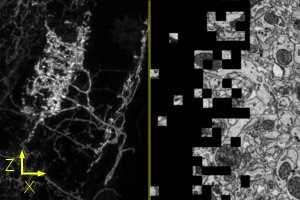
The array tomography project is focused on automating and determining the limits of optical reconstructions of embedded, ultrathin sliced brain samples. This technique, pioneered by the Smith lab at Stanford University, has significant potential for combining high-resolution data with molecular information—determining the location of functional proteins within connected neurons. To realize that potential in an accessible experiment, many obstacles of sample preparation, imaging, and analysis must be overcome: Bill Karsh, Kelly Chamberlain, and Jennifer Colonell in APIG are collaborating with many scientists throughout Janelia to tackle these issues.
We have implemented high-throughput, automated imaging tailored to array tomography samples; this is the imaging engine for an ambitious large-volume reconstruction in the mouse barrel cortex led by JC Rah, a visitor in the Svoboda lab. Bill has adapted Lou Scheffer’s EM tools to enable the alignment of large optical data sets on Janelia’s computing cluster. Jennifer is currently working on the automation of slice collection suitable for optical imaging; specifically, optimizing an ATUM tape-based pickup scheme (ATUM provided by Ken Hayworth of the Lichtman Lab at Harvard).
We are collaborating with Tanya Wolff of the Rubin lab to complete an optical reconstruction of selected neurons in the fly lamina, which has been fully reconstructed in EM. These data will allow us to validate measurements made by array tomography.

On the left is a Golgi stained image of representative cell types in the fly lamina (from Fischbach and Dittrich, Cell Tissue Res., 258:441 (1989)). Top right shows ultrathin slice of embedded fly lamina; two neuron types—L2 and L4—have been labeled with a membrane localized epitope tag. Bottom right shows reconstruction through many of these slices. 3D reconstructions of this resolution reveal the anatomy of and potential connectivity of the neurons.

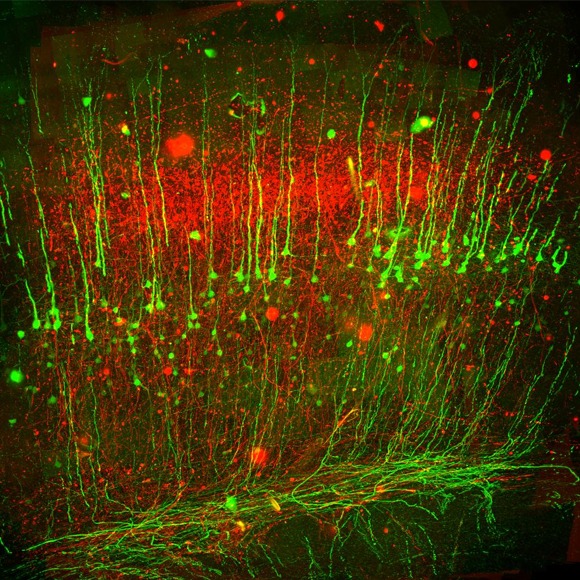
Maximum intensity projection of 1000 slices in mouse barrel cortex; the full size of this volume is 1.3 mm x 1.4 mm x 0.2 mm; a typical barrel is about 0.3 mm in diameter. The resolution of the original data – which is downsampled for display – is 250x250x400 nm. The green somata are layer 5 pyramidal neurons, while the red labels projections from the thalamus. Note that only about 5% of the cells are labeled—the “empty space” is filled with unlabeled cells.
Volume rendering of a portion of the data shown in the maximum intensity projection. Only the labeled layer 5 pyramidal neurons are shown here.
Zoomed in on apical dendrites. This volume is 30 x 60 x 20 microns.
Researchers strive to make measurements on animals in a way that does not inhibit or modify the behavior under study. Anthony Leonardo here at Janelia is investigating the neural basis for prey capture by dragonflies in midflight, a behavior requiring untethered and unrestricted motion of the animal. He and colleagues Reid Harrison and Rob Olberg have developed and demonstrated a lightweight telemetry circuit powered by a small battery that when combined with custom electrical probes, can record and transmit extracellular and neuromuscular signals from the dragonfly to a stationary receiver.
In collaboration with Anthony, we are exploring ways to provide a long-life source of lightweight and untethered power for the dragonfly electronics, as an alternative to the rather heavy batteries commercially available. One approach we are pursuing involves using solar cells, which are photodiodes that generate a current and voltage proportional to the amount of light falling on the active area of the device. While ambient light is a convenient source of optical power, in order to keep the size of the solar cells small, a near-IR light source that cannot be seen by the animal can illuminate the body-mounted solar cell while the dragonfly is perched. An additional component, a small lightweight supercapacitor, is added to store electrical energy required for the telemetry circuit during the brief period of flight of the dragonfly during prey capture. This is a rechargeable process; each time the dragonfly returns to the perch it is illuminated with near-IR light, which is converted to electrical power by the solar cell, recharging the supercapacitor for the next flight.
Devices have been constructed and used to successfully record neural activity in perched dragonflies, and experiments are under way to map the complex dynamical behavior and the underlying neural computations involved in midflight prey capture.
-
-
Tim Harris Lab Head
-
Brian Barbarits
-
Mladen Barbic Senior Scientist
-
Jennifer Colonell Senior Scientist
-
Hananeh Esmailbeigi Postdoctoral Associate
-
Bill Karsh Senior Scientist
-
John Macklin Senior Scientist
-
Song Pang
-
Jacqueline Stephens
Janelia Publications
Prior Publications (6)
A formalism is given in which the optical field generated by a near-field optical aperture is described as an analytic expansion over a complete set of optical modes. This vectoral solution preserves the divergent behavior of the near field and the dipolar nature of the far field. Numerical calculation of the fields requires only evaluation of a well behaved, one-dimensional integral. The formalism is directly applicable to experiments in near-field scanning optical microscopy when relatively flat samples are evaluated.
Luminescent centers with sharp (<0.07 millielectron volt), spectrally distinct emission lines were imaged in a GaAs/AIGaAs quantum well by means of low-temperature near-field scanning optical microscopy. Temperature, magnetic field, and linewidth measurements establish that these centers arise from excitons laterally localized at interface fluctuations. For sufficiently narrow wells, virtually all emission originates from such centers. Near-field microscopy/spectroscopy provides a means to access energies and homogeneous line widths for the individual eigenstates of these centers, and thus opens a rich area of physics involving quantum resolved systems.
Recent advances in probe design have led to enhanced resolution (currently as significant as ~ 12 nm) in optical microscopes based on near-field imaging. We demonstrate that the polarization of emitted and detected light in such microscopes can be manipulated sensitively to generate contrast. We show that the contrast on certain patterns is consistent with a simple interpretation of the requisite boundary conditions, whereas in other cases a more complicated interaction between the probe and the sample is involved. Finally application of the technique to near-filed magneto-optic imaging is demonstrated.
In near-field scanning optical microscopy, a light source or detector with dimensions less than the wavelength (lambda) is placed in close proximity (lambda/50) to a sample to generate images with resolution better than the diffraction limit. A near-field probe has been developed that yields a resolution of approximately 12 nm ( approximately lambda/43) and signals approximately 10(4)- to 10(6)-fold larger than those reported previously. In addition, image contrast is demonstrated to be highly polarization dependent. With these probes, near-field microscopy appears poised to fulfill its promise by combining the power of optical characterization methods with nanometric spatial resolution.