Reiser Lab
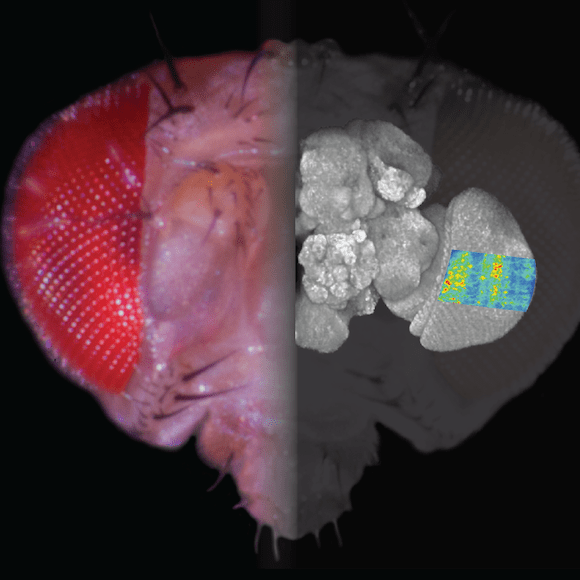
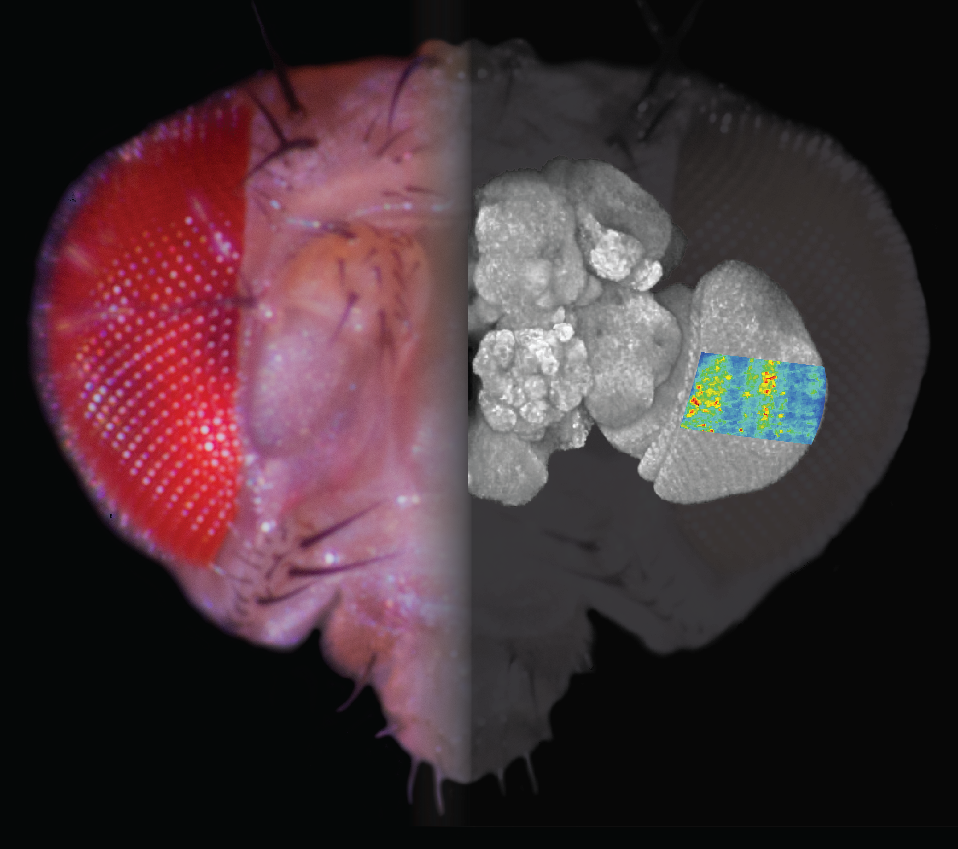
We study the spectacular behavioral repertoire and the molecular genetic toolkit of the fly to uncover the functional organization of neural circuits that orchestrate our favorite behaviors. All projects in the lab combine multiple approaches; we explore the rich behaviors of walking and flying flies supported by extensive instrument development efforts, along with electrophysiology, calcium imaging, and computational methods.
We work closely with several groups within Janelia, especially the labs of Vivek Jayaraman, Gerry Rubin and the Fly Olympiad Project Team.
Our interests in fly vision and thermosensing have lead us to studying an elaborate learned behavior—visual place memory (or how a fly knows where it is). Our approach towards behavioral neurogenetics, makes use of precise measurements of specific behavior in combination with small scale screens of anatomically preselected driver lines (graciously supplied by the Rubin lab) for inactivating small subsets of neurons. The other major effort in the lab works towards establishing and using physiological measurements to understand the roles of identified neurons in specific features of well-defined behaviors.
While we are broadly interested in most aspects of fly behavior, the primary projects in the lab are:
- The sensory basis of gravity sensing (Nikolai Kladt)
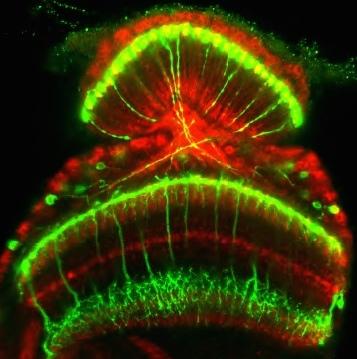
- The functional organization of the early visual system—the lamina and medulla (behavioral genetics: John Tuthill in collaboration with Aljoscha Nern and Gerry Rubin; electrophysiology: John Tuthill; imaging: James Strother in collaboration with Vivek Jayaraman)
- Visual place memory (Tyler Ofstad and Laura Henderson as collaboration with Charles Zuker; recent effort into the role of the central complex as a collaboration with Arnim Jenett and Gerry Rubin).
-
-
Michael Reiser Lab Head
-
Eyal Gruntman Postdoctoral Associate
-
Stephen Holtz Research Staff
-
Mai Morimoto
-
Edward Rogers Research Staff
-
James Strother Postdoctoral Associate
-
Shiuan-Tze Wu Research Staff
-
Emily Willis
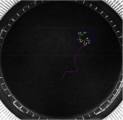
Drosophila on a ball system (www.flyfizz.org)
Janelia Publications
Virtual reality (VR) holds great promise as a tool to study the neural circuitry underlying animal behaviors. Here, we discuss the advantages of VR and the experimental paradigms and technologies that enable closed loop behavioral experiments. We review recent results from VR research in genetic model organisms where the potential combination of rich behaviors, genetic tools and cutting edge neural recording techniques are leading to breakthroughs in our understanding of the neural basis of behavior. We also discuss several key issues to consider when performing VR experiments and provide an outlook for the future of this exciting experimental toolkit.
When the contrast of an image flickers as it moves, humans perceive an illusory reversal in the direction of motion. This classic illusion, called reverse-phi motion, has been well-characterized using psychophysics, and several models have been proposed to account for its effects. Here, we show that Drosophila melanogaster also respond behaviorally to the reverse-phi illusion and that the illusion is present in dendritic calcium signals of motion-sensitive neurons in the fly lobula plate. These results closely match the predictions of the predominant model of fly motion detection. However, high flicker rates cause an inversion of the reverse-phi behavioral response that is also present in calcium signals of lobula plate tangential cell dendrites but not predicted by the model. The fly's behavioral and neural responses to the reverse-phi illusion reveal unexpected interactions between motion and flicker signals in the fly visual system and suggest that a similar correlation-based mechanism underlies visual motion detection across the animal kingdom.
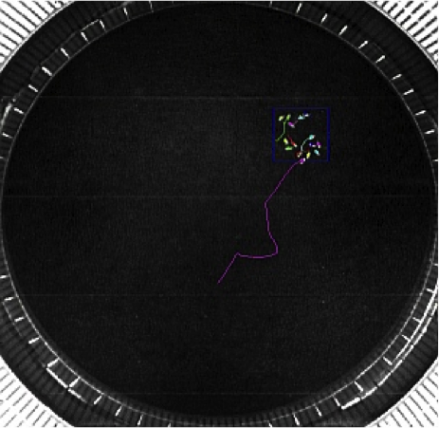
The ability of insects to learn and navigate to specific locations in the environment has fascinated naturalists for decades. The impressive navigational abilities of ants, bees, wasps and other insects demonstrate that insects are capable of visual place learning, but little is known about the underlying neural circuits that mediate these behaviours. Drosophila melanogaster (common fruit fly) is a powerful model organism for dissecting the neural circuitry underlying complex behaviours, from sensory perception to learning and memory. Drosophila can identify and remember visual features such as size, colour and contour orientation. However, the extent to which they use vision to recall specific locations remains unclear. Here we describe a visual place learning platform and demonstrate that Drosophila are capable of forming and retaining visual place memories to guide selective navigation. By targeted genetic silencing of small subsets of cells in the Drosophila brain, we show that neurons in the ellipsoid body, but not in the mushroom bodies, are necessary for visual place learning. Together, these studies reveal distinct neuroanatomical substrates for spatial versus non-spatial learning, and establish Drosophila as a powerful model for the study of spatial memories.
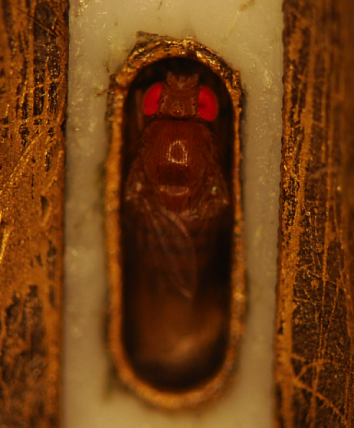
Drosophila melanogaster is a model organism rich in genetic tools to manipulate and identify neural circuits involved in specific behaviors. Here we present a technique for two-photon calcium imaging in the central brain of head-fixed Drosophila walking on an air-supported ball. The ball's motion is tracked at high resolution and can be treated as a proxy for the fly's own movements. We used the genetically encoded calcium sensor, GCaMP3.0, to record from important elements of the motion-processing pathway, the horizontal-system lobula plate tangential cells (LPTCs) in the fly optic lobe. We presented motion stimuli to the tethered fly and found that calcium transients in horizontal-system neurons correlated with robust optomotor behavior during walking. Our technique allows both behavior and physiology in identified neurons to be monitored in a genetic model organism with an extensive repertoire of walking behaviors.
Changes in behavioral state modify neural activity in many systems. In some vertebrates such modulation has been observed and interpreted in the context of attention and sensorimotor coordinate transformations. Here we report state-dependent activity modulations during walking in a visual-motor pathway of Drosophila. We used two-photon imaging to monitor intracellular calcium activity in motion-sensitive lobula plate tangential cells (LPTCs) in head-fixed Drosophila walking on an air-supported ball. Cells of the horizontal system (HS)--a subgroup of LPTCs--showed stronger calcium transients in response to visual motion when flies were walking rather than resting. The amplified responses were also correlated with walking speed. Moreover, HS neurons showed a relatively higher gain in response strength at higher temporal frequencies, and their optimum temporal frequency was shifted toward higher motion speeds. Walking-dependent modulation of HS neurons in the Drosophila visual system may constitute a mechanism to facilitate processing of higher image speeds in behavioral contexts where these speeds of visual motion are relevant for course stabilization.
Prior Publications (5)
Flies, like all animals that depend on vision to navigate through the world, must integrate the optic flow created by self-motion with the images generated by prominent features in their environment. Although much is known about the responses of Drosophila melanogaster to rotating flow fields, their reactions to the more complex patterns of motion that occur as they translate through the world are not well understood. In the present study we explore the interactions between two visual reflexes in Drosophila: object fixation and expansion avoidance. As a fly flies forward, it encounters an expanding visual flow field. However, recent results have demonstrated that Drosophila strongly turn away from patterns of expansion. Given the strength of this reflex, it is difficult to explain how flies make forward progress through a visual landscape. This paradox is partially resolved by the finding reported here that when undergoing flight directed towards a conspicuous object, Drosophila will tolerate a level of expansion that would otherwise induce avoidance. This navigation strategy allows flies to fly straight when orienting towards prominent visual features.
Flying insects exhibit stunning behavioral repertoires that are largely mediated by the visual control of flight. For this reason, presenting a controlled visual environment to tethered insects has been and continues to be a powerful tool for studying the sensory control of complex behaviors. To create an easily controlled, scalable, and customizable visual stimulus, we have designed a modular system, based on panels composed of an 8 x 8 array of individual LEDs, that may be connected together to 'tile' an experimental environment with controllable displays. The panels have been designed to be extremely bright, with the added flexibility of individual-pixel brightness control, allowing experimentation over a broad range of behaviorally relevant conditions. Patterns to be displayed may be designed using custom software, downloaded to a controller board, and displayed on the individually addressed panels via a rapid communication interface. The panels are controlled by a microprocessor-based display controller which, for most experiments, will not require a computer in the loop, greatly reducing the experimental infrastructure. This technology allows an experimenter to build and program a visual arena with a customized geometry in a matter of hours. To demonstrate the utility of this system, we present results from experiments with tethered Drosophila melanogaster: (1) in a cylindrical arena composed of 44 panels, used to test the contrast dependence of object orientation behavior, and (2) above a 30-panel floor display, used to examine the effects of ground motion on orientation during flight.
Optomotor flight control in houseflies shows bandwidth fractionation such that steering responses to an oscillating large-field rotating panorama peak at low frequency, whereas responses to small-field objects peak at high frequency. In fruit flies, steady-state large-field translation generates steering responses that are three times larger than large-field rotation. Here, we examine the optomotor steering reactions to dynamically oscillating visual stimuli consisting of large-field rotation, large-field expansion, and small-field motion. The results show that, like in larger flies, large-field optomotor steering responses peak at low frequency, whereas small-field responses persist under high frequency conditions. However, in fruit flies large-field expansion elicits higher magnitude and tighter phase-locked optomotor responses than rotation throughout the frequency spectrum, which may suggest a further segregation within the large-field pathway. An analysis of wing beat frequency and amplitude reveals that mechanical power output during flight varies according to the spatial organization and motion dynamics of the visual scene. These results suggest that, like in larger flies, the optomotor control system is organized into parallel large-field and small-field pathways, and extends previous analyses to quantify expansion-sensitivity for steering reflexes and flight power output across the frequency spectrum.
It has long been known that many flying insects use visual cues to orient with respect to the wind and to control their groundspeed in the face of varying wind conditions. Much less explored has been the role of mechanosensory cues in orienting insects relative to the ambient air. Here we show that Drosophila melanogaster, magnetically tethered so as to be able to rotate about their yaw axis, are able to detect and orient into a wind, as would be experienced during forward flight. Further, this behavior is velocity dependent and is likely subserved, at least in part, by the Johnston's organs, chordotonal organs in the antennae also involved in near-field sound detection. These wind-mediated responses may help to explain how flies are able to fly forward despite visual responses that might otherwise inhibit this behavior. Expanding visual stimuli, such as are encountered during forward flight, are the most potent aversive visual cues known for D. melanogaster flying in a tethered paradigm. Accordingly, tethered flies strongly orient towards a focus of contraction, a problematic situation for any animal attempting to fly forward. We show in this study that wind stimuli, transduced via mechanosensory means, can compensate for the aversion to visual expansion and thus may help to explain how these animals are indeed able to maintain forward flight.
Flying insects are remarkable examples of sophisticated sensory-motor control systems. Insects have solved the fundamental challenge facing the field of mobile robots: robust sensory-motor mapping. Control models based on insects can contribute much to the design of robotic control systems. We present our work on a preliminary robotic control system inspired by current behavioural and physiological models of the fruit fly, Drosophila melanogaster. We designed a five-degrees-of-freedom robotic system that serves as a novel simulation/mobile robot hybrid. This design has allowed us to implement a fly-inspired control system that uses visual and mechanosensory feedback. Our results suggest that a simple control scheme can yield surprisingly robust fly-like robotic behaviour.