Karpova Lab
We employ quantitative decision-making behavior in rodents, specific perturbation of neural circuit function using molecular tools, analysis of neural correlates of the interesting aspects of the behavioral tasks using electrophysiological and optical techniques, and computational modeling.
This involves learning the value of different behavioral options through exploration, exploiting the most profitable ones, and making timely decisions to abandon options of diminishing value for more rewarding possibilities in the future. Doing so optimally requires keeping track of many probabilistic action outcome associations, which in many cases would be computationally intractable. It is likely that the brain has instead evolved efficient strategies that allow near-optimal performance in a large variety of circumstances. What are the neural mechanisms that the brain uses to solve complex decision-making tasks, and how are these mechanisms perturbed in neuropsychiatric diseases? Our goal is to address these issues.
We aim to establish causal links between circuit computations and aspects of behavioral choice selection in complex situations. Our experimental approach involves:
- Development of quantitative behavioral assays
- Modeling of behavioral data to determine parameters and computations relevant to solving the task
- Recording of population activity during behavior in an aim to identify neural correlates of those parameters and computations
- Perturbation of relevant circuit components during specific behavioral epochs when the important computations take place
We chose to focus on rodents as the model organism because they are capable of very sophisticated behaviors, because it is easier to get large animal numbers needed in behavioral experiments for rodents than for primates and because rodents are better suited for dissecting circuit function using molecular genetic tools and are more amenable to the analysis of population activity.
We are pursuing 4 major directions:
Projects (4)
Behaving optimally in the face of whatever uncertainty the environment poses is often a computationally challenging problem. Animals may employ different behavioral strategies depending on how much they know about their environment (or the task) and on whether they are trying to maximize the immediate or the long-term reward. We have implemented a task, in which we can assess the neuro economic computations that underlie behavioral choices in a stochastic and changing environment. Our initial studies have shown that rodents are remarkably efficient at learning this complex task as well as at adapting their behavior in the face of unpredictable environmental dynamics within the task. We are beginning to address the precise computations that they use through a combination of computational modeling and recordings of population activity in the prefrontal cortex. In the future, we plan to explore the precise role of different regions in the prefrontal cortex and their modulation by mono amines in the behavioral flexibility that our animals display in this complex task.
In the real world, animals are often confronted not only with a nonstationary environment but also with a competitive setting where other active agents compete with them for the available resources. In such situations, the optimal behavioral strategy involves not only the above-mentioned computations but also the ability to adapt to the opponents’ strategy. A key capability under such circumstances is to have maximally unpredictable behavioral sequences to prevent other agents from learning and thereby exploiting one's own behavioral strategy. We have shown that rodents are remarkably efficient at finding an optimal behavioral strategy in a mixed-strategy game. Furthermore, using the optogenetic approach we have found initial evidence for the importance of specific regions in the prefrontal cortex for implementing this strategy. We are now planning to explore precise neural mechanisms animals employ in implementing this strategy using recordings of population activity in the identified regions.
The above mentioned experiments do not replicate the richness of social interaction. We are, therefore, planning to investigate social interaction in pairs of rodents, requiring two animals to cooperate or compete for a reward. We aim to correlate and manipulate the activity in the various regions of the prefrontal cortex to determine their role in the observation and optimization of social interaction in this game-theoretic task.
We have a strong interest in addressing how the neural circuitry underlying adaptive decision making is perturbed in neuropsychiatric disorders. In collaboration with the lab of Josh Dudman we are beginning to explore the network and behavioral deficits in the MitoPark mouse model of Parkinson’s disease. Our hope is to not only reach a deeper understanding of the perturbations that accompany progressive loss of dopamine neuromodulation but to establish quantitative assays that can be used to screen potential pharmacological and genetic therapeutic approaches.
Understanding circuit computations will be impossible without investigating specific functions of different cell types. The ability to target specific cell types has been the central focus of many large-scale genome targeting projects in mice, making it an attractive genetic model for circuit research. This capability has not yet been extended to rats, which are often the preferred behavioral model when complex tasks need to be implemented. Furthermore, even in mice, the number of different cell types that have been successfully targeted by genetic means has been rather limited. To circumvent these two limitations, in collaboration with Loren Looger, Josh Dudman, and Dave Schaffer of UC Berkeley we are pursuing an alternative approach by developing viral reagents for selective targeting of specific cell types through directed evolution of adeno-associated virus tropism.
-
-
Alla Karpova Lab Head
-
Reza Behnam Research Staff
-
Mattias Karlsson Research Staff
-
Maksim Manakov Research Staff
-
Mikhail Proskurin Research Staff
-
Gowan Tervo Research Staff
-
Alison Vollmer Research Staff
-
Victoria Custard
Janelia Publications
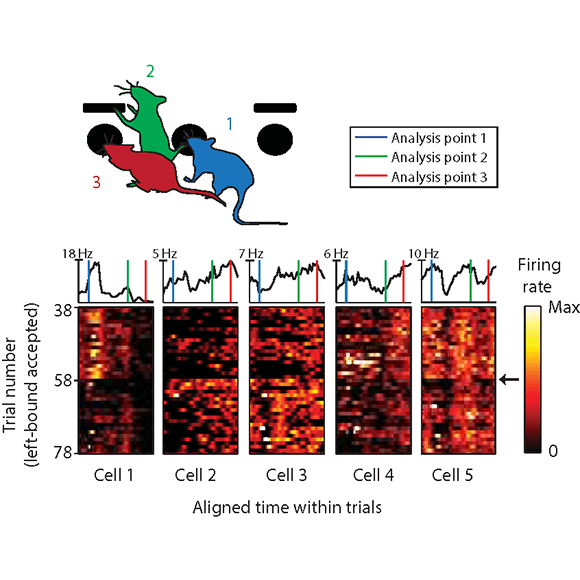
Regions within the prefrontal cortex are thought to process beliefs about the world, but little is known about the circuit dynamics underlying the formation and modification of these beliefs. Using a task that permits dissociation between the activity encoding an animal's internal state and that encoding aspects of behavior, we found that transient increases in the volatility of activity in the rat medial prefrontal cortex accompany periods when an animal's belief is modified after an environmental change. Activity across the majority of sampled neurons underwent marked, abrupt, and coordinated changes when prior belief was abandoned in favor of exploration of alternative strategies. These dynamics reflect network switches to a state of instability, which diminishes over the period of exploration as new stable representations are formed.
Inducible and reversible perturbation of the activity of selected neurons in vivo is critical to understanding the dynamics of brain circuits. Several genetically encoded systems for rapid inducible neuronal silencing have been developed in the past few years offering an arsenal of tools for in vivo experiments. Some systems are based on ion-channels or pumps, others on G protein coupled receptors, and yet others on modified presynaptic proteins. Inducers range from light to small molecules to peptides. This diversity results in differences in the various parameters that may determine the applicability of each tool to a particular biological question. Although further development would be beneficial, the current silencing tool kit already provides the ability to make specific perturbations of circuit function in behaving animals.