Rubin Lab
One of the great successes of biological research over the past three decades has been the use of genetic analysis to discover the pathways that control animal development. The success of this approach was largely dependent on three factors: (1) the genes themselves directly encode proteins, the primary functional units of these pathways; (2) nearly all the genes have been enumerated and described through analysis of genome sequences; and (3) powerful methods had been developed both to screen all the genes for their contribution to a given process and to inactivate, in a controlled way, the function of individual genes.
It is clear that the building blocks of the nervous system and individual neuronal circuits are not genes, but cells. And so the genetic methods that were so powerful in elucidating embryonic development will be of limited use in probing the function of the nervous system. Instead, we will need to be able to assay and manipulate the function of individual cells, if not the individual connections between cells, with the same facility as we can now manipulate genes. The diagram below shows the overall outline of this approach.
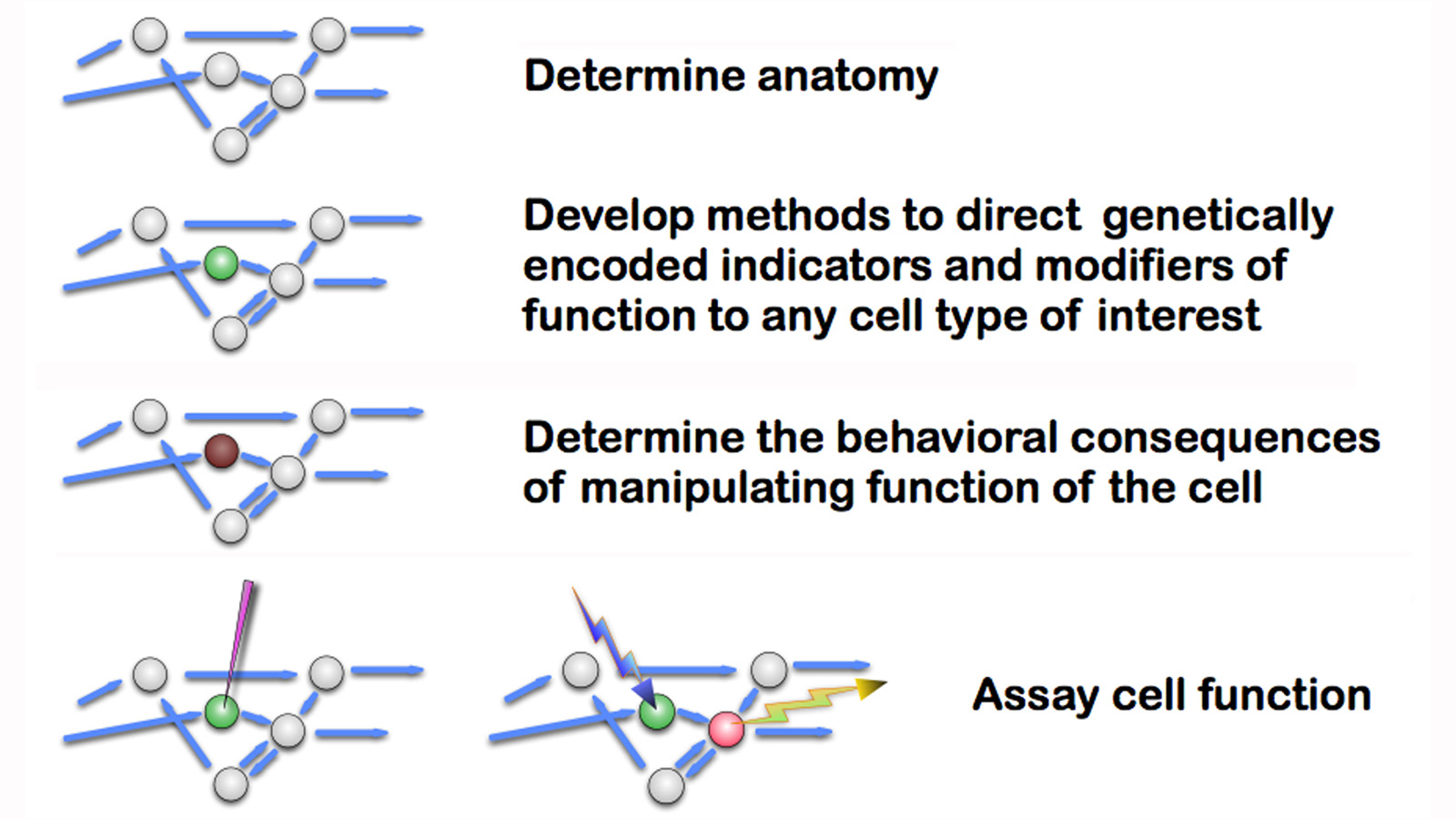
A variety of genetically encoded probes have been developed to allow experimenters to monitor and alter the activity of individual cells, and this remains an active and important area of research in many laboratories. The utility of these probes depends on the precision with which their expression can be directed to small subsets of cells in reproducible, controllable, and convenient ways. Providing the tools required to accomplish this task in the larval and adult nervous system of Drosophila is a primary objective of our current research.
Drosophila researchers have known for more than 20 years how to determine and, to some extent, manipulate the DNA sequences—called promoters and enhancers—that control the temporal and spatial expression of individual genes. We are using our knowledge of high-throughput molecular and genetic methods to define the sequences controlling the neuronal expression patterns of about 1,100 genes. We selected these genes because their predicted function, as well as existing data on their expression, suggests that they are expressed in some, but not all, cells in the nervous system. We have directly analyzed the expression patterns produced by fragments of the control sequences of these genes by generating and analyzing more than 7,000 lines of transgenic animals over the last three years. Prior work has established that separate modules, each of which produces a subset of a gene's total expression repertoire, are used to produce the complex expression patterns of many genes. Consistent with those observations, we have been able to define DNA fragments that generate patterns much more limited than those of the genes from which they were derived, using the assay shown in the diagram below.
We are implementing additional methods to allow us to further refine expression patterns through intersectional strategies. For example, limiting labeling to cells contained in the overlap of the patterns driven by two different fragments. Alternatively we can limit labeling to cells contained in one pattern, but not in the other. We have demonstrated that application of these methods will give us the specificity we require to reproducibly address defined, small cell populations.
We have also developed tools to improve multi-color stochastic labeling of neurons and are using these methods, together with confocal microscopy of dissected adult brains, to produce a detailed atlas of Drosophila neuroanatomy.
Finally, we are applying these tools, usually in collaboration with other laboratories, to study the development and function of selected neuronal circuits. Our current work focuses on three brain areas: the optic lobes, the central complex and the mushroom bodies.
The fruit fly Drosophila melanogaster provides unique experimental advantages for studying complex phenomenon for which there is little preexisting mechanistic information. Our laboratory seeks to develop and apply the genetic and anatomical tools required to realize that potential—previously applied to many other problems in genetics, cell biology and developmental biology—to gain an understanding of the organization and function of a sophisticated nervous system.
Our individual projects are described below.
Projects (8)
The methods and results described in this section are reported in Pfeiffer et al. 2008 and Jenett et al. 2012 where more details can be found. Our approach is based on generating lines in which the expression of GAL4 is driven by a defined DNA fragment that contains one or more enhancers. The pipeline we are using to produce the lines is shown in the first diagram and an example of the analysis as applied to the octopamine receptor 2 gene is shown second.

Pipeline for GAL4 driver production and imaging. (1) We selected approximately 1200 genes for which available expression data or predicted function implies expression in a subset of cells in the adult brain: for example, genes encoding transcription factors, neuropeptides, cell surface proteins, ion channels, transporters, and receptors. We spanned the flanking upstream and downstream intergenic regions of these genes, as well as any of their introns larger than 300 bp, with fragments of DNA that averaged 3 kb in length and overlapped (in regions that could not be covered by a single fragment) by about 1 kb. (2) We generated 7,800 fragments by PCR from genomic DNA which were then cloned, sequence verified and inserted upstream of a core promoter and the GAL4 coding region. In about 200 cases where the upstream intergenic region was small, we generated PCR fragments that also contained the start site of transcription and used them to create transcriptional fusion constructs. (3) Constructs were inserted into the attP2 integration site using the phiC31 site-specific integration system and homozygous stocks generated; Genetic Services, Inc performed the injections and the Janelia Fly Facility generated, and maintains, the homozygous stocks. (4) GAL4 driver lines were crossed to a UAS-GFP reporter, adult brains and ventral nerve cords (VNCs) were imaged by confocal microscopy by the Fly Light project team. (5) See below for a description of the annotation process. (6) Lines with either no expression (about 17%) or too broad expression (about 30%) were not analyzed further, although many of these lines show highly specific patterns in other tissues.
Lines have been deposited in the Bloomington Stock Center. A database showing the expression patterns of the lines and our annotations is available here.

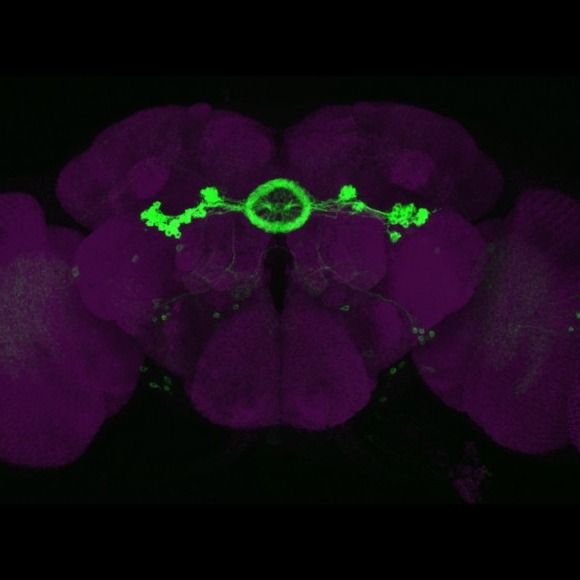
Distinct expression patterns generated by fragments of the octopamine receptor 2 gene. (Top) Diagram of the genomic locus showing the structures of the transcription unit and the position of the fragments that were assayed for enhancer activity. (Bottom) Expression driven by the indicated five fragments in the adult brain and ventral nerve cord is shown in green and the neuropil is counterstained in magenta.
Our analysis of the patterns observed from 6,650 lines (Jenett et al. 2012) indicates that it should be possible to establish a collection of transgenic Drosophila lines, each directing expression to a small subset of cells in the adult brain, and which in sum cover all cells in the brain. We judged that just over half of the lines had a density of labeling—as well as intense, crisp expression patterns—that would make them useful for future anatomical and behavioral experiments. These ranged from expression in ~20 (0.02%) to 5,000 (3%) neurons, excluding Kenyon cells, present in the central brain. We excluded Kenyon cells because the 5,000 Kenyon cells are tightly clustered in the mushroom body (MB) and do not obscure expression patterns elsewhere in the brain. We recognize that the preferred cell number for behavioral studies is not known and will certainly depend on the particular behavior and assay; however, we expect that our lines and the experimental approaches they enable will provide the versatility needed to generate expression patterns of the desired sizes. We believe that many experiments will benefit much sparser expression, perhaps even cell type specific expression. To achieve that goal, we are using intersectional methods as described in the section New Genetic Tools for Manipulating Transgene Expression below.
Barret Pfeiffer, Chris Murphy, Heather Dionne were the lead individuals in constructing the lines, working with Genetic Systems, Inc. and the Fly Facility. Teri Ngo worked closely with the Fly Light histology team to generate the confocal images.
In addition to the adult brain and ventral nerve cord, the lines are being imaged in the third instar larval nervous system by the Fly Light project team and the expression patterns are being analyzed by a team led by Jim Truman.
As part of the Janelia Farm visitor program, the expression patterns generated by the lines are also being imaged in the stage 17 embryonic nervous system (by the laboratory of Chris Doe), in the imaginal discs (by the laboratory of Richard Mann) and in adult ovaries and gut (by the laboratory of Allan Spradling). Images from these efforts are shown:
Our initial intent was to use expert anatomists to describe the expression patterns. While an effective strategy for a small number of lines, or to identify neurons in a particular brain region in all the lines, such an approach did not scale well for a project of this size where our goal was to fully annotate thousands of lines. To overcome this limitation, we developed methods for machine-assisted annotation of the adult central brain (Jenett et al., in press). The patterns of expression of a subset of the lines were registered (Peng et al., 2011) on a standard model of the adult brain using features visible in a reference stain. Using manually constructed 3-D masks, we computationally assigned aspects of the expression pattern in each line to one of the 68 major brain regions and then quantified the intensity and distribution of expression within each region. A human expert then vetted those annotations. The VNCs were annotated by an expert anatomist using a controlled vocabulary. These annotations permit text-based searching of a portion of the GAL4 image collection using the tools provided here. This image database also allows a user to simply browse the data to identify lines that express GAL4 in a particular neuronal cell type, to uncover cell types not previously described, or to examine the patterns generated by all the DNA fragments surrounding a gene of interest.
Following this initial annotation, experts in particular brain regions perform more detailed analyses. This work often involves double labeling to compare the expression patterns in two lines and stochastic labeling to reveal the shapes of individual cells within a line. These efforts are described below for the central complex, the optic lobes, the mushroom bodies and glia.
The adult ventral nerve cord is being annotated in collaboration with visitors David Shepherd (Bangor University, Wales), Darren Williams (King’s College, London) and Janelia group leader Jim Truman.
In Pfeiffer et al. 2010, we described an extensive set of experiments in which we empirically tested a wide range of modifications to the vectors and methods commonly used to direct exogenous gene expression in Drosophila. We were able to modulate the level of transgene expression by varying the strength of the activation domain carried by the transcriptional activator as well as the number of copies of its binding site and other properties of the reporter construct. We have also solved the problem of leakiness of the LexA operator in the absence of LexA protein and made the Split GAL4 and GAL80 intersectional strategies more robust. A diagram of the overall structures of constructs generated in this work is shown in the figure and a complete list of available vectors and transformant fly lines is given in the Tools and Reagents section. Also shown is an example of using the split-GAL4 method to make a cell-type-specific driver line.
We are continuing our efforts to improve the tools available for genetic manipulation. In particular, Barret Pfeiffer and Aljoscha Nern have identified several additional—but not cross-reacting—site-specific recombinases of the Flip/FRT family (see Nern et al. 2011).
In Pfeiffer et al. 2012, we describe a new set of vectors that utilize several well-characterized sequence elements derived from plant and insect viruses to increase the apparent translational efficiency of mRNAs by as much as 20-fold. These increases render expression levels sufficient for genetic constructs previously requiring multiple copies to be effective in single copy, including constructs expressing the temperature-sensitive inactivator of neuronal function Shibire(ts1), and for the use of cytoplasmic GFP to image the fine processes of neurons.

(Top) Diagram of pBP cloning vectors for GAL4, LexA, GAL80 and Split GAL4. (Bottom) Diagram of pJFRC reporter constructs. All constructs contain the pUC19-derived bacterial origin of replication and ampicillin resistance gene, the PhiC31 attB site and the mini-white marker for identification of transformants in Drosophila. The pBP vectors contain the DSCP basal promoter (Pfeiffer et al. 2008) and the hsp70 terminator. The pJFRC constructs utilize an hsp70 basal promoter and an SV40 transcriptional terminator. The vector backbones are modular to allow for many possible combinations: gray shading indicates components that were held constant, while the colored elements were varied between constructs. Examples of some of these alternatives are below colored elements. See Tools and Reagents for more details and a complete list of available plasmids and fly strains. Abbreviations: CRM, conserved regulatory module (generally a 2 - 3 kb enhancer containing fragment of Drosophila DNA); IVS, intervening sequence within the 5’ UTR; WPRE, a Woodchuck Hepatitis Virus Posttranscriptional Regulatory Element; and TERMINATOR, the transcriptional terminator.

Generating a cell-type-specific driver line by intersection of the patterns driven by two enhancer fragments. (Top panels) The expression patterns driven by two different GAL4 lines that only share expression in one cell type—the lamina neuron L3—are shown. The enhancer present in one of these lines was used to drive expression of the activating domain (AD) half of GAL4 and the enhancer from the other was used to drive the DNA binding domain of GAL4. Neither of these constructs alone can drive significant expression (data not shown). (Bottom panels) When both constructs are present, expression is only seen in the lamina L3 neurons of which there are one per lamina cartridge (approximately 800 per lamina). On the left a maximum projection is shown. On the right, a single optical section is shown. Note that the central brain expression seen in each of the parent lines is missing in the intersection.
We are developing strategies for multicolor stochastic labeling that employ several constructs operating independently and in parallel, each with a flp-out-stop cassette upstream of a unique epitope (as shown in diagram below).

A schematic diagram of the strategy used for stochastic multicolor labeling of neurons is shown. The three independent UAS constructs respond to the same GAL4 driver. Each UAS constructs carries a transcriptional stop cassette flanked by FRT sites that blocks expression of the epitope encoded by that construct. Flip recombinase is expressed at low levels, leading to the stochastic removal of the individual stop cassettes and allowing expression of the downstream epitope. Individual cells can express no epitope, a single epitope, combinations of any to epitopes, or all three. This results in neurons being unlabeled or labeled in one of up to seven distinct colors.
The level of flp recombinase expressed determines the density of labeling. Additional colors can be added by adding constructs. We find this method to be more versatile than the “Brainbow” approach for our applications.
The gallery shows some early data from this approach. Aljoscha Nern, Barret Pfeiffer, and members of the Fly Light histology team are now systematically optimizing a number of parameters and reagents including: (1) the transgenic constructs; (2) the source of the recombinases; (3) the structure of the epitopes (in collaboration with Loren Looger); (4) the histological fixation; (5) use of directly labeled primary antibodies; (6) the methods used to optically clear the specimens for imaging; (7) the selection of the fluorescent dyes and imaging conditions to maximize color separation; and (8) the computation methods for color separation (in collaboration with Gene Myers).
Working with the Fly Light project team we plan to employ these methods to determine the structures of 100,000 individual neurons. We will select neurons that are part of the expression patterns of selected sparse GAL4 lines. This will enable addressing the functions of these neurons in subsequent functional imaging and activity modulation experiments. By aligning the images on a single model brain we can make a potential connectivity map in which all the possible synaptic partners of a given neuron can be identified. The accuracy of this map is expected to +/- 2.5 microns, based on the alignment error of the brain aligner software (see the diagram for more details).

Diagram illustrating the resolution with which neurons can be localized in aligned brains. (Left) The reference neuropil of the standard adult female brain is shown (maximum projection). (Right) A portion of an adult brain showing the alignment of three expression patterns. In both panels a 5 micron diameter spot is indicated by the arrows; the radius of this spot represents the alignment error of the current version of the brain aligner.
The central complex (CCX) of, which comprises four structures (protocerebral bridge, fan-shaped body, ellipsoid body and noduli), was initially described by M.E. Power in 1943. However, the fine structure of the CCX was not described until 1989, by U. Hanesch et al. Further anatomy studies describing innervation patterns of single neurons in the central complex followed in 10-year intervals (Renn et al. 1999, Young et al. 2009). Nevertheless, the structure and connectivity of these brain regions remain far from understood.
Three decades of behavioral studies in D. melanogaster, conducted primarily in the laboratories of R. Strauss and M. Heisenberg, reveal a role for the CCX in motor control and planning, and the CCX has also been implicated in learning and memory (Bouhouche et al. 1993, Seiler et al. 2006). In other insects, such as the desert locust Schistocerca gregaria, the CCX has been shown to play a role in processing polarized light (laboratory of U. Homberg).
However, the limited specificity and completeness of tools available for neuroanatomic and behavioral studies has limited our ability to assign observed behavioral phenotypes to specific cell types.
Starting with our collection of GAL4 driver lines Arnim Jenett and Tanya Wolff are aiming to complete the structural analysis of the central complex on a single cell level and to produce, using intersectional strategies, a collection of GAL4 lines with cell-type specific expression. These lines can then be used in behavioral experiments, being carried out in collaboration with the laboratory of Michael Reiser, to significantly increase the precision of structure-function correlations and, consequently, our understanding of the roles of the CCX in learning, memory and behavior.
Application of the stochastic multicolor labeling to a complex expression pattern in the central complex (CCX). The cell bodies, located dorso-posterior of the CCX, project their primary neurits to the protocerebral bridge (PB) where they arborize in a single glomerulus. From there projections reach out to the ventral margin of the fan-shaped body, bifurcate and innervate in the noduli as well as a single column in the third layer of the fan-shaped body. The arborization pattern is very similar to the vertical fiber system (VFS) described by Hanesch et al. 1989, however the projection pattern diverges significantly, which leads us to the assumption that these cells represent a new population of VFS-cells. The MCF facilitates multiple single cell analyses in a single specimen.
(Above) A projection of a small number of confocal sections through an optic lobe labeled with a presynaptic marker (anti-Nc82, magenta). Lamina, medulla, lobula and lobula plate are indicated. A class of optic lobe intrinsic projection neurons (L1 lamina neurons that connect lamina and medulla) and some optic lobe outputs (a subset of lobula plate tangential cells) are labeled using GAL4/UAS (in green). (Left) Visualization of single cell shapes using stochastic labeling (“flip-outs”) . Two examples of a type of transmedullary neuron (single color “flip-outs’” in green; Nc82 marker in grey).
(Above) Multicolor stochastic labeling reveals relative arrangements of neurons. Tiling of processes of a type of local interneuron in the medulla. Individual cells span multiple columns but do not overlap with each other. Potential synaptic contacts. A high-resolution view of visual columns (in the lamina called “cartridges”) in the lamina. Dendritic processes of L2 neurons (red, with a single cell labeled in green using the flip-out method.) are closely associated with presynaptic sites (blue, anti-Nc82 staining).
Using the Split-GAL4 intersectional method Aljoscha Nern has made driver lines specific for each of the 12 cell types present in the lamina. In collaboration with the Reiser Lab, the effects on visual perception of inactivating or activating each of these cell types is being determined.
|
|
|
| Malte Kremer | Ulrike Gaul |
Malte Kremer visiting from Ulrike Gaul's lab in Munich screened the images of the Rubin GAL4 driver lines generated by the FlyLight project team to identify lines that show expression in specific types of glia. They are using these lines to characterize the glial subtypes in the adult Drosophila brain and determine region-restricted specializations. They identified all previously described generic subtypes and found lines that are specific to each of them. For most of these subtypes, they also found lines that label only subsets of one generic class. They are characterizing glia in detail in these driver lines using GAL4/LexA double labeling, stochastic multicolor labeling and genetic intersections.
(Left) Neuropil-associated astrocyte-like glia populate the brains' neuropil regions and can be targeted with specific GAL4 lines.
(Right) Single cell morphology of perineurial glia revealed by stochastic multicolor labeling. The maximum density projection is shown.
|
|
| Yoshi Aso | Hiromu Tanimoto |
This project began with a visitor project with Yoshi Aso from Hiromu Tanimoto's laboratory at the Max Planck Institute in Munich. In October 2011, Yoshi Aso joined the Rubin Lab as a postdoctoral fellow. Our objective has been to develop genetic reagents to facilitate anatomical and functional studies of the mushroom body (MB). The MB has been implicated in a wide range of fly behaviors. These include olfactory leaning, context generalization, habituation, temperature preference and sleep. The MB is constructed from the major class of intrinsic neurons, Kenyon cells, and approximately 50 other intrinsic and extrinsic cell types. The dendrites and axon bundle of Kenyon cells form the calyx and lobes respectively (left). In the calyx, Kenyon cells receive input from the olfactory projection neurons. The lobes of the MB are considered as the main output site of Kenyon cells, but also receive many inputs from extrinsic neurons. Many MB-extrinsic neurons intersect the axon bundles of the Kenyon cells, forming the compartmental subdivisions in the lobes (middle panel). This anatomical complexity presumably reflects the wide array of behaviors that the MB affects. Due to the limited ability to manipulate specific cell types, however, it has been difficult to address how the MB-circuits process information and drive diverse behaviors is largely unknown. Using intersectional strategies, we are generating cell-type specific drivers and characterizing their anatomy (right panel). We are using those drivers, in collaboration with several laboratories, to determine the behavioral consequences of inactivating or activating individual cell types.

(Left)Kenyon cells labeled in 13F02-GAL4. Maximum intensity projection of a confocal stack. (Middle) MB-extrinsic neurons (colors) and Kenyon cells (gray). Maximum intensity projection of 13 confocal stacks registered with the Brain Aligner. For clarity, lines highly specific for the MB-extrinsic neurons were selected, and additional expression in other cell types was masked manually. (Right) Expression pattern of a split GAL4 intersection. This driver labels only a pair of dopaminergic neurons (MB-MP1) in the brain; these cells have been implicated in the induction of aversive odor memory.
![]() |
![]() |
| Divya Sitaraman | Mike Nitabach |
For example, in an ongoing visitor project, Divya Sitaraman from Mike Nitabach’s laboratory at Yale is spending a year in our laboratory assaying the driver lines for their effects on sleep.
-
-
Gerald Rubin Lab Head
-
Yoshi Aso Postdoctoral Associate
-
Heather Dionne Research Staff
-
Arnim Jenett Research Staff
-
Aljoscha Nern Research Staff
-
Teri Ngo Research Staff
-
Barret Pfeiffer Graduate Student
-
Tanya Wolff Senior Scientist
-
Ming Wu Postdoctoral Associate
-
Crystal Sullivan
Lab Alumni Groups
Mark Fortini
Kevin Jones
Mary Mullins
Tom Neufeld
Brian Avery
Cyrus Harmon
George Hartzell
Gregg Helt
Audrey Huang
Richard Carthew
Alan Cowman
Janice Fischer
Matthew Freeman
Ulrike Gaul
Ernst Hafen
Iswar Hariharan
Roger Karess
Frank Laski
Michael Levine
Marek Mlodzik
Craig Montell
Steven Mount
Donald Rio
Hermann Steller
Tian Xu
Michael Brodsky
Erwin Frise
Eric Lai
Andrea Page-McCaw
Duojia Pan
Ilaria Rebay
Amy Tang
Marc Therrien
David Wassarman
Fly stocks generated in the Rubin lab are generally deposited in the Bloomington Drosophila Stock Center. For more specialized stocks please contact us directly.
| Line name | Insertion Site | Bloomington Stock Number | Reference | Chr |
|---|---|---|---|---|
| pJFRC1-10XUAS-mCD8::GFP | attP2 | 32184 | Pfeiffer et al. 2010 | 3 |
| pJFRC2-10XUAS-IVS-mCD8::GFP | attP2 | 32185 | Pfeiffer et al. 2010 | 3 |
| " | attP40 | 32186 | " | 2 |
| " | su(Hw)attP1 | 32187 | " | 3 |
| " | su(Hw)attP5 | 32188 | " | 2 |
| " | su(Hw)attP8 | 32189 | " | 1 |
| pJFRC3-1XUAS-IVS-mCD8::GFP | attP2 | 32190 | " | 3 |
| pJFRC4-3XUAS-IVS-mCD8::GFP | attP2 | 32191 | " | 3 |
| pJFRC5-5XUAS-IVS-mCD8::GFP | attP2 | 32192 | " | 3 |
| pJFRC6-15XUAS-IVS-mCD8::GFP | attP2 | 32193 | " | 3 |
| pJFRC7-20XUAS-IVS-mCD8::GFP | attP2 | 32194 | " | 3 |
| pJFRC8-40XUAS-IVS-mCD8::GFP | attP2 | 32195 | " | 3 |
| pJFRC12-10XUAS-IVS-myr::GFP | attP2 | 32197 | Pfeiffer et al. 2010 | 3 |
| " | attP40 | 32198 | " | 2 |
| " | su(Hw)attP5 | 32199 | " | 2 |
| " | su(Hw)attP1 | 32200 | " | 3 |
| " | su(Hw)attP8 | 32196 | " | 1 |
| pJFRC13-10XUAS-IVS-GFP | attP2 | 32201 | Pfeiffer et al. 2010 | 3 |
| pJFRC14-10XUAS-IVS-GFP-WPRE | attP2 | 32202 | Pfeiffer et al.2010 | 3 |
| pJFRC15-13XLexAop2-mCD8::GFP | attP2 | 32203 | " | 3 |
| " | attP40 | 32205 | " | 2 |
| " | su(Hw)attP8 | 32204 | " | 1 |
| pJFRC16-16XLexAop2-mCD8::GFP | attP2 | 32206 | " | 3 |
| pJFRC17-26XLexAop2-mCD8::GFP | attP2 | 32207 | " | 3 |
| pJFRC18-8XLexAop2-mCD8::GFP | attP2 | 32208 | Pfeiffer et al. 2010 | 3 |
| pJFRC19-13XLexAop2-IVS-myr::GFP | attP2 | 32209 | " | 3 |
| " | attP40 | 32210 | " | 2 |
| " | su(Hw)attP1 | 32212 | " | 3 |
| " | su(Hw)attP8 | 32211 | " | 1 |
| pJFRC20-8XLexAop2-IVS-GAL80-WPRE | attP2 | 32213 | Pfeiffer et al. 2010 and unpublished | 3 |
| " | attP40 | 32214 | " | 2 |
| " | su(Hw)attP1 | 32215 | " | 3 |
| " | su(Hw)attP5 | 32216 | " | 2 |
| " | su(Hw)attP8 | 32217 | " | 1 |
| pJFRC21-10XUAS-IVS-mCD8::RFP | attP2 | 32218 | " | 3 |
| " | attP40 | 32219 | " | 2 |
| " | su(Hw)attP8 | 32220 | " | 1 |
| pJFRC22-10XUAS-IVS-myr::tdTomato | attP2 | 32221 | " | 3 |
| " | attP40 | 32222 | " | 2 |
| " | su(Hw)attP8 | 32223 | " | 1 |
| pJFRC23-10XUAS-IVS-myr::Dronpa | attP2 | 32224 | Vaziri et al 2008; Pfeiffer et al. 2010 | 3 |
| " | attP40 | 32225 | " | 2 |
| pJFRC24-10XUAS-IVS-myr::tdEos | attP2 | 32226 | Pfeiffer et al. 2010 and unpublished | 3 |
| " | attP40 | 32227 | " | 2 |
| P{20XUAS-GCaMP3} | attP2 | 32236 | Tian et al. 2009; Pfeiffer et al. 2010 | 3 |
| PBac{20XUAS-GCaMP3} | VK00005 | 32237 | " | 3 |
| P{20XUAS-GCaMP3}su(Hw) | su(Hw)attP8 | 32234 | " | 1 |
| P{20XUAS-GCaMP3} | attP18 | 32235 | " | 1 |
| pJFRC24-10XUAS-IVS-myr::tdEos; pJFRC24-10XUAS-IVS-myr::tdEos | attP40;attP2 | 32228 | Pfeiffer et al. 2010 and unpublished | 2;3 |
| pJFRC15-13XLexAop2-mCD8::GFP, pJFRC21-10XUAS-IVS-mCD8::RFP | su(Hw)attP8, attP18 | 32229 | " | 1,1 |
| pJFRC34-5XUAS-DSCP-E86tetLC | attP2 | " | 3 | |
| pJFRC39-10XUAS-FRT>STOP>FRT-E86tetLC | attP2 | " | 3 | |
| pJFRC26-13XLexAop2-IVS-dTrpA1-WPRE | VK00005 | " | 3 | |
| pJFRC31-13XLexAop2-GCamp3-WPRE, pJFRC31-13XLexAop2-GCamp3-WPRE | attP2; VK00005 | " | 3,3 | |
| pJFRC40-13XLexAop2-FRT>STOP>FRT-myrGFP | attP2 | " | 3 | |
| pJFRC153-20XUAS-IVS-B2::PEST | attP2 | Nern et al. 2011 | 3 | |
| pJFRC154-3XUAS-IVS-B2::PEST | attP40 | Nern et al. 2011 | 2 | |
| pJFRC155-1XUAS-DSCP-B2::PEST/TM3 | attP2 | Nern et al. 2011 | 3 | |
| pJFRC156-21XUAS-B2RT>-dSTOP-B2RT>-myr::RFP | attP2 | Nern et al. 2011 | 3 | |
| pJFRC156-21XUAS-B2RT>-dSTOP-B2RT>-myr::RFP | attP40 | Nern et al. 2011 | 2 | |
| pJFRC156-21XUAS-B2RT>-dSTOP-B2RT>-myr::RFP | VK00005 | Nern et al. 2011 | 3 | |
| pJFRC157-20XUAS-IVS-B3::PEST | attP2 | Nern et al. 2011 | 3 | |
| pJFRC158-3XUAS-IVS-B3::PEST/CyO | attP40 | Nern et al. 2011 | 2 | |
| pJFRC159-1XUAS-DSCP-B3::PEST | attP2 | Nern et al. 2011 | 3 | |
| pJFRC160-21XUAS-B3RT>-dSTOP-B3RT>-myr::RFP | attP2 | Nern et al. 2011 | 3 | |
| pJFRC160-21XUAS-B3RT>-dSTOP-B3RT>-myr::RFP | attP40 | Nern et al. 2011 | 2 | |
| pJFRC160-21XUAS-B3RT>-dSTOP-B3RT>-myr::RFP | VK00005 | Nern et al. 2011 | 3 | |
| pJFRC161-20XUAS-IVS-KD::PEST | attP2 | Nern et al. 2011 | 3 | |
| pJFRC162-3XUAS-IVS-KD::PEST | attP40 | Nern et al. 2011 | 2 | |
| pJFRC163-1XUAS-DSCP-KD::PEST | attP2 | Nern et al. 2011 | 3 | |
| pJFRC164-21XUAS-KDRT>-dSTOP-KDRT>-myr::RFP | attP2 | Nern et al. 2011 | 3 | |
| pJFRC164-21XUAS-KDRT>-dSTOP-KDRT>-myr::RFP | attP40 | Nern et al. 2011 | 2 | |
| pJFRC164-21XUAS-KDRT>-dSTOP-KDRT>-myr::RFP | VK00005 | Nern et al. 2011 | 3 | |
| pJFRC165-20XUAS-IVS-R::PEST | attP2 | Nern et al. 2011 | 3 | |
| pJFRC166-3XUAS-IVS-R::PEST | attP40 | Nern et al. 2011 | 2 | |
| pJFRC167-1XUAS-DSCP-R::PEST | attP2 | Nern et al. 2011 | 3 | |
| pJFRC168-21XUAS-RSRT>-dSTOP-RSRT>-myr::RFP | attP2 | Nern et al. 2011 | 3 | |
| pJFRC168-21XUAS-RSRT>-dSTOP-RSRT>-myr::RFP/CyO | attP40 | Nern et al. 2011 | 2 | |
| pJFRC168-21XUAS-RSRT>-dSTOP-RSRT>-myr::RFP | VK00005 | Nern et al. 2011 | 3 | |
| pJFRC170-3XUAS-IVS-Cre::PEST | attP40 | Nern et al. 2011 | 2 | |
| pJFRC171-1XUAS-DSCP-Cre::PEST/TM3 | attP2 | Nern et al. 2011 | 3 | |
| pJFRC172-10XUAS-loxP>-dSTOP-loxP>-myr::GFP | attP2 | Nern et al. 2011 | 3 | |
| pJFRC172-10XUAS-loxP>-dSTOP-loxP>-myr::GFP | attP40 | Nern et al. 2011 | 2 | |
| pJFRC173-20XUAS-IVS-Dre::PEST | attP2 | Nern et al. 2011 | 3 | |
| pJFRC176-10XUAS-rox>-dSTOP-rox>-myr::GFP | attP2 | Nern et al. 2011 | 3 | |
| pJFRC176-10XUAS-rox>-dSTOP-rox>-myr::GFP | attP40 | Nern et al. 2011 | 2 | |
| pJFRC150-20XUAS-IVS-Flp1::PEST | attP2 | Nern et al. 2011 | 3 | |
| pJFRC151-3XUAS-IVS-Flp2::PEST | attP40 | Nern et al. 2011 | 2 | |
| pJFRC152-20XUAS-IVS-Flp1 | attP2 | Nern et al. 2011 | 3 | |
| pJFRC177-10XUAS-FRT>-dSTOP-FRT>-myr::GFP | attP2 | Nern et al. 2011 | 3 | |
| pJFRC177-10XUAS-FRT>-dSTOP-FRT>-myr::GFP | attP40 | Nern et al. 2011 | 2 | |
| pJFRC27-13XLexAop2-IVS-GCamp3-p10 | attP2 | Pfeiffer et al. 2012 | 3 | |
| pJFRC27-13XLexAop2-IVS-GCamp3-p10 | VK00005 | Pfeiffer et al. 2012 | 3 | |
| pJFRC27-13XLexAop2-IVS-GCamp3-p10 | su(Hw)attP5 | Pfeiffer et al. 2012 | 2 | |
| pJFRC27-13XLexAop2-IVS-GCamp3-p10 | attP40 | Pfeiffer et al. 2012 | 2 | |
| pJFRC28-10XUAS-IVS-GFP-p10 | attP2 | Pfeiffer et al. 2012 | 3 | |
| pJFRC29-10XUAS-IVS-myr::GFP-p10 | attP2 | Pfeiffer et al. 2012 | 3 | |
| pJFRC57-13XLexAop2-IVS-GFP-p10 | attP2 | Pfeiffer et al. 2012 | 3 | |
| pJFRC57-13XLexAop2-IVS-GFP-p10 | VK00005 | Pfeiffer et al. 2012 | 3 | |
| pJFRC57-13XLexAop2-IVS-GFP-p10 | su(Hw)attP5 | Pfeiffer et al. 2012 | 2 | |
| pJFRC59-13XLexAop2-IVS-myr::GFP-p10 | attP2 | Pfeiffer et al. 2012 | 3 | |
| pJFRC59-13XLexAop2-IVS-myr::GFP-p10 | VK00005 | Pfeiffer et al. 2012 | 3 | |
| pJFRC59-13XLexAop2-IVS-myr::GFP-p10 | su(Hw)attP5 | Pfeiffer et al. 2012 | 2 | |
| pJFRC65-13XLexAop2-IVS-GFP-aequorin-p10 | attP2 | Pfeiffer et al. 2012 | 3 | |
| pJFRC65-13XLexAop2-IVS-GFP-aequorin-p10 |
VK00005 | Pfeiffer et al. 2012 | 3 | |
| pJFRC65-13XLexAop2-IVS-GFP-aequorin-p10 | su(Hw)attP5 | Pfeiffer et al. 2012 | 2 | |
| pJFRC80-10XUAS-IVS-Syn21-GFP | attP2 | Pfeiffer et al. 2012 | 3 | |
| pJFRC81-10XUAS-IVS-Syn21-GFP-p10 | attP2 | Pfeiffer et al. 2012 | 3 | |
| pJFRC82-20XUAS-IVS-Syn21-GFP-p10 | attP2 | Pfeiffer et al. 2012 | 3 | |
| pJFRC83-10XUAS-IVS-L21-GFP | attP2 | Pfeiffer et al. 2012 | 3 | |
| pJFRC84-10XUAS-IVS-AcNPV-GFP | attP2 | Pfeiffer et al. 2012 | 3 | |
| pJFRC85-10XUAS-IVS-EoNPV-GFP | attP2 | Pfeiffer et al. 2012 | 3 | |
| pJFRC86-10XUAS-IVS-TMV-GFP | attP2 | Pfeiffer et al. 2012 | 3 | |
| pJFRC90-20XUAS-IVS-Syn21-mPA-p10 | attP2 | Pfeiffer et al. 2012 | 3 | |
| pJFRC90-20XUAS-IVS-Syn21-mPA-p10 | VK00005 | Pfeiffer et al. 2012 | 3 | |
| pJFRC90-20XUAS-IVS-Syn21-mPA-p10 | su(Hw)attP5 | Pfeiffer et al. 2012 | 2 | |
| pJFRC91-20XUAS-IVS-Syn21-mSPA-GFP-p10 | attP2 | Pfeiffer et al. 2012 | 3 | |
| pJFRC91-20XUAS-IVS-Syn21-mSPA-GFP-p10 | VK00005 | Pfeiffer et al. 2012 | 3 | |
| pJFRC91-20XUAS-IVS-Syn21-mSPA-GFP-p10 | su(Hw)attP5 | Pfeiffer et al. 2012 | 2 | |
| pJFRC92-20XUAS-IVS-Syn21-mC3PA-GFP-p10 | attP2 | Pfeiffer et al. 2012 | 3 | |
| pJFRC92-20XUAS-IVS-Syn21-mC3PA-GFP-p10 | VK00005 | Pfeiffer et al. 2012 | 3 | |
| pJFRC93-13XLexAop2-IVS-Syn21-mPA-p10 | VK00005 | Pfeiffer et al. 2012 | 3 | |
| pJFRC93-13XLexAop2-IVS-Syn21-mPA-p10 | su(Hw)attP1 | Pfeiffer et al. 2012 | 3 | |
| pJFRC93-13XLexAop2-IVS-Syn21-mPA-p10 | su(Hw)attP8 | Pfeiffer et al. 2012 | X | |
| pJFRC94-13XLexAop2-IVS-Syn21-mSPA-GFP-p10 | VK00005 | Pfeiffer et al. 2012 | 3 | |
| pJFRC94-13XLexAop2-IVS-Syn21-mSPA-GFP-p10 | su(Hw)attP1 | Pfeiffer et al. 2012 | 3 | |
| pJFRC94-13XLexAop2-IVS-Syn21-mSPA-GFP-p10 | su(Hw)attP8 | Pfeiffer et al. 2012 | X | |
| pJFRC95-13XLexAop2-IVS-Syn21-mC3PA-GFP-p10 | VK00005 | Pfeiffer et al. 2012 | 3 | |
| pJFRC95-13XLexAop2-IVS-Syn21-mC3PA-GFP-p10 | su(Hw)attP1 | Pfeiffer et al. 2012 | 3 | |
| pJFRC96-20XUAS-IVS-GFP-aequorin-p10 | attP2 | Pfeiffer et al. 2012 | 3 | |
| pJFRC96-20XUAS-IVS-GFP-aequorin-p10 |
VK00005 | Pfeiffer et al. 2012 | 3 | |
| pJFRC96-20XUAS-IVS-GFP-aequorin-p10 | attP40 | Pfeiffer et al. 2012 | 2 | |
| pJFRC97-20XUAS-IVS-GCamp3-p10 | attP2 | Pfeiffer et al. 2012 | 3 | |
| pJFRC97-20XUAS-IVS-GCamp3-p10 | VK00005 | Pfeiffer et al. 2012 | 3 | |
| pJFRC97-20XUAS-IVS-GCamp3-p10 | su(Hw)attP1 | Pfeiffer et al. 2012 | 3 | |
| pJFRC98-20XUAS-IVS-Shibire-ts1-p10 | attP2 | Pfeiffer et al. 2012 | 3 | |
| pJFRC98-20XUAS-IVS-Shibire-ts1-p10 | VK00005 | Pfeiffer et al. 2012 | 3 | |
| pJFRC99-20XUAS-IVS-Syn21-Shibire-ts1-p10 | attP2 | Pfeiffer et al. 2012 | 3 | |
| pJFRC99-20XUAS-IVS-Syn21-Shibire-ts1-p10 | VK00005 | Pfeiffer et al. 2012 | 3 | |
| pJFRC99-20XUAS-IVS-Syn21-Shibire-ts1-p10 | su(Hw)attP1 | Pfeiffer et al. 2012 | 3 | |
| pJFRC100-20XUAS-TTS-Shibire-ts1-p10 | attP2 | Pfeiffer et al. 2012 | 3 | |
| pJFRC100-20XUAS-TTS-Shibire-ts1-p10 | VK00005 | Pfeiffer et al. 2012 | 3 | |
| pJFRC100-20XUAS-TTS-Shibire-ts1-p10 | su(Hw)attP1 | Pfeiffer et al. 2012 | 3 | |
| pJFRC100-20XUAS-TTS-Shibire-ts1-p10 | su(Hw)attP5 | Pfeiffer et al. 2012 | 2 | |
| pJFRC101-20XUAS-IVS-Syn21-Shibire-ts1-GFP-p10 | attP2 | Pfeiffer et al. 2012 | 3 | |
| pJFRC101-20XUAS-IVS-Syn21-Shibire-ts1-GFP-p10 | VK00005 | Pfeiffer et al. 2012 | 3 | |
| pJFRC104-13XLexAop2-IVS-Syn21-Shibire-ts1-p10 | attP2 | Pfeiffer et al. 2012 | 3 | |
| pJFRC104-13XLexAop2-IVS-Syn21-Shibire-ts1-p10 | VK00005 | Pfeiffer et al. 2012 | 3 | |
| pJFRC104-13XLexAop2-IVS-Syn21-Shibire-ts1-p10 | su(Hw)attP1 | Pfeiffer et al. 2012 | 3 |
Rubin lab Plasmid Constructs are available from Addgene, which has distributed over 430 of the plasmids listed below.
Plasmids from Pfeiffer et al. 2008 and Pfeiffer et al. 2010
| Name | Addgene Plasmid ID |
5' UTR IVS | Transgene | 3' UTR WPRE | 3' UTR Term. | Ref |
|---|---|---|---|---|---|---|
|
pBDP |
|
none |
|
|
Pfeiffer et al. 2008 |
|
|
pBPGUw |
|
GAL4a |
|
hsp70 |
Pfeiffer et al. 2008 |
|
|
pBPGw |
|
GAL4a |
|
hsp70 |
Pfeiffer et al. 2008 |
|
|
pBPGAL4.1Uw |
|
GAL4a |
|
hsp70 |
Pfeiffer et al. 2010 |
|
|
pBPGAL4.2Uw-2 |
|
GAL4a |
|
SV40 |
Pfeiffer et al. 2010 |
|
|
pBPGAL4.2::VP16Uw |
|
GAL4::VP16a |
|
hsp70 |
Pfeiffer et al. 2010 |
|
|
pBPGAL4.2::p65Uw |
|
GAL4::p65a |
|
hsp70 |
Pfeiffer et al. 2010 |
|
|
pBPnlsLexA::GADflUw |
|
nlsLexA::GADfla |
|
hsp70 |
Pfeiffer et al. 2010 |
|
|
pBPLexA::p65Uw |
|
LexA::p65a |
|
hsp70 |
Pfeiffer et al. 2010 |
|
|
pBPnlsLexA::p65Uw |
|
nlsLexA::p65a |
|
hsp70 |
Pfeiffer et al. 2010 |
|
|
pBPZpGAL4DBDUw |
|
Zip-GAL4DBDa |
|
hsp70 |
Pfeiffer et al. 2010 |
|
|
pBPp65ADZpUw |
|
p65AD-Zipa |
|
hsp70 |
Pfeiffer et al. 2010 |
|
|
pBPGAL80Uw-4 |
+ |
GAL80a |
+ |
hsp70 |
Pfeiffer et al. 2010 |
|
|
pBPGAL80Uw-6 |
+ |
GAL80a |
+ |
SV40 |
Pfeiffer et al. 2010 |
|
|
pJFRC-MUH |
|
|
|
|
Pfeiffer et al. 2010 |
|
|
pJFRC12-10XUAS-IVS-myr::GFP |
+ |
myr::GFP |
|
SV40 |
Pfeiffer et al. 2010 |
|
|
pJFRC14-10XUAS-IVS-GFP-WPRE |
+ |
GFP |
+ |
SV40 |
Pfeiffer et al. 2010 |
|
|
pJFRC18-8XLexAop2-mCD8::GFP |
|
mCD8::GFP |
|
SV40 |
Pfeiffer et al. 2010 |
|
|
pJFRC19-13XLexAop2-IVS-myr::GFP |
+ |
myr::GFP |
|
SV40 |
Pfeiffer et al. 2010 |
|
|
pJFRC2-10XUAS-IVS-mCD8::GFP |
+ |
mCD8::GFP |
|
SV40 |
Pfeiffer et al. 2010 |
|
|
pJFRC2-INS |
|
mCD8::GFP |
|
SV40 |
Pfeiffer et al. 2010 |
|
|
pJFRC3-1XUAS-IVS-mCD8::GFP |
|
mCD8::GFP |
|
SV40 |
Pfeiffer et al. 2010 |
|
|
pJFRC4-3XUAS-IVS-mCD8::GFP |
|
mCD8::GFP |
|
SV40 |
Pfeiffer et al. 2010 |
|
|
pJFRC5-5XUAS-IVS-mCD8::GFP |
|
mCD8::GFP |
|
SV40 |
Pfeiffer et al. 2010 |
|
|
pJFRC6-15XUAS-IVS-mCD8::GFP |
|
mCD8::GFP |
|
SV40 |
Pfeiffer et al. 2010 |
|
|
pJFRC7-20XUAS-IVS-mCD8::GFP |
|
mCD8::GFP |
|
SV40 |
Pfeiffer et al. 2010 |
|
|
pJFRC8-40XUAS-IVS-mCD8::GFP |
|
mCD8::GFP |
|
SV40 |
Pfeiffer et al. 2010 |
BP plasmid vector backbones are derived from pBPGUw and contain the pUC19-derived bacterial origin of replication and ampicillin resistance gene, the PhiC31 attB site, the mini-white marker for identification of transformants in Drosophila, and the DSCP basal promoter. Abbreviations: U, DSCP basal promoter; w, mini-white marker; nls, nuclear localization signal; IVS, intervening sequence within the 5’ UTR; WPRE, a Woodchuck Hepatitis Virus Posttranscriptional Regulatory Element within the 3’ UTR; 3’ UTR Term., the transcriptional terminator; and pBP, plasmid BP backbone.
Janelia Farm Reporter Construct (JFRC) backbones are derived from pBDP. In addition, all vectors also contain a basal promoter derived from hsp70 and an SV40 transcriptional terminator.
a = Drosophila codon-optimized transgene
Plasmids from Nern et al PNAS 2011: Multiple new site-specific recombinases for use in manipulating animal genomes
| Name | Addgene Plasmid ID |
|---|---|
|
pJFRC150-20XUAS-IVS-Flp1::PEST |
|
| pJFRC151-3XUAS-IVS-Flp2::PEST | |
|
pJFRC153-20XUAS-IVS-B2::PEST |
|
|
pJFRC156-21XUAS-B2RT>-dSTOP-B2RT>-myr::RFP |
|
|
pJFRC157-20XUAS-IVS-B3::PEST |
|
|
pJFRC159-1XUAS-DSCP-B3::PEST |
|
|
pJFRC158-3XUAS-IVS-B3::PEST |
|
|
pJFRC160-21XUAS-B3RT>-dSTOP-B3RT>-myr::RFP |
|
|
pJFRC161-20XUAS-IVS-KD::PEST |
|
|
pJFRC164-21XUAS-KDRT>-dSTOP-KDRT>-myr::RFP |
|
|
pJFRC165-20XUAS-IVS-R::PEST |
|
|
pJFRC168-21XUAS-RSRT>-dSTOP-RSRT>-myr::RFP |
|
|
pJFRC170-3XUAS-IVS-Cre::PEST |
|
|
pJFRC172-10XUAS-loxP>-dSTOP-loxP>-myr::GFP |
|
|
pJFRC173-20XUAS-IVS-Dre::PEST |
|
|
pJFRC176-10XUAS-rox>-dSTOP-rox>-myr::GFP |
|
|
pBPhsFlp1 |
|
|
pJFRC177-10XUAS-FRT>-dSTOP-FRT>-myr::GFP |
Plasmids from Pfeiffer et al PNAS 2012: Using translational enhancers to increase transgene expression in Drosophila
| Name | Addgene Plasmid ID |
|---|---|
|
pJFRC28-10XUAS-IVS-GFP-p10 |
|
|
pJFRC81-10XUAS-IVS-Syn21-GFP-p10 |
Related Links
Lines have been deposited in the Bloomington Stock Center. A database showing the expression patterns of the lines and our annotation is available here.
Janelia Publications
We established a collection of 7,000 transgenic lines of Drosophila melanogaster. Expression of GAL4 in each line is controlled by a different, defined fragment of genomic DNA that serves as a transcriptional enhancer. We used confocal microscopy of dissected nervous systems to determine the expression patterns driven by each fragment in the adult brain and ventral nerve cord. We present image data on 6,650 lines. Using both manual and machine-assisted annotation, we describe the expression patterns in the most useful lines. We illustrate the utility of these data for identifying novel neuronal cell types, revealing brain asymmetry, and describing the nature and extent of neuronal shape stereotypy. The GAL4 lines allow expression of exogenous genes in distinct, small subsets of the adult nervous system. The set of DNA fragments, each driving a documented expression pattern, will facilitate the generation of additional constructs for manipulating neuronal function.
The ability to specify the expression levels of exogenous genes inserted in the genomes of transgenic animals is critical for the success of a wide variety of experimental manipulations. Protein production can be regulated at the level of transcription, mRNA transport, mRNA half-life, or translation efficiency. In this report, we show that several well-characterized sequence elements derived from plant and insect viruses are able to function in Drosophila to increase the apparent translational efficiency of mRNAs by as much as 20-fold. These increases render expression levels sufficient for genetic constructs previously requiring multiple copies to be effective in single copy, including constructs expressing the temperature-sensitive inactivator of neuronal function Shibire(ts1), and for the use of cytoplasmic GFP to image the fine processes of neurons.
Site-specific recombinases have been used for two decades to manipulate the structure of animal genomes in highly predictable ways and have become major research tools. However, the small number of recombinases demonstrated to have distinct specificities, low toxicity, and sufficient activity to drive reactions to completion in animals has been a limitation. In this report we show that four recombinases derived from yeast-KD, B2, B3, and R-are highly active and nontoxic in Drosophila and that KD, B2, B3, and the widely used FLP recombinase have distinct target specificities. We also show that the KD and B3 recombinases are active in mice.
A wide variety of biological experiments rely on the ability to express an exogenous gene in a transgenic animal at a defined level and in a spatially and temporally controlled pattern. We describe major improvements of the methods available for achieving this objective in Drosophila melanogaster. We have systematically varied core promoters, UTRs, operator sequences, and transcriptional activating domains used to direct gene expression with the GAL4, LexA, and Split GAL4 transcription factors and the GAL80 transcriptional repressor. The use of site-specific integration allowed us to make quantitative comparisons between different constructs inserted at the same genomic location. We also characterized a set of PhiC31 integration sites for their ability to support transgene expression of both drivers and responders in the nervous system. The increased strength and reliability of these optimized reagents overcome many of the previous limitations of these methods and will facilitate genetic manipulations of greater complexity and sophistication.
We demonstrate the feasibility of generating thousands of transgenic Drosophila melanogaster lines in which the expression of an exogenous gene is reproducibly directed to distinct small subsets of cells in the adult brain. We expect the expression patterns produced by the collection of 5,000 lines that we are currently generating to encompass all neurons in the brain in a variety of intersecting patterns. Overlapping 3-kb DNA fragments from the flanking noncoding and intronic regions of genes thought to have patterned expression in the adult brain were inserted into a defined genomic location by site-specific recombination. These fragments were then assayed for their ability to function as transcriptional enhancers in conjunction with a synthetic core promoter designed to work with a wide variety of enhancer types. An analysis of 44 fragments from four genes found that >80% drive expression patterns in the brain; the observed patterns were, on average, comprised of <100 cells. Our results suggest that the D. melanogaster genome contains >50,000 enhancers and that multiple enhancers drive distinct subsets of expression of a gene in each tissue and developmental stage. We expect that these lines will be valuable tools for neuroanatomy as well as for the elucidation of neuronal circuits and information flow in the fly brain.
Prior Publications (30 of 260)
Cell and tissue specific gene expression is a defining feature of embryonic development in multi-cellular organisms. However, the range of gene expression patterns, the extent of the correlation of expression with function, and the classes of genes whose spatial expression are tightly regulated have been unclear due to the lack of an unbiased, genome-wide survey of gene expression patterns.
Transcriptional regulation in eukaryotes generally operates at the level of individual genes. Regulation of sets of adjacent genes by mechanisms operating at the level of chromosomal domains has been demonstrated in a number of cases, but the fraction of genes in the genome subject to regulation at this level is unknown.
The fly Drosophila melanogaster is one of the most intensively studied organisms in biology and serves as a model system for the investigation of many developmental and cellular processes common to higher eukaryotes, including humans. We have determined the nucleotide sequence of nearly all of the approximately 120-megabase euchromatic portion of the Drosophila genome using a whole-genome shotgun sequencing strategy supported by extensive clone-based sequence and a high-quality bacterial artificial chromosome physical map. Efforts are under way to close the remaining gaps; however, the sequence is of sufficient accuracy and contiguity to be declared substantially complete and to support an initial analysis of genome structure and preliminary gene annotation and interpretation. The genome encodes approximately 13,600 genes, somewhat fewer than the smaller Caenorhabditis elegans genome, but with comparable functional diversity.
A comparative analysis of the genomes of Drosophila melanogaster, Caenorhabditis elegans, and Saccharomyces cerevisiae-and the proteins they are predicted to encode-was undertaken in the context of cellular, developmental, and evolutionary processes. The nonredundant protein sets of flies and worms are similar in size and are only twice that of yeast, but different gene families are expanded in each genome, and the multidomain proteins and signaling pathways of the fly and worm are far more complex than those of yeast. The fly has orthologs to 177 of the 289 human disease genes examined and provides the foundation for rapid analysis of some of the basic processes involved in human disease.
A fundamental goal of genetics and functional genomics is to identify and mutate every gene in model organisms such as Drosophila melanogaster. The Berkeley Drosophila Genome Project (BDGP) gene disruption project generates single P-element insertion strains that each mutate unique genomic open reading frames. Such strains strongly facilitate further genetic and molecular studies of the disrupted loci, but it has remained unclear if P elements can be used to mutate all Drosophila genes. We now report that the primary collection has grown to contain 1045 strains that disrupt more than 25% of the estimated 3600 Drosophila genes that are essential for adult viability. Of these P insertions, 67% have been verified by genetic tests to cause the associated recessive mutant phenotypes, and the validity of most of the remaining lines is predicted on statistical grounds. Sequences flanking >920 insertions have been determined to exactly position them in the genome and to identify 376 potentially affected transcripts from collections of EST sequences. Strains in the BDGP collection are available from the Bloomington Stock Center and have already assisted the research community in characterizing >250 Drosophila genes. The likely identity of 131 additional genes in the collection is reported here. Our results show that Drosophila genes have a wide range of sensitivity to inactivation by P elements, and provide a rationale for greatly expanding the BDGP primary collection based entirely on insertion site sequencing. We predict that this approach can bring >85% of all Drosophila open reading frames under experimental control.
Drosophila yan has been postulated to act as an antagonist of the proneural signal mediated by the sevenless/Ras1/MAPK pathway. We have mutagenized the eight MAPK phosphorylation consensus sites of yan and examined the effects of overexpressing the mutant protein in transgenic flies and transfected S2 cultured cells. Our results suggest that phosphorylation by MAPK affects the stability and subcellular localization of yan, resulting in rapid down-regulation of yan activity. Furthermore, MAPK-mediated down-regulation of yan function appears to be critical for the proper differentiation of both neuronal and nonneuronal tissues throughout development, suggesting that yan is an essential component of a general timing mechanism controlling the competence of a cell to respond to inductive signals.
Apoptotic cell death is a mechanism by which organisms eliminate superfluous or harmful cells. Expression of the cell death regulatory protein REAPER (RPR) in the developing Drosophila eye results in a small eye owing to excess cell death. We show that mutations in thread (th) are dominant enhancers of RPR-induced cell death and that th encodes a protein homologous to baculovirus inhibitors of apoptosis (IAPs), which we call Drosophila IAP1 (DIAP1). Overexpression of DIAP1 or a related protein, DIAP2, in the eye suppresses normally occurring cell death as well as death due to overexpression of rpr or head involution defective. IAP death-preventing activity localizes to the N-terminal baculovirus IAP repeats, a motif found in both viral and cellular proteins associated with death prevention.
We have identified a Drosophila gene, peanut (pnut), that is related in sequence to the CDC3, CDC10, CDC11, and CDC12 genes of S. cerevisiae. These genes are required for cytokinesis, and their products are present at the bud neck during cell division. We find that pnut is also required for cytokinesis: in pnut mutants, imaginal tissues fail to proliferate and instead develop clusters of large, multinucleate cells. Pnut protein is localized to the cleavage furrow of dividing cells during cytokinesis and to the intercellular bridge connecting postmitotic daughter cells. In addition to its role in cytokinesis, pnut displays genetic interactions with seven in absentia, a gene required for neuronal fate determination in the compound eye, suggesting that pnut may have pleiotropic functions. Our results suggest that this class of proteins is involved in aspects of cytokinesis that have been conserved between flies and yeast.
We show that the activities of two Ets-related transcription factors required for normal eye development in Drosophila, pointed and yan, are regulated by the Ras1/MAPK pathway. The pointed gene codes for two related proteins, and we show that one form is a constitutive activator of transcription, while the activity of the other form is stimulated by the Ras1/MAPK pathway. Mutation of the single consensus MAPK phosphorylation site in the second form abrogates this responsiveness. yan is a negative regulator of photoreceptor determination, and genetic data suggest that it acts as an antagonist of Ras1. We demonstrate that yan can repress transcription and that this repression activity is negatively regulated by the Ras1/MAPK signal, most likely through direct phosphorylation of yan by MAPK.
We have constructed a series of strains to facilitate the generation and analysis of clones of genetically distinct cells in developing and adult tissues of Drosophila. Each of these strains carries an FRT element, the target for the yeast FLP recombinase, near the base of a major chromosome arm, as well as a gratuitous cell-autonomous marker. Novel markers that carry epitope tags and that are localized to either the cell nucleus or cell membrane have been generated. As a demonstration of how these strains can be used to study a particular gene, we have analyzed the developmental role of the Drosophila EGF receptor homolog. Moreover, we have shown that these strains can be utilized to identify new mutations in mosaic animals in an efficient and unbiased way, thereby providing an unprecedented opportunity to perform systematic genetic screens for mutations affecting many biological processes.
Development of the Drosophila retina occurs asynchronously; differentiation, its front marked by the morphogenetic furrow, progresses across the eye disc epithelium over a 2 day period. We have investigated the mechanism by which this front advances, and our results suggest that developing retinal cells drive the progression of morphogenesis utilizing the products of the hedgehog (hh) and decapentaplegic (dpp) genes. Analysis of hh and dpp genetic mosaics indicates that the products of these genes act as diffusible signals in this process. Expression of dpp in the morphogenetic furrow is closely correlated with the progression of the furrow under a variety of conditions. We show that hh, synthesized by differentiating cells, induces the expression of dpp, which appears to be a primary mediator of furrow movement.
The argos gene encodes a protein that is required for viability and that regulates the determination of cells in the Drosophila eye. A developmental analysis of argos mutant eyes indicates that the mystery cells, which are usually nonneuronal, are transformed into extra photoreceptors, and that supernumerary cone cells and pigment cells are also recruited. Clonal analysis indicates that argos acts nonautonomously and can diffuse over the range of several cell diameters. Conceptual translation of the argos gene suggests that it encodes a secreted protein.
We have conducted a genetic screen for mutations that decrease the effectiveness of signaling by a protein tyrosine kinase, the product of the Drosophila melanogaster sevenless gene. These mutations define seven genes whose wild-type products may be required for signaling by sevenless. Four of the seven genes also appear to be essential for signaling by a second protein tyrosine kinase, the product of the Ellipse gene. The putative products of two of these seven genes have been identified. One encodes a ras protein. The other locus encodes a protein that is homologous to the S. cerevisiae CDC25 protein, an activator of guanine nucleotide exchange by ras proteins. These results suggest that the stimulation of ras protein activity is a key element in the signaling by sevenless and Ellipse and that this stimulation may be achieved by activating the exchange of GTP for bound GDP by the ras protein.
Histological staining of wild-type and sevenless transgenic Drosophila melanogaster bearing Rh3-lacZ fusion genes permits the selective visualization of polarization-sensitive R7 and R8 photoreceptor cells located along the dorsal anterior eye margin. Diffusion of beta-galactosidase throughout these cells reveals that they project long axons to the two most peripheral synaptic target rows of the dorsal posterior medulla, defining a specialized marginal zone of this optic lobe. Comparison of the staining patterns of marginal and nonmarginal Rh3-lacZ-expressing photoreceptor cells in the same histological preparations suggest that the marginal cells possess morphologically specialized axons and synaptic terminals. These findings are discussed with reference to the neuroanatomy of the corresponding dorsal marginal eye and optic lobe regions of the larger dipterans Musca and Calliphora, and in relation to the ability of Drosophila to orient to polarized light.
In the development of multicellular organisms a diversity of cell types differentiate at specific positions. Spacing patterns, in which an array of two or more cell types forms from a uniform field of cells, are a common feature of development. Identical precursor cells may adopt different fates because of competition and inhibition between them. Such a pattern in the developing Drosophila eye is the evenly spaced array of R8 cells, around which other cell types are subsequently recruited. Genetic studies suggest that the scabrous mutation disrupts a signal produced by R8 cells that inhibits other cells from also becoming R8 cells. The scabrous locus was cloned, and it appears to encode a secreted protein partly related to the beta and gamma chains of fibrinogen. It is proposed that the sca locus encodes a lateral inhibitor of R8 differentiation. The roles of the Drosophila EGF-receptor homologue (DER) and Notch genes in this process were also investigated.
The rhodopsin genes of Drosophila melanogaster are expressed in nonoverlapping subsets of photoreceptor cells within the insect visual system. Two of these genes, Rh3 and Rh4, are known to display complementary expression patterns in the UV-sensitive R7 photoreceptor cell population of the compound eye. In addition, we find that Rh3 is expressed in a small group of paired R7 and R8 photoreceptor cells at the dorsal eye margin that are apparently specialized for the detection of polarized light. In this paper we present a detailed characterization of the cis-acting requirements of both Rh3 and Rh4. Promoter deletion series demonstrate that small regulatory regions (less than 300 bp) of both R7 opsin genes contain DNA sequences sufficient to generate their respective expression patterns. Individual cis-acting elements were further identified by oligonucleotide-directed mutagenesis guided by interspecific sequence comparisons. Our results suggest that the Drosophila rhodopsin genes share a simple bipartite promoter structure, whereby the proximal region constitutes a functionally equivalent promoter "core" and the distal region determines cell-type specificity. The expression patterns of several hybrid rhodopsin promoters, in which all or part of the putative core regions have been replaced with the analogous regions of different rhodopsin promoters, provide additional evidence in support of this model.
The Drosophila homeo box gene rough is required in photoreceptor cells R2 and R5 for normal eye development. We show here that rough protein expression is limited to a subset of cells in the developing retina where it is transiently expressed for 30-60 hr. The rough protein is first expressed broadly in the morphogenetic furrow but is rapidly restricted to the R2, R3, R4, and R5 precursor cells. Ubiquitous expression of rough under the control of the hsp70 promoter in third-instar larvae suppresses the initial steps of ommatidial assembly. Structures derived from other imaginal discs are not affected. Ectopic expression of rough in the R7 precursor, through the use of the sevenless promoter, causes this cell to develop into an R1-6 photoreceptor subtype; however, this cell still requires sevenless function for its neural differentiation. Taken together with previous analyses of the rough mutant phenotype, these results suggest that the normal role of rough is to establish the unique cell identity of photoreceptors R2 and R5.
Null mutations of glass specifically remove photoreceptor cells, leaving other cell types intact. We have isolated the glass gene and have shown that its transcript encodes a putative protein of 604 amino acids with five zinc-fingers. The glass product may be a transcription factor required for the development of a single neuronal cell type.
Recent studies suggest that the fly uses the inositol lipid signaling system for visual excitation and that the Drosophila transient receptor potential (trp) mutation disrupts this process subsequent to the production of IP3. In this paper, we show that trp encodes a novel 1275 amino acid protein with eight putative transmembrane segments. Immunolocalization indicates that the trp protein is expressed predominantly in the rhabdomeric membranes of the photoreceptor cells.
The Drosophila gene sevenless encodes a putative trans-membrane receptor required for the formation of one particular cell, the R7 photoreceptor, in each ommatidium of the compound eye. Mutations in this gene result in the cell normally destined to form the R7 cell forming a non-neuronal cell type instead. These observations have led to the proposal that the sevenless protein receives at least part of the positional information required for the R7 developmental pathway. We have generated antibodies specific for sevenless and have examined expression of the protein by light and electron microscopy. sevenless protein is present transiently at high levels in at least 9 cells in each developing ommatidium and is detectable several hours before any overt differentiation of R7. The protein is mostly localized at the apices of the cells, in microvilli, but is also found deeper in the tissue where certain cells contact the R8 cell. This finding suggests that R8 expresses a ligand for the sevenless protein.
The determination of cell fates during the assembly of the ommatidia in the compound eye of Drosophila appears to be controlled by cell-cell interactions. In this process, the sevenless gene is essential for the development of a single type of photoreceptor cell. In the absence of proper sevenless function the cells that would normally become the R7 photoreceptors instead become nonneuronal cells. Previous morphological and genetic analysis has indicated that the product of the sevenless gene is involved in reading or interpreting the positional information that specifies this particular developmental pathway. The sevenless gene has now been isolated and characterized. The data indicate that sevenless encodes a transmembrane protein with a tyrosine kinase domain. This structural similarity between sevenless and certain hormone receptors suggests that similar mechanisms are involved in developmental decisions based on cell-cell interaction and physiological or developmental changes induced by diffusible factors.
We show that the germline specificity of P element transposition is controlled at the level of mRNA splicing and not at the level of transcription. In the major P element RNA transcript, isolated from somatic cells, the first three open reading frames are joined by the removal of two introns. Using in vitro mutagenesis and genetic analysis we demonstrate the existence of a third intron whose removal is required for transposase production. We propose that this intron is only removed in the germline and that its removal is the sole basis for the germline restriction of P element transposition.
Using a novel method for detecting cross-homologous nucleic acid sequences we have isolated the gene coding for the major rhodopsin of Drosophila melanogaster and mapped it to chromosomal region 92B8-11. Comparison of cDNA and genomic DNA sequences indicates that the gene is divided into five exons. The amino acid sequence deduced from the nucleotide sequence is 373 residues long, and the polypeptide chain contains seven hydrophobic segments that appear to correspond to the seven transmembrane segments characteristic of other rhodopsins. Three regions of Drosophila rhodopsin are highly conserved with the corresponding domains of bovine rhodopsin, suggesting an important role for these polypeptide regions.
We have made a P-element derivative called Pc[ry], which carries the selectable marker gene rosy, but which acts like a nondefective, intact P element. It transposes autonomously into the germline chromosomes of an M-strain Drosophila embryo and it mobilizes in trans the defective P elements of the singed-weak allele. Frameshift mutations introduced into any of the four major open reading frames of the P sequence were each sufficient to eliminate the transposase activity, but none affected signals required in cis for transposition of the element. Complementation tests between pairs of mutant elements suggest that a single polypeptide comprises the transposase. We have examined transcripts of P elements both from natural P strains and from lines containing only nondefective Pc[ry] elements, and have identified two RNA species that appear to be specific for autonomous elements.
Thirty-six isogenic D. melanogaster strains that differed only in the chromosomal location of a 7.2 or an 8.1 kb DNA segment containing the (autosomal) rosy gene were constructed by P-element-mediated gene transfer. Since the flies were homozygous for a rosy- allele, rosy gene function in these indicated the influence of flanking sequences on gene expression. The tissue distribution of XDH activity in all the strains was normal. Each line exhibited a characteristic level of adult XDH-specific activity. The majority of these values were close to wild-type levels; however, the total variation in specific activity among the lines was nearly fivefold. Thus position effects influence expression of the rosy gene quantitatively but do not detectably alter tissue specificity. X-linked rosy insertions were expressed on average 1.6 times more activity in males than in females. Hence the gene acquires at least partial dosage compensation upon insertion into the X chromosome.
Exogenous DNA sequences were introduced into the Drosophila germ line. A rosy transposon (ry1), constructed by inserting a chromosomal DNA fragment containing the wild-type rosy gene into a P transposable element, transformed germ line cells in 20 to 50 percent of the injected rosy mutant embryos. Transformants contained one or two copies of chromosomally integrated, intact ry1 that were stably inherited in subsequent generations. These transformed flies had wild-type eye color indicating that the visible genetic defect in the host strain could be fully and permanently corrected by the transferred gene. To demonstrate the generality of this approach, a DNA segment that does not confer a recognizable phenotype on recipients was also transferred into germ line chromosomes.
We have shown previously that four of five white mutant alleles arising in P-M dysgenic hybrids result from the insertion of strongly homologous DNA sequence elements. We have named these P elements. We report that P elements are present in 30-50 copies per haploid genome in all P strains examined and apparently are missing entirely from all M strains examined, with one exception. Furthermore, members of the P family apparently transpose frequently in P-M dysgenic hybrids; chromosomes descendant from P-M dysgenic hybrids frequently show newly acquired P elements. Finally, the strain-specific breakpoint hotspots for the rearrangement of the pi 2 P X chromosome occurring in P-M dysgenic hybrids are apparently sites of residence of P elements. These observations strongly support the P factor hypothesis for the mechanistic basis of P-M hybrid dysgenesis.
We describe the isolation of a cloned DNA segment carrying unique sequences from the white locus of Drosophila melanogaster. Sequences within the cloned segment are shown to hybridize in situ to the white locus region on the polytene chromosomes of both wild-type strains and strains carrying chromosomal rearrangements whose breakpoints bracket the white locus. We further show that two small deficiency mutations, deleting white locus genetic elements but not those of complementation groups contiguous to white, delete the genomic sequences corresponding to a portion of the cloned segment. The strategy we have employed to isolate this cloned segment exploits the existence of an allele at the white locus containing a copy of a previously cloned transposable, reiterated DNA sequence element. We describe a simple, rapid method for retrieving cloned segments carrying a copy of the transposable element together with contiguous sequences corresponding to this allele. The strategy described is potentially general and we discuss its application to the cloning of the DNA sequences of other genes in Drosophila, including those identified only by genetic analysis and for which no RNA product is known.
The stability of elements of three different dispersed repeated gene families in the genome of Drosophila tissue culture cells has been examined. Different amounts of sequences homologous to elements of 412, copia and 297 dispersed repeated gene families are found in the genomes of D. melanogaster embryonic and tissue culture cells. In general the amount of these sequences is increased in the cell lines. The additional sequences homologous to 412, copia and 297 occur as intact elements and are dispersed to new sites in the cell culture genome. It appears that these elements can insert at many alternative sites. We also describe a DNA sequence arrangement found in the D. melanogaster embryo genome which appears to result from a transposition of an element of the copia dispersed repeated gene family into a new chromosomal site. The mechanism of insertion of this copia element is precise to within 90 bp and may involve a region of weak sequence homology between the site of insertion and the direct terminal repeats of the copia element.