Conferences
Other Events
Organizers invite participants based on evaluation of abstract submissions. Interested applicants must register online and submit a research abstract relevant to the meeting topic.
Our spring meetings encompass a variety of topics, including the biology of circadian clocks, machine learning in neuroscience, and the role of dendrites in circuit computation. We are also holding a high-resolution imaging meeting in memory of Mats Gustafsson, a Janelia lab head who passed away last year and was a driving force in the field.
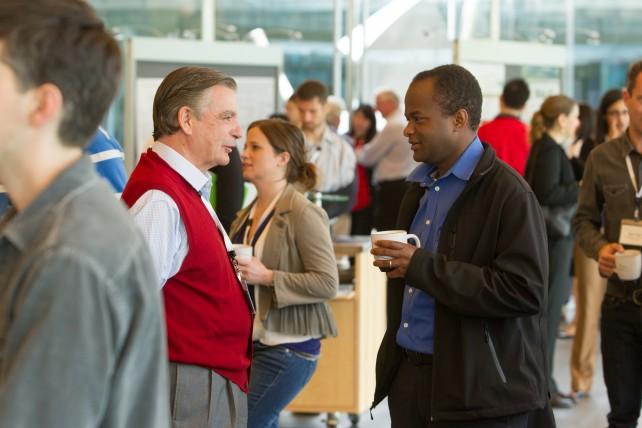
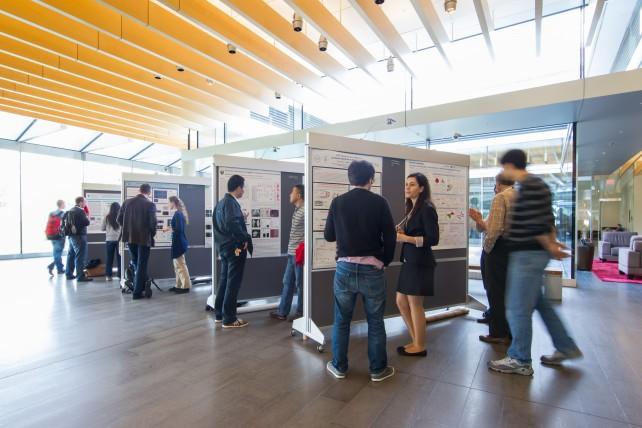
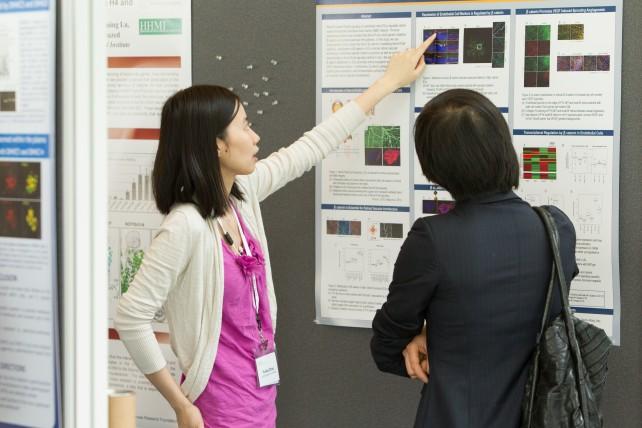
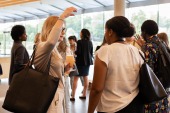
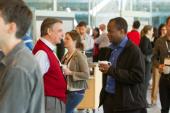
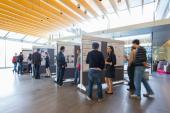
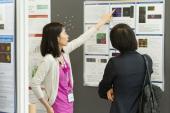
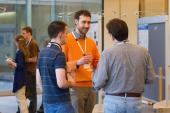
All participants are expected to contribute to the intellectual content of the meeting, including graduate students and postdocs. To achieve these goals, all of the attendees will be active members of the research field and will present their work in a talk or poster format.
Registration for Fall 2012 conferences is now closed (except BioImage Informatics - see link for more details).
This meeting is co-sponsored by HHMI/Janelia Farm and the Max Planck Institute and will be held at the Max Planck Institute of Molecular Cell Biology and Genetics in Dresden, Germany. It continues the successful series of BioImage Informatics conferences held annually. The need and use of image informatics in the life sciences continues to expand and novel methods enable new studies. Trends such as large and high-dimensional images, algorihtmic generality, and error quantification of image-processing results present stimulating challenges to both the method and application sides. The 2012 BioImage Informatics meeting will highlight novel concepts and advances in the methods and algorithms, advances in software tools, knowledge transfer from, e.g., Computer Vision, and significant biological applications of imaging. The conference traditionally also provides a forum for an in-depth discussion of the challenges in this area and the established and emerging software tools available to tackle them.
Registration will open soon at www.bioimageinformatics2012.ethz.ch
Organizers
Fuhui Long, Janelia Farm Research Campus/HHMI
Ivo Sbalzarini, ETH Zurich, MPI-CBG
Pavel Tomancak, MPI-CBG
Michael Unser, EPFL
This meeting is the continuation of the "Maggot Meeting" series. Containing about 10,000 neurons, the nervous system of the Drosophila larva is complex enough to provide insights into the organizational principles of larger nervous systems, yet the relatively small numbers of cells in larvae provide distinct advantages over adults for linking behavior to underlying neural circuits. There have been rapid advances in EM reconstruction of larval circuits and in the generation of light-level atlases of larval neurons that are linked to specific genetic driver lines. At the same time, recently developed methods enable high resolution and high-throughput characterization of a range of larval behaviors. This high level of anatomical resolution, coupled with a growing set of genetic tools available in Drosophila and fine-detail behavioral analysis, makes the fly larva an excellent model system for moving from neural circuits to behavior. This meeting will provide a timely updating of advances in the study of larval behavioral neurogenetics.
Registration for this meeting is closed.
Organizers
James Truman, Janelia Farm Research Campus/HHMI
Marta Zlatic, Janelia Farm Research Campus/HHMI
Invited Participants
Michael Bate, University of Cambridge
Matthew Cobb, University of Manchester
Barry Condron, University of Virginia
Chris Doe, HHMI/University of Oregon
Yu Fengwei, Temasek Lifesciences Laboratory
Bertram Gerber, University of Wuerzburg
Raul Godoy-Herrera, Universidad de Chile
Yuh-Nung Jan, HHMI/University of California, San Francisco
Matthias Landgraf, Cambridge University
Matthieu Louis, Center for Genomic Regulation
Liria Masuda-Nakagawa, University of Tokyo
Craig Montell, The Johns Hopkins School of Medicine
David Morton, Oregon Health & Science University
Akinao Nose, University of Tokyo
Michael Pankratz, University of Bonn
Aravi Samuel, Harvard University
Ping Shen, University of Georgia
Marla Sokolowski, University of Toronto at Mississauga
Simon Sprecher, University of Fribourg
Andreas Thum, University of Konstanz
Dan Tracey, Duke University
K. VijayRaghavan, National Centre for Biological Sciences
Hongyan Wang, Duke NUS
The observation that in most neurodegenerative diseases early and quite striking axonal and synaptic degradation occurs, has led to a dramatic increase in interest in understanding the molecular mechanisms underlying loss of axonal integrity. This meeting is meant to bring together leading researchers who are shaping the burgeoning field of axonal and synaptic auto-destruction. We have invited a slate of exceptional researchers to speaker on neurite degeneration in a variety of settings (e.g. developmental axon and synapse elimination, neuromuscular junction biology, Wallerian degeneration, peripheral neuropathy, and neurodegenerative disease) and model genetic organisms. Presentations will focus on addressing central questions including: (1) What are the intrinsic mechanisms that drive axon auto-destruction after injury or in disease? (2) How do changes in axonal transport or RNA metabolism affect axonal maintenance or degeneration? (3) What extrinsic factors influence axon degeneration (e.g. glial-derived)? (4) How do these pathways modulate functional loss after axon injury or in neurodegenerative disease? Discussion sessions will allow a frank assessment of the status of the field, framing of key future goals, and (we hope) initiation of productive collaborations.
Registration for this meeting is closed.
Organizers
Robert Burgess, The Jackson Laboratory
Marc Freeman, HHMI/University of Massachusetts Medical School
Erika Holzbaur, University of Pennsylvania
Invited Participants
Susan Ackerman, HHMI/The Jackson Laboratory
Robert Baloh, Cedars-Sinai Medical Center
Gary Bassell, Emory University School of Medicine
Christine Beattie, Ohio State University
Frank Bradke, German Center for Neurodegenerative Diseases
Valeria Cavalli, Washington University in St. Louis
Michael Coleman, The Babraham Institute
Catherine Collins, University of Michigan
Felipe Court, Catholic University of Chile
Graeme Davis, University of California, San Francisco
Valina Dawson, Johns Hopkins University
Michael Fainzilber, Weizmann Institute of Science
Aaron Gitler, Stanford University
Michael Granato, University of Pennsylvania
Simon John, HHMI/The Jackson Laboratory
Martin Kerschensteiner, Ludwig-Maximilians-University Munich
Virginia Lee, University of Pennsylvania
Mary Logan, Oregon Health & Science University
Jeffrey Milbrandt, Washington University in St. Louis
Thomas Misgeld, Technical University Munich
Klaus-Armin Nave, Max Planck Institute of Experimental Medicine
Guy Rouleau, University of Montreal
Thomas Schwarz, Harvard Medical School
Charlotte Sumner, Johns Hopkins University
Marc Tessier-Lavigne, The Rockefeller University
Identifying the functional organization of neural networks is key to understanding how the brain processes and stores information. This workshop, a follow-up to the first one held in fall 2010, will continue to explore advances in the genetic, molecular, optical and computational tools that facilitate neural circuit reconstruction by light microcopy. Topics to be discussed include: genetic methods, cytochemistry, light-based acquisition strategies and informatics.
Registration for this meeting is closed.
Organizers
Jeff Lichtman, Harvard University
Gene Myers, Janelia Farm Research Campus/HHMI
Gerald Rubin, Janelia Farm Research Campus/HHMI
Stephen Smith, Stanford University School of Medicine
Invited Participants
Giorgio Ascoli, George Mason University
Eric Betzig, Janelia Farm Research Campus/HHMI
Randy Bruno, Columbia University
Ed Callaway, Salk Institute for Biological Studies
Albert Cardona, University of Zurich and ETH Zurich
Hollis Cline, The Scripps Research Institute
Winfried Denk, Max Planck Institute for Medical Research
Barry Dickson, Research Institute of Molecular Pathology, Vienna
Michael Hausser, University College London
Michael Hawrylycz, Allen Institute for Brain Science
Josh Huang, Cold Spring Harbor Laboratory
Jason Kerr, Max Planck Institute for Biological Cybernetics
Tzumin Lee, Janelia Farm Research Campus/HHMI
Loren Looger, Janelia Farm Research Campus/HHMI
Robert Marc, University of Utah School of Medicine
Maryann Martone, University of California, San Diego
Kristina Micheva, Stanford University
Partha Mitra, Cold Spring Harbor Laboratory
Atsushi Miyawaki, RIKEN Brain Science Institute
Aljoscha Nern, Janelia Farm Research Campus/HHMI
Pavel Osten, Cold Spring Harbor Laboratory
Hanchuan Peng, Janelia Farm Research Campus/HHMI
Badri Roysam, University of Houston
Joshua Sanes, Harvard University
Sebastian Seung, HHMI/Massachusetts Institute of Technology
Stephan Sigrist, Freie Universität Berlin
Charles Stevens, Salk Institute for Biological Studies
Michael Stryker, University of California, San Francisco
Karel Svoboda, Janelia Farm Research Campus/HHMI
Larry Swanson, University of Southern California
James Truman, Janelia Farm Research Campus/HHMI
Roger Tsien, HHMI/University of California, San Diego
Rachel Wong, University of Washington
Hongkui Zeng, Allen Institute for Brain Science
Xiaowei Zhuang, HHMI/Harvard University
A follow-up to the first held in spring 2010, this conference will focus not on pure image analysis, but will instead stress the importance of extracting useful and biologically relevant descriptions and knowledge from image contents in a systematic, comprehensive and high-throughput way. We will review the state-of-the-art in the related fields, and promote the development of critical tools to accelerate the discovery of useful knowledge from image contents. Among others, participants will discuss topics relevant to how biologists and biomedical researchers are currently annotating 3D images on different scales, and how these methods can be improved, as well as how to manage complex annotations with regard to ontology and database limitations.
Registration for this meeting is closed.
Organizers
Erik Meijering, Erasmus MC - University Medical Center Rotterdam
Gene Myers, Janelia Farm Research Campus/HHMI
Hanchuan Peng, Janelia Farm Research Campus/HHMI
Invited Participants
Manfred Auer, Lawrence Berkeley National Lab
Chandrajit Bajaj, University of Texas at Austin
Zhirong Bao, Sloan-Kettering Institute
Gaudenz Danuser, Harvard Medical School
James Duncan, Yale University
Kevin Eliceiri, University of Wisconsin-Madison
Thomas Goddard, University of California, San Francisco
Michael Hawrylycz, Allen Institute for Brain Science
Tianzi Jiang, Chinese Academy of Sciences
Takeo Kanade, Carnegie Mellon University
Boudewijn Lelieveldt, Leiden University Medical Center
Fuhui Long, Janelia Farm Research Campus/HHMI
B. Manjunath, University of California, Santa Barbara
Dimitris Metaxas, Rutgers University
Alexander Pico, The Gladstone Institutes
William Ryu, University of Toronto
Jianbo Shi, University of Pennsylvania
Tanveer Syeda-Mahmood, IBM Almaden Research Center
Dimitrios Vavylonis, Lehigh University
Robert Waterston, University of Washington
Building on discussions from the first two meetings in this series, this conference will showcase the development of cutting-edge tools and technology for imaging, from cells to intact animals. Sessions will cover the design and discovery of new fluorescent proteins (and intriguing alternatives), and their incorporation into sensors for signaling molecules and cellular states. Innovative imaging modalities making use of such reagents, as well as biological discoveries gleaned from such experiments, will also be presented. It is our hope that the meeting can present a clear picture of how far these tools have come in recent years, and what additional reagents and capabilities are required to continue the advance of the Age of Light.
Registration for this meeting is closed.
Organizers
Loren Looger, Janelia Farm Research Campus/HHMI
Atsushi Miyawaki, RIKEN Brain Science Institute
Ryohei Yasuda, Duke University Medical Center
Jin Zhang, The Johns Hopkins University
Invited Participants
Eric Betzig, Janelia Farm Research Campus/HHMI
Edward Boyden, Massachusetts Institute of Technology
Robert Campbell, University of Alberta
Adam Cohen, Harvard University
Daniel Evanko, Nature Methods
Oliver Griesbeck, Max Plank Institute of Neurobiology
Fritjof Helmchen, Brain Research Institute, University of Zurich
Thomas Hughes, Montana State University
Samie Jaffrey, Cornell University
Jason Kerr, Max Planck Institute for Biological Cybernetics
Baljit Khakh, University of California, Los Angeles
Tom Knopfel, RIKEN Brain Science Institute
Leon Lagnado, University of Cambridge
Jeff Lichtman, Harvard University
Michael Lin, Stanford University
Takeharu Nagai, Hokkaido University
Masamichi Ohkura, Saitama University Brain Science Institute
Amy Palmer, University of Colorado at Boulder
David Piston, Vanderbilt University
Jim Remington, University of Oregon
Carsten Schultz, European Molecular Biology Laboratory (EMBL)
Hari Shroff, National Institutes of Health
Karel Svoboda, Janelia Farm Research Campus/HHMI
Vladislav Verkhusha, Albert Einstein College of Medicine
Sam Wang, Princeton University
Jenny Yang, Georgia State University
Gary Yellen, Harvard Medical School
David Yue, Johns Hopkins University School of Medicine
Hongkui Zeng, Allen Institute for Brain Science
Neuronal classification is particularly complex in mammalian nervous systems. Although the extent of neuronal diversity is daunting at the whole-brain scale, the problem can be parceled by leveraging the considerable specificity among different regions. This conference will focus on the cerebral cortex with a particular emphasis on the rodent hippocampus. Neurons are commonly phenotyped based on their observed properties, including morphology (axonal-dendritic shape, location, and connectivity), physiology (rhythms, spiking patterns, membrane properties, synaptic plasticity), and molecular identity (neurotransmitter, protein markers, gene expression, enzymatic cascades, transcription factors). The ultimate goal is to integrate neuronal classification with the rich evidence on computational processing in the hippocampus (memory storage and retrieval, spatial exploration and navigation, etc.) and related cortical areas. The foremost worldwide researchers in the field will jointly review the status of current knowledge, identify open scientific questions, discuss new directions of research, and germinate consensus towards a systematic organization of available information.
Registration for this meeting is closed.
Organizers
Giorgio Ascoli, George Mason University
Thomas Klausberger, Medical University of Vienna
Massimo Scanziani, HHMI/University of California, San Diego
Peter Somogyi, Medical Research Council (MRC)
Invited Participants
Afia Ali, The School of Pharmacy, University of London
Stewart Anderson, Weill Cornell Medical College
Marco Capogna, Medical Research Council (MRC)
Rosa Cossart, Université de la Méditerranée
Gordon Fishell, New York University School of Medicine
Norbert Hájos, Institute of Experimental Medicine, Hungary
Michael Hasselmo, Boston University
Josh Huang, Cold Spring Harbor Laboratory
Peter Jonas, Institute of Science and Technology Austria
Dimitri Kullmann, University College London
Karri Lamsa, Medical Research Council (MRC)
Albert Lee, Janelia Farm Research Campus/HHMI
Ed Lein, Allen Institute for Brain Science
Attila Losonczy, Columbia University
Gianmaria Maccaferri, Northwestern University
Chris McBain, National Institutes of Health
Hannah Monyer, University of Heidelberg
Zoltan Nusser, Institute of Experimental Medicine, Hungary
Bernardo Rudy, NYU Langone Medical Center
Ivan Soltesz, University of California, Irvine
Nelson Spruston, Janelia Farm Research Campus/HHMI
János Szabadics, Institute of Experimental Medicine, Hungary
Alex Thomson, The School of Pharmacy, University of London
Menno Witter, Norwegian University of Science and Technology
This meeting will focus on recent developments in circadian biology, with an emphasis on mechanisms of circadian clock oscillation, coordination between oscillators, and connections between circadian clocks and physiology.
MEETING AGENDA
Organizers
Erin O’Shea, HHMI/Harvard University
Joe Takahashi, HHMI/University of Texas Southwestern Medical Center
Invited Participants
Joseph Bass, Northwestern University
Deborah Bell-Pedersen, Texas A&M University
Michael Brunner, University of Heidelberg
Michael Do, Harvard Medical Center
Jay Dunlap, Dartmouth Medical Center
Susan Golden, University of California, San Diego
Carla Green, University of Texas Southwestern Medical Center
Michael Hastings, MRC Laboratory of Molecular Biology
Samer Hattar, Johns Hopkins University
John Hogenesch, University of Pennsylvania
Steve Kay, University of California, San Diego
Takao Kondo, Nagoya University
Achim Kramer, Charité - Universitätsmedizin Berlin
Martha Merrow, University of Groningen
Felix Naef, École Polytechnique Fédérale de Lausanne
Michael Nitabach, Yale School of Medicine
John O'Neill, University of Cambridge
Andrew Oates, Max Planck Institute of Molecular Cell Biology & Genetics
David Rand, Warwick Systems Biology Centre
Rama Ranganathan, University of Texas Southwestern Medical Center
Michael Rosbash, HHMI/Brandeis University
Ueli Schibler, University of Geneva
Benjamin Tu, University of Texas Southwestern Medical Center
Hiroki Ueda, RIKEN Center for Developmental Biology
David Welsh, University of California, San Diego
Brian Zoltowski, Southern Methodist University
Information processing and storage in neuronal dendrites mediate the circuit computations that underlie behavior. There are four interacting aspects: 1) synaptic input is delivered by circuit connectivity, 2) the electrical properties of dendrites, 3) transformation of input into specific patterns of network output, and 4) various forms of plasticity respond to this activity. This meeting will examine these four aspects (connectivity, electrical properties, transformations and plasticity) in the context of circuit computations.
MEETING AGENDA
Organizers
Jeff Magee, Janelia Farm/HHMI
Stephen Williams, University of Queensland
Erin Schuman, Max Planck Institute
Invited Participants
Heinz Beck, University of Bonn Medical Center
Deanna Benson, Mount Sinai Medical Center
Solange Brown, Johns Hopkins School of Medicine
Pico Caroni, Friedrich Miescher Institute for Biomedical Research (FMI)
Fabrizio Gabbiani, Baylor College of Medicine
Kristen Harris, University of Texas at Austin
Michael Hausser, University College London
Fritjof Helmchen, Brain Research Institute, University of Zurich
Dax Hoffman, National Institutes of Health
Lily Jan, HHMI/University of California, San Francisco
Daniel Johnston, University of Texas at Austin
Jinhyun Kim, Korea Institute of Science and Techology, Seoul
Arthur Konnerth, Technical University Munich
Ken Kosik, University of California, Santa Barbara
Matthew Larkum, Humboldt University
Máté Lengyel, Cambridge University
Attila Losonczy, Columbia University
Wolfgang Maass, Technische Universität Graz
Judit Makara, Institute of Experimental Medicine, Hungary
Zoltan Nusser, Institute of Experimental Medicine, Hungary
Wilfrid Rall, National Institute of Diabetes and Digestive and Kidney Diseases/NIH
Stefan Remy, German Center for Neurodegenerative Diseases
Jackie Schiller, Technion - Israel Institute of Technology
Terrence Sejnowski, HHMI/Salk Institute for Biological Studies
Gordon Shepherd, Yale School of Medicine
Steven Siegelbaum, HHMI/Columbia University
Nelson Spruston, Janelia Farm Research Campus/HHMI
Greg Stuart, The Australian National University
Gabor Tamas, University of Szeged
Gina Turrigiano, Brandeis University
Sam Wang, Princeton University
Stephen Williams, Queensland Brain Institute
Over the past few years, an increasing number of laboratories have targeted the central complex and nearby regions of the insect brain for anatomical, physiological and behavioral studies. This meeting will bring together a cross-section of such researchers, and others studying related topics in higher sensory processing and sensorimotor integration. The meeting format (short theme-focused talks, chaired panels to end each themed session) is intended to enable focused and specific discussions about the issues of each session, details of which will follow in the weeks to come. We will request that participants whose research touches the central complex try to present their data and ideas in the context of specific, testable hypotheses about the region’s function and attempt to relate their findings to those of others in the field. We believe that this effort, in contrast to the more typical approach of providing a narrative of the lab’s findings, will lead to more productive discussions and help achieve the goal of the meeting, as reflected in its title.
MEETING AGENDA
Organizers
Eugenia Chiappe, Janelia Farm/HHMI
Stanley Heinze, University of Massachusetts Medical School
Vivek Jayaraman, Janelia Farm/HHMI
Invited Participants
George Boyan, Ludwig-Maximilians-Universität München
Catherine Carr, University of Maryland
Ann-Shyn Chiang, National Tsing Hua University
Benjamin de Bivort, Rowland Institute at Harvard
Berthold Hedwig, University of Cambridge
Ralf Heinrich, Institute for Zoology
Uwe Homberg, Philipps-Universität Marburg
Arnim Jenett, Janelia Farm Research Campus/HHMI
Ryohei Kanzaki, University of Tokyo
James Knierim, Johns Hopkins University
Rüdiger Krahe, McGill University
Thomas Labhart, University of Zurich
Stephen Lisberger, HHMI/University of California, San Francisco
Rudolf Loesel, Institut für Biologie II
Michael Mauk, University of Texas, Austin
Michael Reiser, Janelia Farm Research Campus/HHMI
Fred Rieke, HHMI/University of Washington
Roy Ritzmann, Case Western Reserve University
Gabe Sibley, George Washington University
Mandyam Srinivasan, University of Queensland
Barry Stein, Wake Forest Baptist Medical Center
Nicholas Strausfeld, University of Arizona
Roland Strauss, Johannes Gutenberg-Universitaet Mainz
Barbara Webb, University of Edinburgh
Mathias Wernet, Stanford University
Asa Winther, Karolinska Institutet
This meeting will focus on various aspects of circuit assembly including axon guidance, lamina targeting specificity, synapse formation, dendritogenesis, reaction to injury and signaling (including RNA and cytoskeletal regulation in neurites) and activity-dependent processes. This will be a small meeting with some additional speakers and about an equal number of graduate students and postdoctoral fellows. We anticipate that the small size and high quality will encourage discussion.
MEETING AGENDA
Organizers
Tom Jessell, HHMI/Columbia University
Carla Shatz, Stanford University
Larry Zipursky, HHMI/ University of California, Los Angeles
Invited Participants
Silvia Arber, Biozentrum, University of Basel and FMI
Ben Barres, Stanford School of Medicine
Greg Bashaw, University of Pennsylvania
Robert Darnell, HHMI/Rockefeller University
David Feldheim, University of California, Santa Cruz
Daniel Feldman, University of California, Berkeley
Marla Feller, University of California, Berkeley
John Flanagan, Harvard Medical School
Marc Freeman, HHMI/University of Massachusetts Medical School
David Ginty, HHMI/Johns Hopkins University School of Medicine
Michael Greenberg, Harvard Medical School
Wes Grueber, Columbia University
Christine Holt, University of Cambridge
Mark Hubener, Max Planck Institute of Neurobiology, Martinsried
Andrew Huberman, University of California, San Diego
Yuh-Nung Jan, HHMI/University of California, San Francisco
Yishi Jin, HHMI/University of California, San Diego
Alex Kolodkin, HHMI/Johns Hopkins University
Liqun Luo, HHMI/Stanford University
Carol Mason, Columbia University
Samuel Pfaff, HHMI/Salk Institute for Biological Studies
Hitoshi Sakano, University of Tokyo
Iris Salecker, National Institute for Medical Research
Joshua Sanes, Harvard University
Kang Shen, HHMI/Stanford School of Medicine
The size and complexity of neural circuits, and of the experimental datasets collected for their study, motivate neuroscientists to study and foster advances in machine learning and statistical inference. Neuroscientists need both innovative new tools for large-scale data analysis, and a better formal understanding of learning and inference that could illuminate how neural circuits function. This meeting will bring together creative researchers from a broad range of the machine learning and statistical inference community, including many from outside neuroscience, to discuss current research frontiers and perhaps to spark new ideas for applications to problems in neural circuit analysis.
MEETING AGENDA
Organizers
Mitya Chklovskii, Janelia Farm/HHMI
Sean Eddy, Janelia Farm/HHMI
Elena Rivas, Janelia Farm/HHMI
Invited Participants
Kristin Branson, Janelia Farm/HHMI
Aaron Clauset, University of Colorado, Boulder
Sophie Deneve, Ecole Normale Supérieure
Michael Elad, The Technion - Israel Institute of Technology
Brendan Frey, University of Toronto
Stuart Geman, Brown University
Elad Hazan, Technion - Israel Institute of Technology
Viren Jain, Janelia Farm/HHMI
Philip Kegelmeyer, Sandia National Laboratories
Yann LeCun, New York University
Jun Liu, Harvard University
Partha Mitra, Cold Spring Harbor Laboratory
Bruno Olshausen, University of California, Berkeley
Stanley Osher, University of California, Los Angeles
Liam Paninski, Columbia University
Hanchuan Peng, Janelia Farm/HHMI
Fernando Pereira, Google Research
Maneesh Sahani, University College London
Eero Simoncelli, HHMI/New York University
Haim Sompolinsky, The Hebrew University
Mats G.L. Gustafsson became a group leader at Janelia Farm in 2008. In April 2011, he passed away after a courageous battle with brain cancer. Mats was a leader in the field of high resolution light microscopy and pioneered a set of super-resolution methods including structured illumination light microscopy (SIM) and I5M. These allow visualization of cellular components that typically go undetected by light microscopes. This meeting will honor the memory of Mats and his contribution to the field of bioimaging by bringing together people who have worked with him over the years, as well as others who develop and/or apply innovative optical imaging techniques. Through a series of talks, posters and group discussions, we will cover various methods, including SIM, STED, PALM, STORM, adaptive optics, multiplane imaging, and others.
MEETING AGENDA
Organizers
David Agard, HHMI/University of California, San Francisco
Eric Betzig, Janelia Farm/HHMI
Invited Participants
Sara Abrahamsson, University of California, San Francisco
Joerg Bewersdorf, Yale University
Michael Davidson, Florida State University
Reto Fiolka, Janelia Farm Research Campus/HHMI
Alan Greenaway, Heriot Watt University
Rainer Heintzmann, Institute of Phototonic Technology
Stefan Hell, Max Planck Institute for Biophysical Chemistry
Harald Hess, Janelia Farm Research Campus/HHMI
Zvi Kam, Weizmann Institute of Science
Philipp Keller, Janelia Farm Research Campus/HHMI
Tom Kirchhausen, Harvard Medical School
Peter Kner, University of Georgia
Frederick Lanni, Carnegie Mellon University
Timothy Mitchison, Harvard Medical School
Hesper Rego, Harvard School of Public Health/CSIR, South Africa
Markus Sauer, University of Wuerzburg
Lothar Schermelleh, University of Oxford
John Sedat, University of California, San Francisco
Lin Shao, Janelia Farm Research Campus/HHMI
Jason Swedlow, University of Dundee
David Williams, University of Rochester
Tony Wilson, University of Oxford
Janine Stevens, JFRC

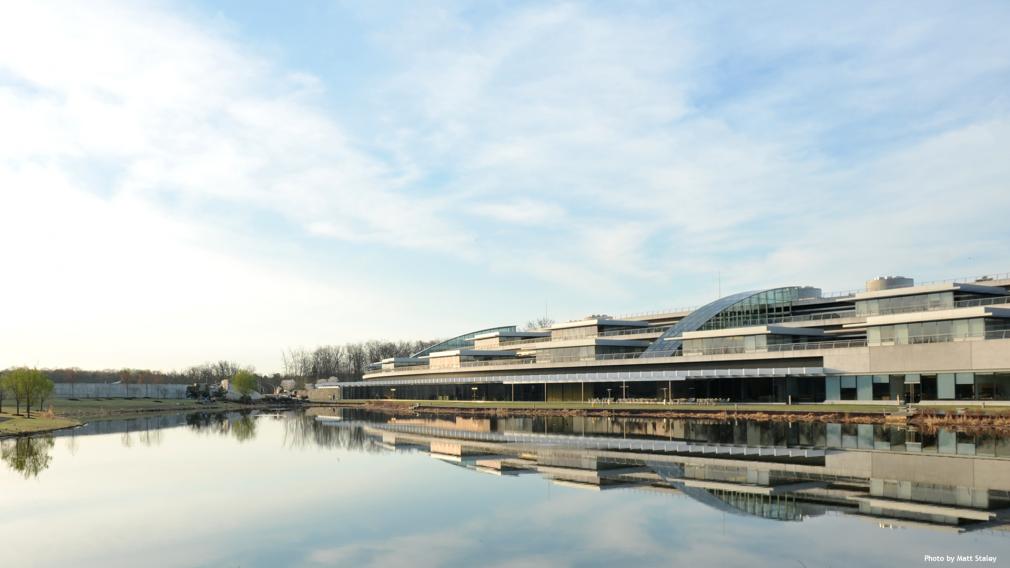
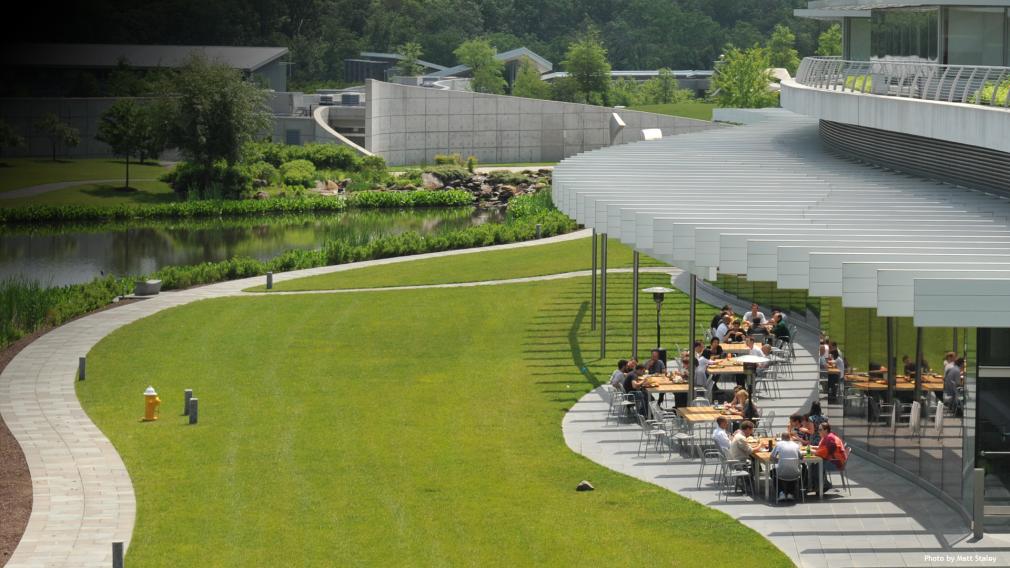
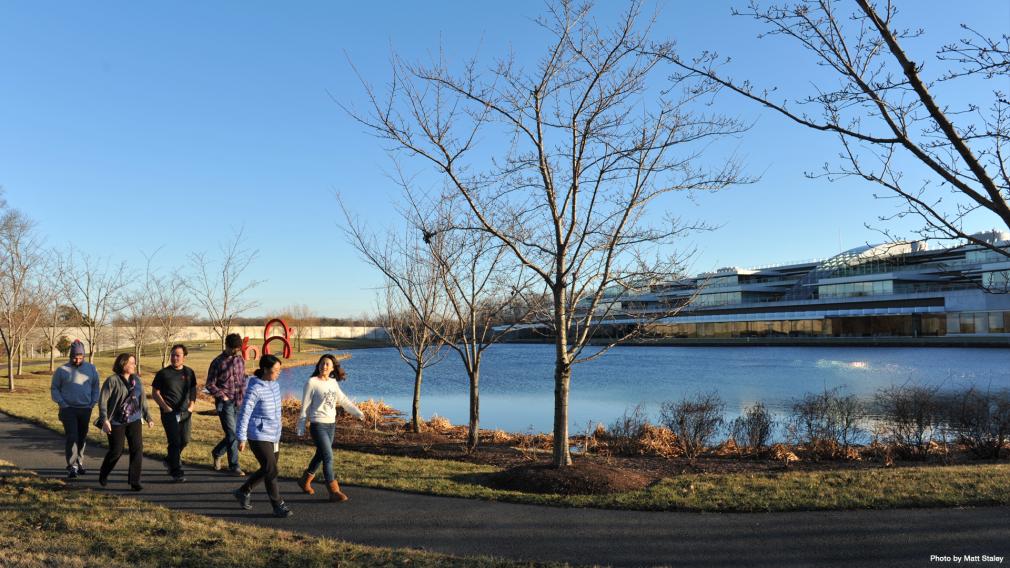
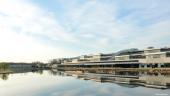
Rooms in the guest house look out over a small pond toward a hardwood forest.
They typically run for two and a half days, beginning Sunday evening and ending mid day on Wednesday.
Accommodations
All external participants are housed on-site in our guest house. Units are single queen rooms. A fitness center is available for guests' use.
Size
Janelia conferences range from small workshops for more intimate discussions to larger meetings of up to about 60 people.
Structure
Each conference normally has at least one external and one internal organizer (usually a Janelia lab head). Meetings are announced on the Janelia website each March and September and openly advertised so that interested members of the scientific community may apply online. The conference organizers invite participants based on their research abstract and ability to contribute to the scientific discussion. Presentations may include talks and/or posters.
Cost
HHMI funds the local costs of the meeting, including food and accommodation for all participants. Travel costs are discussed below.
Travel
Travel costs are not normally covered, but Janelia has some funds available to provide travel assistance to a fraction of participants. If you need such assistance in order to attend, please apply in the “travel funds request” field during online registration.
In accordance with our travel policy, travel expenses for approved participants will be reimbursed up to a fixed amount based on the average cost of advanced-purchase, coach class air travel from the participant's geographical region to Janelia Farm. If approved, participants must attend the entire conference to qualify for reimbursement. Download our detailed travel policy for more information.
Abstract Book
To facilitate interactions, all conference participants are asked to provide a short abstract on their research interests, which will be included in an abstract book.
Publication
Presentations at Janelia conferences do not constitute scientific publications, and their scientific content may not be shared outside of the conference without the express permission of the presenter. Permission is required for sharing through tweets, websites, or blogs as well as more traditional means of communication. This has been the standard ethic for dissemination of unpublished results presented in closed scientific meetings, and we feel that this ethic is important to promote the free exchange of unpublished material, which is in the interests of all participants. The advent of new Internet technology does not change the standards for ethical conduct of science.
For these reasons, participants are not permitted to record presentations or posters by electronic or photographic means without the express permission of the presenter. Given these assurances, presenters should speak openly and not allude to any data or experiments that they are not prepared to discuss in full.
The application to participate in a Janelia conference contains the following statement, and each participant must agree to these provisions: "Presentations and posters are not to be recorded by electronic or photographic means, and the scientific content of Janelia conference presentations, posters, and discussions is not to be shared outside of the conference, without the express permission of the presenter. Permission is required for sharing through tweets, websites, or blogs as well as more traditional means of communication. Authors are requested to omit references to the scientific content of Janelia conferences from any publication."
Internal Web-Casting
We record platform talks and broadcast them within Janelia’s laboratory building via the intranet ONLY for the convenience of our resident and visiting scientists. We hold these recordings for seven days after the talk and then delete them from our systems. All participants must agree to this recording.
Child Care
We have child care available for children between the ages of six weeks and five years (space permitting, see http://centers.brighthorizons.com/learninglab/). The hours are 7:30 am to 6:30 pm. Participants must pay for child care and the cost varies depending on the child's age. Some paperwork is required in advance (vaccination certificates, etc.). Please contact the child care director at (571) 209-4025 for more information.
Janelia Conference Scholarships for Students from Disadvantaged Backgrounds
Conference scholarships that cover the cost of travel and specified associated out-of-pocket expenses (for example, poster printing) are offered by Janelia Farm to graduate students who would otherwise be unable to participate in our meetings. These scholarships will allow graduate students who are members of a group underrepresented in the sciences, who come from disadvantaged backgrounds, or who are actively involved in promoting diversity in the sciences to attend conferences at Janelia. They will function to increase access of these students to leading scientists and to enrich the possible recruiting pool for Janelia Farm. One scholarship will be awarded per conference.
Eligibility
Any matriculated graduate student may apply. To be eligible for consideration, an applicant must self-identify as a member of a group underrepresented in the sciences, as having come from a disadvantaged background, or as being interested in promoting diversity in the sciences.
A student is considered to come from a disadvantaged background if he or she comes from an environment that may have hindered him or her from obtaining the knowledge, skills, and ability required to enroll in an undergraduate institution. For example, students from very-low-income families (such as those eligible for food stamps or public housing) or whose parents did not go to college are considered to come from a disadvantaged background.
Application
The application deadline has passed. Applicants were asked to:
- Specify which conference they wish to attend
- Explain why they will both benefit and contribute scientifically in attending
- Explain how they believe they meet the eligibility requirements
- Provide a CV
- Provide a reference from their academic advisor
- Register online for the conference of choice
Applications will be assessed by the Janelia Farm Conference Program administrator in conjunction with the conference organizers.
Logistics
Scholarship applicants must also formally register for their conference of choice at http://conference.janelia.org/cms. Scholarship applications cannot be considered if the conference registration process is not completed.
Why do I have to submit an abstract and what should I write?
Abstracts for JFRC conferences serve several purposes: they help the organizers plan the meeting agenda, act as a scientific introduction for the attending participants who may not know your research well, and allow you to state your future research goals, which may elicit useful assistance or suggestions. We ask that all participants submit an abstract, even if it is short.
How can I confirm that my abstract submission is complete?
Upon completion of the required items, which are the presentation title, author(s), abstract, and key words, you will receive an e-mail confirmation with a summary of all of the information entered in our online registration. Because this notification will be sent to your e-mail address, please avoid entering confidential information during registration.
Make sure you have saved all abstract information before the submission deadline for the conference. Once the submission deadline has passed, you will be able to view your abstract information.
If you have any questions regarding accommodations, meals, or transportation/parking, please contact the Campus Services department at reservations@janelia.hhmi.org. If you have technical problems or have any other questions about the Janelia conference program, please send an email to Conference Management at conference@janelia.hhmi.org.
How can I ensure that an assistant or alternate contact is included in all conference e-mail correspondence?
You can specify an assistant/alternate e-mail address on the "Contact Info" tab in the registration system. All conference notifications are sent to both the primary e-mail address and the assistant/alternate e-mail address for your account.
When will I find out if I have been accepted to participate in the conference?
Approximately four months before the date your conference begins, you should be notified of your status. However, this may vary. We will inform you as soon as the organizers have made their decisions.
What if I need to make changes to my abstract or personal information after the registration website has closed?
Because the conference organizers require your abstract for creating the final agenda, we ask that you please complete all registration information in advance of the deadline. However, if you do need to make modifications, please send an e-mail to conference@janelia.hhmi.org.
Is there a registration fee to attend Janelia Farm conferences?
There is no registration fee for our conferences, and we cover the cost of food and housing.
How do I get to Janelia Farm Research Campus?
Directions to Janelia Farm can be found at http://www.janelia.org/campus-community/janelia-farm-campus. We recommend you use Washington Dulles International Airport when traveling, as it is a short cab ride from campus. Directions from Dulles Airport will be emailed one to two weeks prior to the start of the meeting. We suggest that you print all directions and have them on hand when using ground transportation to ensure that you do not get lost (printable directions from Dulles to Janelia). If you need additional assistance getting to campus, please call our main line at 571-209-4000 to reach the reception desk.
JFRC does not offer transportation to campus, but does offer a shuttle service to Washington Dulles International at the close of each meeting. You may sign-up to use this service at check-in.
Please note JFRC is a secure campus and you will not be allowed access prior to your scheduled arrival date.
Does Janelia Farm pay for my travel expenses?
Conference organizers are allotted funds to provide travel scholarships to a fraction of participants. In accordance with our travel policy, travel expenses for these participants will be reimbursed up to a fixed amount based on the average cost of advanced-purchase, coach class air travel from the participant’s geographical region to Janelia Farm. Unless otherwise approved, you must attend the entire conference in order to receive your reimbursement. Click HERE to download our detailed travel policy.
Can I drive to the meeting and park my car on campus?
Yes, but please let us know ahead of time so that we can arrange this with campus security.
How do I reach Janelia Farm from Washington Dulles International Airport?
You will need to take a cab from the airport to Janelia Farm. It is about a 15-minute, $30 ride.
How do I get back to Washington Dulles International Airport after the conference?
We provide free shuttle service from Janelia farm back to Dulles Airport. Three shuttles will leave at staggered times to accommodate all travelers. The trip takes approximately 15 - 20 minutes. You can sign up for a shuttle at the reception desk any time during your conference. If the shuttle times are not amenable to your flight schedule, you can request a cab by filling out the appropriate form at the reception desk. The cab ride to Dulles Airport is about $30.
How far in advance do I need to arrive at the airport for my return flight?
It is recommended that you arrive at the airport three hours in advance for international flights and two hours in advance for domestic flights. However, this time-frame is largely dependent on the day/time of your travel and whether you are checking baggage. We do provide a kiosk for printing your boarding pass before leaving Janelia Farm.
When can I arrive and check-in for my Janelia Conference?
We typically expect check-ins to occur after 3 pm on the first day of the conference, which is normally a Sunday. However, if your travel plans call for you to arrive earlier, we will do what we can to accommodate you. Our reception area is staffed 24 hours a day; however, if you have any questions regarding the conference, you must wait until the designated registration period to speak with a conference coordinator.
If you arrive early and would like to purchase refreshments, you may use the credit allotted on your room key. This credit is available to you throughout your stay and is intended for use in Bob's, our campus Pub.
What happens during check-in?
At check-in you will receive your room key, which also has credit applied to it for your use at Bob’s Pub. You will also receive your conference abstract book and an updated agenda if any changes have been made. At this time, or any time during the conference, you can sign up for a shuttle or cab service back to Dulles Airport.
Where will I stay when I attend a Janelia Conference?
You will receive your room key to the guest house and conference materials at the registration desk upon your arrival. If you live locally and do not need accommodations, please notify conference management on the travel page of the registration process.
What will I eat while at Janelia Farm?
We will provide you with breakfast, lunch, and dinner. For snacks and other options, feel free to use the credit applied to your room key at Bob's Pub, which is open all day.
What if I have special needs regarding meals or accommodations?
Please notify us of any special needs you may have in the "special needs" section during the online registration. You may also e-mail Campus Services at reservations@janelia.hhmi.org.
When will I receive the meeting agenda?
Those who are invited or who apply and are chosen to participate will receive a provisional agenda following registration, when it is available. A more current agenda will be sent along with directions from Washington Dulles International Airport about one week prior to the meeting. The agenda will also be posted on our web site.
How big are the poster boards?
Our poster board size is approximately 45 inches tall by 45 inches wide (1.14 meters x 1.14 meters).
Do I need to bring my own laptop?
No. We have both PCs and MACs available for your use, but feel free to bring your own if you wish. You can bring your presentation on a disc or other portable hard drive. Keep in mind that our optimal screen resolution is 1024 x 768.
Do I have to attend the whole meeting?
Yes. By agreeing to participate in a Janelia conference, you agree to stay for the entirety of the meeting. Only in rare instances do we permit participants to arrive late or leave early.
What should I do if I am unable to attend the conference?
We are sorry you will not be joining us. Once you are logged into the Web system, under the "Conference Info" section you will find "Decline Registration." Please click the "Decline Registration" button. Once you have declined registration, we will note that you will not be attending and you will no longer receive any notifications regarding the conference.
Am I expected to present my work at the conference?
We do expect everyone to be an active participant, by presenting either a talk or a poster.