GENIE
The goal of the Genetically-Encoded Neuronal Indicator and Effector (GENIE) Project is to engineer fluorescent sensors that facilitate imaging of neuronal activity in vivo.
For more than fifteen years, fluorescent proteins have been engineered to sense neuronal activity. Genetically-encoded indicators hold the promise of imaging the activity of large populations of neurons in vivo. Despite numerous advances, the full potential of this technology has yet to be realized, mainly because of limitations in the performance of existing indicators. Uncovering the principles underlying the function of neural circuits requires imaging activity in neuronal microcompartments, such as dendrites and synapses, as well as groups of specific neurons, during complex behaviors. Fluorescent sensors are currently the key bottleneck limiting these "killer apps".
The GENIE Project provides the organization, multidisciplinary know-how, and efficient assays to dramatically accelerate optimization of indicator scaffolds and other sensors invented at Janelia and elsewhere.
The goals of the GENIE Project are:
- Screen thousands of indicator variants generated by mutagenesis using a custom, high-throughput, mammalian neuron-based electrical stimulation/imaging platform. Assays in neurons under physiological conditions, as compared to testing in purified protein preparations or non-neuronal cells, allows for quantitation of responses in the relevant cell type with relevant calcium dynamics.
- Produce indicators with distinct biophysical features, including high and low affinities for calcium, slow or fast rise/decay kinetics, increased overall brightness, and reduced toxicity. Measurements in neurons with low firing rates will benefit from high affinity, slow indicators, whereas measurements in neurons with high firing rates may benefit from indicators with low affinity and fast kinetics.
- Validate lead indicator variants by in vivo testing in mouse, Drosophila, and C. elegans neurons in vivo. Indicator performance depends on the neurobiological model system being employed and the neurobiological problem being addressed. It will thus be critical to benchmark indicators in a variety of contexts.
- Develop novel indicators, including spectral variants and sensors that measure other neuronal state variables, such as voltage. The efficient assays developed as part of the GENIE Project are ideal to prototype and optimize additional fluorescent sensors for a variety of applications in neurobiology.
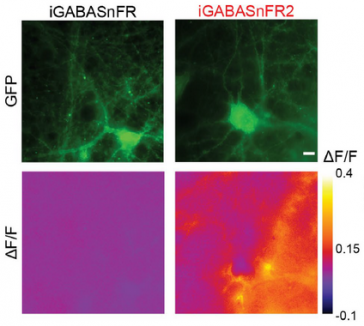
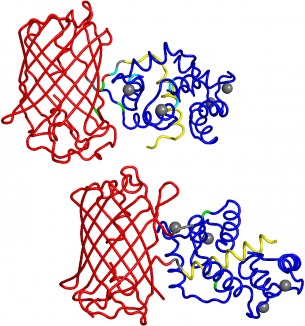
To identify indicators with desirable properties, we have established quantitative assays to test thousands of fluorescent activity indicator variants, including genetically-encoded calcium indicators (GECIs) and voltage indicators (GEVIs), generated by mutagenesis according to both rational and unbiased design strategies. Sensor variants are tested on our mammalian neuronal culture screening platform. Neurons are plated in 24- or 96-well format, transduced with sensors, and stimulated with an electrical field to trigger action potentials. Neurons are imaged with fluorescence microscopy. This automated assay allows quantitative evaluation of dozens of indicators per day. Initially, we are focusing on the GCaMP scaffold, consisting of a green fluorescent protein, calmodulin, and myosin light chain kinase peptide. We find that even for this relatively mature scaffold, considerable headroom exists in terms of improvement of indicator dynamic range, brightness, kinetics, and toxicity. The screening technology will facilitate the development of other fluorescent sensors for neurobiology.
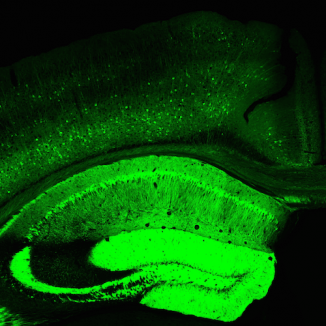
A subset of lead GECI variants is being tested in secondary assays in several model organisms, including the Drosophila larval neuromuscular junction (NMJ), Drosophila adult olfactory and visual system neurons, C. elegans mechanosensory neurons, mouse visual cortex, and mouse hippocampal brain slices. This diverse set of secondary assays is required to validate GECIs in various contexts. For example, the Drosophila larval neuromuscular junction and mouse acute hippocampal slices allow precise stimulus control and are thus preferred preparations for a detailed biophysical analysis of GECI dynamics. Testing GECIs in C. elegans in a tactile stimulation assay allows us to evaluate overall brightness and performance in a behaving organism with tiny neurons. Mouse visual cortical neurons, loaded with GECI variants by viral transduction or in transgenic mice, are imaged in anesthetized mice visually stimulated with drifting gratings on a computer monitor. The exquisite tuning of mammalian visual cortical neurons to specific visual features provides an assay for rundown due to long-term GECI expression.
-Established mammalian neuronal culture stimulation/imaging platform, including automated stimulation and fluorescence microscopy in 24- and 96-well plate format.
-Screened more than 1000 GCaMP variants on neuronal culture platform.
-Engineered novel GCaMP variants with faster kinetics and higher signal-to-noise ratios compared to prior sensors.
-Established in vivo mouse visual cortex stimulation/imaging assay.
-Successfully assayed novel variants in Drosophila larval NMJ stimulation/imaging assay.
-Tested novel variants in C. elegans mechanosensory neurons in tactile stimulation assay.
The GENIE Project is building infrastructure for optimization of fluorescent protein indicators and effectors of neural function. Future scaffolds to be developed could include calcium-sensing indicators with different spectral properties, fluorescence resonance energy transfer (FRET)-based sensors, and integrators of calcium-dependent signaling. The project's efforts will synergize in the future with those of other Janelia team projects, including the Fly Light Project, by providing improved indicators for use in Drosophila neuronal circuit mapping and correlation of fly behavior with activity.
The GENIE Project consists of a diverse group of scientists at various stages in their career paths. We are invertebrate and vertebrate neurophysiologists, behavioral neuroscientists, biophysicists, microscopists, structural biologists, protein biochemists, cell biologists, genetic engineers, virologists, and molecular biologists. We leverage the shared resources at Janelia, which include experts in instrument design, cell culture, histology, genetic engineering, applied physics, and microscopy. We also partner with collaborators around the world and participants in the Janelia visitor program. Our hope is that the fulfillment of the GENIE Project's mission will not only enable insights that reveal novel emergent principles about neural circuit control of behavior, but will also spur unforeseen opportunities for collaboration that lead to further technological achievements.
Data and reagents will be shared within nine months after initial discovery of improved indicators. Data will be published in academic journals and/or made available on this website (see Janelia Technology section). DNA constructs will be deposited at Addgene, Inc. Viruses will be deposited at the University of Pennsylvania Vector Core. Mice will be deposited at The Jackson Laboratory. Drosophila will be made available at the Bloomington Drosophila Stock Center. C. elegans lines will be distributed upon request.
Prior to publication, reagents will be made available to collaborators who agree to testing sensor variants using previously agreed upon procedures and standards of merit; for example, one obvious collaboration would involve investigators testing in species/systems not represented as part of the GENIE Project.
For additional GENIE Project reagent information, please visit the GENIE Project Community Forum.
Plasmids available from Addgene.org:
CMV-GCaMP6s (improved SNR, slower kinetics)
CMV-GCaMP6m (improved SNR, intermediate kinetics)
CMV-GCaMP6f (improved SNR, faster kinetics)
CMV-GCaMP5G
CMV-GCaMP3
Viruses available from University of Pennsylvania Viral Vector Core:
AAV2/1.hSynap.GCaMP6s.WPRE.SV40
AAV2/1.hSynap.GCaMP6m.WPRE.SV40
AAV2/1.hSynap.GCaMP6f.WPRE.SV40
AAV2/1.CAG.GCaMP6s.WPRE.SV40
AAV2/1.CAG.GCaMP6m.WPRE.SV40
AAV2/1.CAG.GCaMP6f.WPRE.SV40
AAV2/1.hSynap.flex.GCaMP6s.WPRE.SV40
AAV2/1.hSynap.flex.GCaMP6m.WPRE.SV40
AAV2/1.hSynap.flex.GCaMP6f.WPRE.SV40
AAV2/1.CAG.flex.GCaMP6s.WPRE.SV40
AAV2/1.CAG.flex.GCaMP6m.WPRE.SV40
AAV2/1.CAG.flex.GCaMP6f.WPRE.SV40
---
AAV2/1.hSynap.GCaMP5G.WPRE.SV40
AAV2/1.hSynap.Flex.GCaMP5G.WPRE.SV40
AAV2/1.CAG.Flex.GCaMP5G.WPRE.SV40
AAV2/5.hSynap.GCaMP5G.WPRE.SV40
AAV2/9.hSynap.GCaMP5G.WPRE.SV40
AAV2/9.hSynap.Flex.GCaMP5G.WPRE.SV40
---
AAV2/1.hSynap.GCaMP3.3.SV40
AAV2/5.hSynap.GCaMP3.3.SV40
AAV2/9.hSynap.GCaMP3.3.SV40
AAV2/1.hSynap.Flex.GCaMP3.3.SV40
AAV2/5.hSynap.Flex.GCaMP3.3.SV40
AAV2/9.hSynap.Flex.GCaMP3.3.SV40
Mice available from The Jackson Laboratory:
Rosa26-CAG-lox-stop-lox-GCaMP3-WPRE
Thy1-GCaMP3
Flies available from Bloomington Stock Center:
P{20XUAS-IVS-GCaMP6s}attP40
P{20XUAS-IVS-GCaMP6m}attP40
P{20XUAS-IVS-GCaMP6f}attP40
PBac{20XUAS-IVS-GCaMP6s}VK00005
PBac{20XUAS-IVS-GCaMP6m}VK00005
---
P{20XUAS-IVS-GCaMP5G}attP40
PBac{20XUAS-IVS-GCaMP5G}VK00005
---
P{UAS-GCaMP3.T}attP40
P{20XUAS-GCaMP3}su(Hw)attP8
P{20XUAS-GCaMP3}attP18
P{20XUAS-GCaMP3}attP2
PBac{20XUAS-GCaMP3}VK00005
C. elegans distributed upon request:
mec-4::nls-RSET-GCaMP6s:SL2:nls-TagRFP::unc-54utr
Team Members Groups
Jaye Anne Gallagher
Sevinc Mutlu