Lee (Albert) Lab
.png)
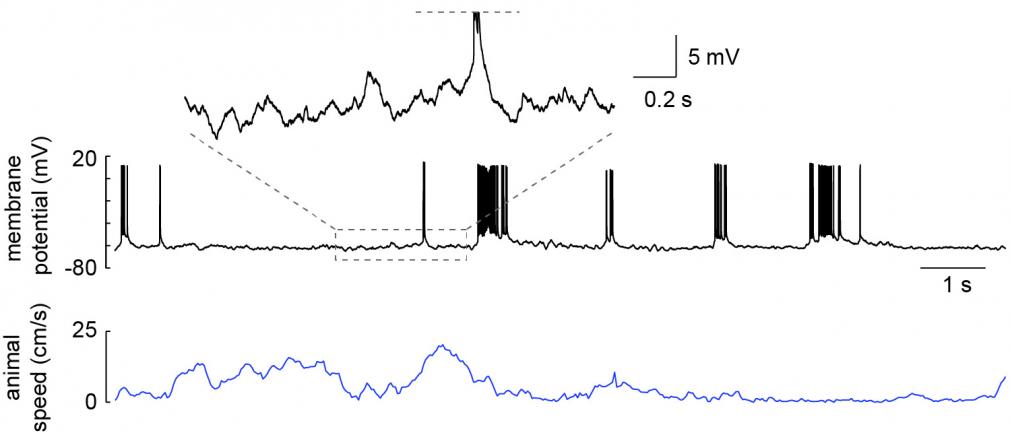
Whole-cell recording of an anatomically-identified hippocampal CA1 pyramidal neuron from a freely moving rat. Bottom panels show simultaneous records of subthreshold membrane potential (inset: action potential triplet with scale bars 20 mV and 10 ms) and behavioral activity (speed of head movement).
We use extracellular recording to monitor the simultaneous activity of large numbers of neurons from several brain areas while an animal learns biologically-relevant tasks. This allows us to get an overall picture of the neural circuits underlying these behaviors. In order to monitor and manipulate the activity of a single neuron in much greater detail, we have developed and continue to develop methods to do intracellular recording in freely moving animals. This allows us to more directly study the cellular and synaptic mechanisms of learning during behavior.
The primary focus of the lab is the neural basis of learning and memory. In particular, we study hippocampal and reward-related spatial learning in rodents. Both are immensely rich topics that should provide fundamental insights into the foundations of mammalian behavior. Our approach mainly involves two electrophysiological methods that complement each other: whole-cell intracellular and multiple-single-unit extracellular recording in freely behaving rats and mice. With multielectrode extracellular recording we can follow the simultaneous activity of many neurons from several brain areas for weeks as an animal learns and then retrieves specific memories. In vivo whole-cell recording in freely moving rats, a new technique that I developed with Professor Michael Brecht (Humboldt University, Berlin) and Dr. Jérôme Epsztein (INMED-INSERM, Marseille), provides an unprecedented ability to measure and manipulate an individual neuron as an animal learns (Lee et al. 2006, Lee et al. 2009, Epsztein et al. 2010, Epsztein et al. 2011). It also allows one to connect neural activity during behavior to the recorded cell’s specific anatomy. More generally, this technique can bring two large areas of neuroscience closer together: in vitro cellular/molecular studies of neuronal integration and plasticity on the one hand, and behavioral and extracellular studies of animals engaged in learning and memory tasks on the other (Epsztein et al. 2011).
The hippocampus is a brain region that has been shown to be crucial for both the formation of episodic memories (i.e., memories of events from daily life) in humans, and spatial learning (i.e., learning the layout of a given environment) in rodents. Recent electrophysiological recordings in the human hippocampus have revealed neurons that fire in a highly specific manner for famous people and objects (Quiroga et al. 2005). This sparse coding bears a striking resemblance to that of the well-known rodent hippocampal place cells (which fire selectively when the animal is in a particular location of an environment), thus adding new significance to the study of place cells as an animal model of human hippocampal-dependent memory. Previously, in the laboratory of Professor Matthew Wilson, I studied sequence learning across populations of place cells recorded extracellularly in freely moving rats (Lee and Wilson 2002), employing multiple spike train analysis methods that I developed for this purpose (Lee and Wilson 2004). Similar phenomena could underlie human episodic memory encoding. To make this connection more explicit, a rodent learning a temporal sequence of places by linking a set of place cells could be homologous to a human encoding an experience consisting of a sequence of items each represented by a small group of hippocampal cells (e.g., enter restaurant, notice famous person, meet friends, sit at corner table).
However, to really get at the cellular/synaptic mechanisms of hippocampal learning requires more detailed measurement and control of place cells than is possible with extracellular recording. Whole-cell recording in freely moving rodents allow us to measure the subthreshold membrane potential activity associated with place cells. Since subthreshold activity reflects the synaptic inputs to a cell better than spiking (which represents the cell’s output) does, we can more directly measure the synaptic plasticity correlates of hippocampal learning as the animal actually forms spatial memories (Epsztein et al. 2011). Furthermore, by stimulating or suppressing spiking in the recorded cell (through whole-cell current injection), we can directly test various proposed mechanisms of synaptic plasticity, such as those that do or do not depend on postsynaptic spiking.
Ultimately, hippocampal spatial learning serves the survival needs of the animal. Learning in order to successfully obtain rewards is clearly a key part of this. Thus we use extracellular recording of populations of neurons from hippocampal and reward-related brain areas to study changes in neural activity over timescales of up to several weeks as a rodent learns natural, biologically-relevant tasks. Through collaborations with other Janelia researchers, we can complement our recordings with techniques such as activation and inactivation of specific parts of the circuits underlying these behaviors. The hope is that the basic interactions between these regions will be common to both rodents and humans.
A major focus of the lab is the further technical development of whole-cell recording in freely moving rodents. We have previously demonstrated that our current method can yield high-quality whole-cell recordings of remarkable stability that last for up to an hour in freely moving animals (Lee et al. 2006). However, as it is a new technique, it is still difficult to perform, so the first task is to improve the success rate and make it easier to use. The long-term technical goal is to make it a standard tool for cellular/synaptic studies of behavior, thus more directly linking in vitro and in vivo research. In addition to our studies of hippocampal learning mechanisms, we and our colleagues will be able to answer fundamental questions about basic cell physiology properties and synaptic integration in different types of anatomically identified neurons from various brain areas during natural behaviors (Epsztein et al. 2011). Janelia Farm provides an ideal environment for pursuing the development of new techniques for neuroscience through its excellent infrastructure and support, stated research goals, and array of highly talented scientists.
-
-
Albert Lee Lab Head
-
Jeremy Cohen Postdoctoral Associate
-
Min Ji Kim Research Staff
-
Doyun Lee Postdoctoral Associate
-
Hua-Peng Liaw Research Staff
-
Bei-Jung Lin Research Staff
-
Dylan Rich Graduate Student
-
Heather Davies
Janelia Publications
The origin of the spatial receptive fields of hippocampal place cells has not been established. A hippocampal CA1 pyramidal cell receives thousands of synaptic inputs, mostly from other spatially tuned neurons; however, how the postsynaptic neuron's cellular properties determine the response to these inputs during behavior is unknown. We discovered that, contrary to expectations from basic models of place cells and neuronal integration, a small, spatially uniform depolarization of the spatially untuned somatic membrane potential of a silent cell leads to the sudden and reversible emergence of a spatially tuned subthreshold response and place-field spiking. Such gating of inputs by postsynaptic neuronal excitability reveals a cellular mechanism for receptive field origin and may be critical for the formation of hippocampal memory representations.
Related Links
Electrophysiological recordings from behaving animals provide an unparalleled view into the functional role of individual neurons. Intracellular approaches can be especially revealing as they provide information about a neuron's inputs and intrinsic cellular properties, which together determine its spiking output. Recent technical developments have made intracellular recording possible during an ever-increasing range of behaviors in both head-fixed and freely moving animals. These recordings have yielded fundamental insights into the cellular and circuit mechanisms underlying neural activity during natural behaviors in such areas as sensory perception, motor sequence generation, and spatial navigation, forging a direct link between cellular and systems neuroscience.
Related Links
For each environment a rodent has explored, its hippocampus contains a map consisting of a unique subset of neurons, called place cells, that have spatially tuned spiking there, with the remaining neurons being essentially silent. Using whole-cell recording in freely moving rats exploring a novel maze, we observed differences in intrinsic cellular properties and input-based subthreshold membrane potential levels underlying this division into place and silent cells. Compared to silent cells, place cells had lower spike thresholds and peaked versus flat subthreshold membrane potentials as a function of animal location. Both differences were evident from the beginning of exploration. Additionally, future place cells exhibited higher burst propensity before exploration. Thus, internal settings appear to predetermine which cells will represent the next novel environment encountered. Furthermore, place cells fired spatially tuned bursts with large, putatively calcium-mediated depolarizations that could trigger plasticity and stabilize the new map for long-term storage. Our results provide new insight into hippocampal memory formation.
Related Links
Prior Publications (5)
In vivo intracellular recordings of hippocampal neurons reveal the occurrence of fast events of small amplitude called spikelets or fast prepotentials. Because intracellular recordings have been restricted to anesthetized or head-fixed animals, it is not known how spikelet activity contributes to hippocampal spatial representations. We addressed this question in CA1 pyramidal cells by using in vivo whole-cell recording in freely moving rats. We observed a high incidence of spikelets that occurred either in isolation or in bursts and could drive spiking as fast prepotentials of action potentials. Spikelets strongly contributed to spiking activity, driving approximately 30% of all action potentials. CA1 pyramidal cell firing and spikelet activity were comodulated as a function of the animal's location in the environment. We conclude that spikelets have a major impact on hippocampal activity during spatial exploration.
Related Links
Intracellular recordings are routinely used to study the synaptic and intrinsic properties of neurons in vitro. A key requirement for these recordings is a mechanically very stable preparation; thus their use in vivo had been limited previously to head-restrained animals. We have recently demonstrated that anchoring the electrode rigidly in place with respect to the skull provides sufficient stabilization for long-lasting, high-quality whole-cell recordings in awake, freely moving rats. This protocol describes our procedure in detail, adds specific instructions for targeting hippocampal CA1 pyramidal neurons and updates it with changes that facilitate patching and improve the success rate. The changes involve combining a standard, nonhead-mounted micromanipulator with a gripper to firmly hold the recording pipette during the anchoring process then gently release it afterwards. The procedure from the beginning of surgery to the end of a recording takes approximately 5 h. This technique allows new studies of the mechanisms underlying neuronal integration and cellular/synaptic plasticity in identified cells during natural behaviors.
Related Links
Intracellular recording, which allows direct measurement of the membrane potential and currents of individual neurons, requires a very mechanically stable preparation and has thus been limited to in vitro and head-immobilized in vivo experiments. This restriction constitutes a major obstacle for linking cellular and synaptic physiology with animal behavior. To overcome this limitation we have developed a method for performing whole-cell recordings in freely moving rats. We constructed a miniature head-mountable recording device, with mechanical stabilization achieved by anchoring the recording pipette rigidly in place after the whole-cell configuration is established. We obtain long-duration recordings (mean of approximately 20 min, maximum 60 min) in freely moving animals that are remarkably insensitive to mechanical disturbances, then reconstruct the anatomy of the recorded cells. This head-anchored whole-cell recording technique will enable a wide range of new studies involving detailed measurement and manipulation of the physiological properties of identified cells during natural behaviors.
Related Links
Information processing in the brain is believed to require coordinated activity across many neurons. With the recent development of techniques for simultaneously recording the spiking activity of large numbers of individual neurons, the search for complex multicell firing patterns that could help reveal this neural code has become possible. Here we develop a new approach for analyzing sequential firing patterns involving an arbitrary number of neurons based on relative firing order. Specifically, we develop a combinatorial method for quantifying the degree of matching between a "reference sequence" of N distinct "letters" (representing a particular target order of firing by N cells) and an arbitrarily long "word" composed of any subset of those letters including repeats (representing the relative time order of spikes in an arbitrary firing pattern). The method involves computing the probability that a random permutation of the word's letters would by chance alone match the reference sequence as well as or better than the actual word does, assuming all permutations were equally likely. Lower probabilities thus indicate better matching. The overall degree and statistical significance of sequence matching across a heterogeneous set of words (such as those produced during the course of an experiment) can be computed from the corresponding set of probabilities. This approach can reduce the sample size problem associated with analyzing complex firing patterns. The approach is general and thus applicable to other types of neural data beyond multiple spike trains, such as EEG events or imaging signals from multiple locations. We have recently applied this method to quantify memory traces of sequential experience in the rodent hippocampus during slow wave sleep.
Related Links
Rats repeatedly ran through a sequence of spatial receptive fields of hippocampal CA1 place cells in a fixed temporal order. A novel combinatorial decoding method reveals that these neurons repeatedly fired in precisely this order in long sequences involving four or more cells during slow wave sleep (SWS) immediately following, but not preceding, the experience. The SWS sequences occurred intermittently in brief ( approximately 100 ms) bursts, each compressing the behavioral sequence in time by approximately 20-fold. This rapid encoding of sequential experience is consistent with evidence that the hippocampus is crucial for spatial learning in rodents and the formation of long-term memories of events in time in humans.