
Simpson Lab
We use genetic tools and screening strategies to identify the specific neurons necessary and sufficient to control grooming and feeding, behaviors which were chosen for their sequential progression and cue integration properties. Detailed mapping of the circuits that govern these specific behaviors in flies may reveal common architectural principles that help explain how human brains produce a diverse repertoire of appropriate behavior in response to internal state and external stimuli.
But a fly only extends its mouthparts when it is hungry, and when the sweet taste is not accompanied by a bitter one. The neurons that integrate several sensory inputs and internal state information have not yet been found. Activating the mechanosensory neurons at the base of bristles can trigger a scratch reflex, but activating many bristles results in an ordered series of leg sweeps and rubs designed to remove debris from the eyes and head, followed by the wings and body. The motor neurons required to perform grooming movements may also be critical for walking. How they are organized to perform different tasks in different contexts is not known.
The fly brain has a lot of terra incognita – areas whose behavioral functions are undiscovered. The anatomical regions relevant for many behaviors are not known. The way a given behavior can be disrupted is often informative, even if the neural circuit or cause is not yet known. We identify the neurons needed for particular behaviors, rather than the genes, using the plethora of genetic tools available in Drosophila to target, manipulate, and image neurons. We also mirror the tradition of unbiased genetics screens in that we test the potential role of many different groups of neurons (using the large Rubin GAL4 collection and others) and allow the results to suggest which brain regions are relevant. This approach provides entry points into the circuits, from which we can then search anatomically for potentially connected neurons.
Grooming
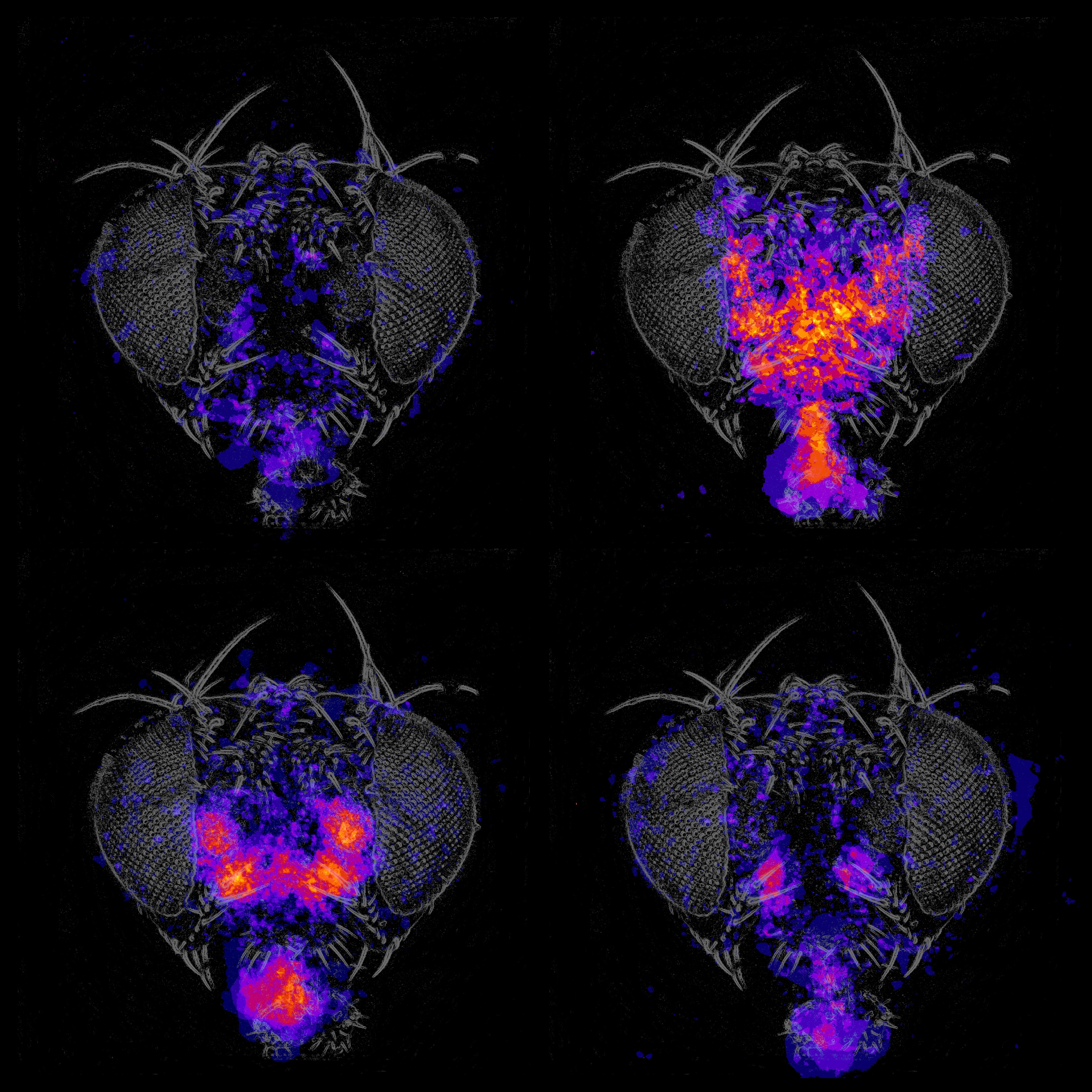
Flies remove dust from their bodies in an orderly way, starting from their eyes and proceeding to their heads, wings, and abdomens. This progression is likely influenced by mechanosensory feedback. The data from our observation of grooming behavior in normal flies and in flies where the activity of different groups of neurons has been altered supports the idea that grooming is made up of small reflex modules or subroutines linked together. We are identifying the neurons that control the reflex components and the neurons that coordinate them to produce the grooming behavioral sequence. Contrasting the way behavioral sequences are produced for courtship and grooming may be particularly informative.
Feeding and Proboscis Extension
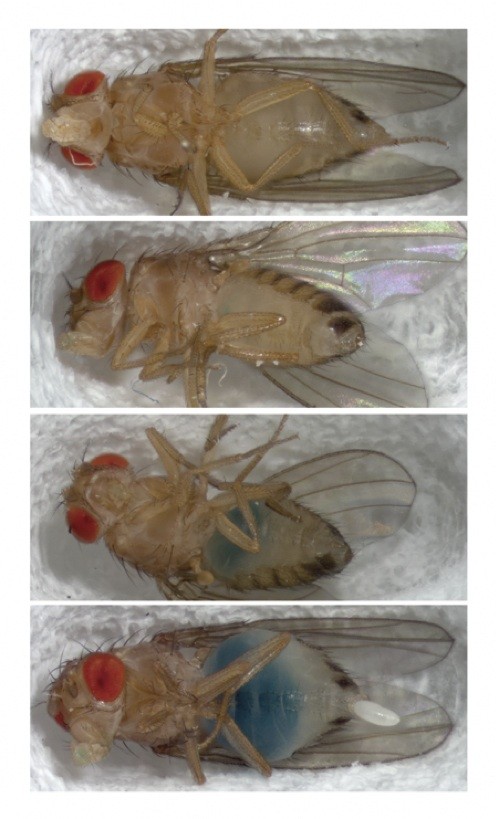
Flies eat when they are hungry and good food is available. Generally they do not eat more than they need. We want to identify neurons that can stimulate feeding in sated flies to map the brain areas that detect metabolic state and encode hunger. We will explore where the external sensory cues (sweet and bitter taste) are integrated with the internal metabolic state cues to activate the motor program of the proboscis extension reflex (PER).
PER is activated during feeding and drinking, but it can also be evoked during courtship or in response to aversive stimuli. We are investigating how these sensory stimuli converge on what we think is a common program to control this motor behavior. The motor program itself contains 32 motor neurons and 12 muscles that function in a coordinated manner to extend and retract the proboscis. While the motor neurons are known by traditional anatomical techniques, the ability to alter activity in particular neurons is recent and allows us to study how this motor program is generated.
Courtship Song Circuits
Male Drosophila melanogaster produce courtship song by vibrating their wings at 160Hz (sine) and 260Hz (pulse). The male-specific isoform of Fruitless marks many of the neurons necessary and sufficient for this behavior, but other components of the song circuit remain elusive. Although the basic nature of the song is innate, some aspects may be modified by experience, sensory feedback, or social context. We are analyzing the song structure and identifying neurons that drive song production as another example of how neural circuits produce behavioral sequences.
Tool Development: dBrainbow and BrainAligner
We are screening for neurons necessary and sufficient for behaviors, not the genes. This requires tools to manipulate specific populations of neurons. Initially we used enhancer trapping to generate collections of GAL4, GAL80, and LexA lines that we use to target neural activators and inhibitors to different brain regions. Now we primarily use the defined enhancer GAL4 and split-GAL4 collections established by the Rubin lab. We are building additional reagents to manipulate different types of neurons and are developing a web site to display and query the expression patterns of our lines.
We adapted the vertebrate Brainbow technique for labeling neurons in different colors to visualize lineages and individual neurons within our GAL4 expression patterns (Nature Methods 2011).
In collaboration with Hanchuan Peng and Gene Myers, we developed the BrainAligner for automatically registering confocal images of fly brains onto a common coordinate system. This allows us to generate an atlas of all our GAL4 expression patterns to identify lines that target particular brain regions. We use this to make predictions about anatomical correlation with behavioral function and connectivity (Submitted 2010).
Collaborations
The Simpson lab participates in the Drosophila Interests Group (a joint lab meeting of the 10 fly labs at Janelia) and the Behavior Interest Group (an occasional meeting of the Janelia neuroethology community). We are also part of two project teams, FlyLight and the FlyOlympiad. There is a coordinated effort to “Understand the Fly Brain” at Janelia, using light microscopy, electron microscopy, and large-scale quantitative behavioral analysis. My lab and I participate actively in this joint effort.
We understand that functional and anatomical mapping of the fly brain is an ambitious task, and we hope that our efforts will contribute to the larger community-wide endeavor. The anatomical images, circuit maps, and genetic tools we make can be used to address a broad range of scientific questions well beyond those we focus on in one lab. We feel strongly that tools are improved by sharing and we freely distribute the reagents we make. We look forward to hearing from anyone interested in our research.
Collaborators
-
-
Julie Simpson Lab Head
-
Stephanie Albin Postdoctoral Associate
-
Matthew Britton
-
Phuong Chung Research Staff
-
Stefanie Hampel Research Staff
-
Jon-Michael Knapp Research Staff
-
Claire McKellar Postdoctoral Associate
-
Primoz Ravbar Postdoctoral Associate
-
Andrew Seeds Research Staff
-
Emily Willis
Janelia Publications
Research in the fruit fly Drosophila melanogaster has led to insights in neural development, axon guidance, ion channel function, synaptic transmission, learning and memory, diurnal rhythmicity, and neural disease that have had broad implications for neuroscience. Drosophila is currently the eukaryotic model organism that permits the most sophisticated in vivo manipulations to address the function of neurons and neuronally expressed genes. Here, we summarize many of the techniques that help assess the role of specific neurons by labeling, removing, or altering their activity. We also survey genetic manipulations to identify and characterize neural genes by mutation, overexpression, and protein labeling. Here, we attempt to acquaint the reader with available options and contexts to apply these methods.
Analyzing Drosophila melanogaster neural expression patterns in thousands of three-dimensional image stacks of individual brains requires registering them into a canonical framework based on a fiducial reference of neuropil morphology. Given a target brain labeled with predefined landmarks, the BrainAligner program automatically finds the corresponding landmarks in a subject brain and maps it to the coordinate system of the target brain via a deformable warp. Using a neuropil marker (the antibody nc82) as a reference of the brain morphology and a target brain that is itself a statistical average of data for 295 brains, we achieved a registration accuracy of 2 μm on average, permitting assessment of stereotypy, potential connectivity and functional mapping of the adult fruit fly brain. We used BrainAligner to generate an image pattern atlas of 2954 registered brains containing 470 different expression patterns that cover all the major compartments of the fly brain.
We developed a multicolor neuron labeling technique in Drosophila melanogaster that combines the power to specifically target different neural populations with the label diversity provided by stochastic color choice. This adaptation of vertebrate Brainbow uses recombination to select one of three epitope-tagged proteins detectable by immunofluorescence. Two copies of this construct yield six bright, separable colors. We used Drosophila Brainbow to study the innervation patterns of multiple antennal lobe projection neuron lineages in the same preparation and to observe the relative trajectories of individual aminergic neurons. Nerve bundles, and even individual neurites hundreds of micrometers long, can be followed with definitive color labeling. We traced motor neurons in the subesophageal ganglion and correlated them to neuromuscular junctions to identify their specific proboscis muscle targets. The ability to independently visualize multiple lineage or neuron projections in the same preparation greatly advances the goal of mapping how neurons connect into circuits.
Automatic alignment (registration) of 3D images of adult fruit fly brains is often influenced by the significant displacement of the relative locations of the two optic lobes (OLs) and the center brain (CB). In one of our ongoing efforts to produce a better image alignment pipeline of adult fruit fly brains, we consider separating CB and OLs and align them independently. This paper reports our automatic method to segregate CB and OLs, in particular under conditions where the signal to noise ratio (SNR) is low, the variation of the image intensity is big, and the relative displacement of OLs and CB is substantial. We design an algorithm to find a minimum-cost 3D surface in a 3D image stack to best separate an OL (of one side, either left or right) from CB. This surface is defined as an aggregation of the respective minimum-cost curves detected in each individual 2D image slice. Each curve is defined by a list of control points that best segregate OL and CB. To obtain the locations of these control points, we derive an energy function that includes an image energy term defined by local pixel intensities and two internal energy terms that constrain the curve's smoothness and length. Gradient descent method is used to optimize this energy function. To improve both the speed and robustness of the method, for each stack, the locations of optimized control points in a slice are taken as the initialization prior for the next slice. We have tested this approach on simulated and real 3D fly brain image stacks and demonstrated that this method can reasonably segregate OLs from CBs despite the aforementioned difficulties.
The V3D system provides three-dimensional (3D) visualization of gigabyte-sized microscopy image stacks in real time on current laptops and desktops. V3D streamlines the online analysis, measurement and proofreading of complicated image patterns by combining ergonomic functions for selecting a location in an image directly in 3D space and for displaying biological measurements, such as from fluorescent probes, using the overlaid surface objects. V3D runs on all major computer platforms and can be enhanced by software plug-ins to address specific biological problems. To demonstrate this extensibility, we built a V3D-based application, V3D-Neuron, to reconstruct complex 3D neuronal structures from high-resolution brain images. V3D-Neuron can precisely digitize the morphology of a single neuron in a fruitfly brain in minutes, with about a 17-fold improvement in reliability and tenfold savings in time compared with other neuron reconstruction tools. Using V3D-Neuron, we demonstrate the feasibility of building a 3D digital atlas of neurite tracts in the fruitfly brain.
The role of gamma amino butyric acid (GABA) release and inhibitory neurotransmission in regulating most behaviors remains unclear. The vesicular GABA transporter (VGAT) is required for the storage of GABA in synaptic vesicles and provides a potentially useful probe for inhibitory circuits. However, specific pharmacologic agents for VGAT are not available, and VGAT knockout mice are embryonically lethal, thus precluding behavioral studies. We have identified the Drosophila ortholog of the vesicular GABA transporter gene (which we refer to as dVGAT), immunocytologically mapped dVGAT protein expression in the larva and adult and characterized a dVGAT(minos) mutant allele. dVGAT is embryonically lethal and we do not detect residual dVGAT expression, suggesting that it is either a strong hypomorph or a null. To investigate the function of VGAT and GABA signaling in adult visual flight behavior, we have selectively rescued the dVGAT mutant during development. We show that reduced GABA release does not compromise the active optomotor control of wide-field pattern motion. Conversely, reduced dVGAT expression disrupts normal object tracking and figure-ground discrimination. These results demonstrate that visual behaviors are segregated by the level of GABA signaling in flies, and more generally establish dVGAT as a model to study the contribution of GABA release to other complex behaviors.
Drosophila is a marvelous system to study the underlying principles that govern how neural circuits govern behaviors. The scale of the fly brain (approximately 100,000 neurons) and the complexity of the behaviors the fly can perform make it a tractable experimental model organism. In addition, 100 years and hundreds of labs have contributed to an extensive array of tools and techniques that can be used to dissect the function and organization of the fly nervous system. This review discusses both the conceptual challenges and the specific tools for a neurogenetic approach to circuit mapping in Drosophila.
Prior Publications (2)
Previous studies showed that Roundabout (Robo) in Drosophila is a repulsive axon guidance receptor that binds to Slit, a repellent secreted by midline glia. In robo mutants, growth cones cross and recross the midline, while, in slit mutants, growth cones enter the midline but fail to leave it. This difference suggests that Slit must have more than one receptor controlling midline guidance. In the absence of Robo, some other Slit receptor ensures that growth cones do not stay at the midline, even though they cross and recross it. Here we show that the Drosophila genome encodes three Robo receptors and that Robo and Robo2 have distinct functions, which together control repulsive axon guidance at the midline. The robo,robo2 double mutant is largely identical to slit.
Slit is secreted by midline glia in Drosophila and functions as a short-range repellent to control midline crossing. Although most Slit stays near the midline, some diffuses laterally, functioning as a long-range chemorepellent. Here we show that a combinatorial code of Robo receptors controls lateral position in the CNS by responding to this presumptive Slit gradient. Medial axons express only Robo, intermediate axons express Robo3 and Robo, while lateral axons express Robo2, Robo3, and Robo. Removal of robo2 or robo3 causes lateral axons to extend medially; ectopic expression of Robo2 or Robo3 on medial axons drives them laterally. Precise topography of longitudinal pathways appears to be controlled by a combination of long-range guidance (the Robo code determining region) and short-range guidance (discrete local cues determining specific location within a region).
Janelia Positions
Funded post-doc positions may be available. We are especially interested in people with expertise in the following areas:
1. Functional Imaging
2. Behavioral Analysis
3. Central Pattern Generators
For more information or to apply, please Email Dr. Julie Simpson.
To apply, please send your CV and include three references. In the subject line, include the word "Postdoc". If you have specific salary requirements, please include them in your e-mail; all information is confidential. HHMI is an equal opportunity employer.
We also have one graduate student position available. More information on the graduate program is available online.
All information is confidential. HHMI is an equal opportunity employer.


