
Filter
Associated Lab
- Aguilera Castrejon Lab (19) Apply Aguilera Castrejon Lab filter
- Ahrens Lab (75) Apply Ahrens Lab filter
- Aso Lab (42) Apply Aso Lab filter
- Baker Lab (38) Apply Baker Lab filter
- Betzig Lab (116) Apply Betzig Lab filter
- Beyene Lab (15) Apply Beyene Lab filter
- Bock Lab (17) Apply Bock Lab filter
- Branson Lab (56) Apply Branson Lab filter
- Card Lab (43) Apply Card Lab filter
- Cardona Lab (64) Apply Cardona Lab filter
- Chklovskii Lab (13) Apply Chklovskii Lab filter
- Clapham Lab (16) Apply Clapham Lab filter
- Cui Lab (19) Apply Cui Lab filter
- Darshan Lab (12) Apply Darshan Lab filter
- Dennis Lab (3) Apply Dennis Lab filter
- Dickson Lab (46) Apply Dickson Lab filter
- Druckmann Lab (25) Apply Druckmann Lab filter
- Dudman Lab (58) Apply Dudman Lab filter
- Eddy/Rivas Lab (30) Apply Eddy/Rivas Lab filter
- Egnor Lab (11) Apply Egnor Lab filter
- Espinosa Medina Lab (25) Apply Espinosa Medina Lab filter
- Feliciano Lab (16) Apply Feliciano Lab filter
- Fetter Lab (41) Apply Fetter Lab filter
- FIB-SEM Technology (1) Apply FIB-SEM Technology filter
- Fitzgerald Lab (30) Apply Fitzgerald Lab filter
- Freeman Lab (15) Apply Freeman Lab filter
- Funke Lab (46) Apply Funke Lab filter
- Gonen Lab (91) Apply Gonen Lab filter
- Grigorieff Lab (62) Apply Grigorieff Lab filter
- Harris Lab (65) Apply Harris Lab filter
- Heberlein Lab (94) Apply Heberlein Lab filter
- Hermundstad Lab (32) Apply Hermundstad Lab filter
- Hess Lab (80) Apply Hess Lab filter
- Ilanges Lab (4) Apply Ilanges Lab filter
- Jayaraman Lab (49) Apply Jayaraman Lab filter
- Ji Lab (33) Apply Ji Lab filter
- Johnson Lab (7) Apply Johnson Lab filter
- Kainmueller Lab (19) Apply Kainmueller Lab filter
- Karpova Lab (15) Apply Karpova Lab filter
- Keleman Lab (13) Apply Keleman Lab filter
- Keller Lab (77) Apply Keller Lab filter
- Koay Lab (20) Apply Koay Lab filter
- Lavis Lab (162) Apply Lavis Lab filter
- Lee (Albert) Lab (34) Apply Lee (Albert) Lab filter
- Leonardo Lab (23) Apply Leonardo Lab filter
- Li Lab (32) Apply Li Lab filter
- Lippincott-Schwartz Lab (182) Apply Lippincott-Schwartz Lab filter
- Liu (Yin) Lab (9) Apply Liu (Yin) Lab filter
- Liu (Zhe) Lab (65) Apply Liu (Zhe) Lab filter
- Looger Lab (138) Apply Looger Lab filter
- Magee Lab (49) Apply Magee Lab filter
- Menon Lab (18) Apply Menon Lab filter
- Murphy Lab (13) Apply Murphy Lab filter
- O'Shea Lab (8) Apply O'Shea Lab filter
- Otopalik Lab (13) Apply Otopalik Lab filter
- Pachitariu Lab (56) Apply Pachitariu Lab filter
- Pastalkova Lab (19) Apply Pastalkova Lab filter
- Pavlopoulos Lab (19) Apply Pavlopoulos Lab filter
- Pedram Lab (15) Apply Pedram Lab filter
- Podgorski Lab (16) Apply Podgorski Lab filter
- Reiser Lab (55) Apply Reiser Lab filter
- Riddiford Lab (44) Apply Riddiford Lab filter
- Romani Lab (52) Apply Romani Lab filter
- Rubin Lab (149) Apply Rubin Lab filter
- Saalfeld Lab (66) Apply Saalfeld Lab filter
- Satou Lab (18) Apply Satou Lab filter
- Scheffer Lab (38) Apply Scheffer Lab filter
- Schreiter Lab (72) Apply Schreiter Lab filter
- Schulze Lab (1) Apply Schulze Lab filter
- Sgro Lab (23) Apply Sgro Lab filter
- Shroff Lab (35) Apply Shroff Lab filter
- Simpson Lab (23) Apply Simpson Lab filter
- Singer Lab (80) Apply Singer Lab filter
- Spruston Lab (98) Apply Spruston Lab filter
- Stern Lab (160) Apply Stern Lab filter
- Sternson Lab (54) Apply Sternson Lab filter
- Stringer Lab (44) Apply Stringer Lab filter
- Svoboda Lab (136) Apply Svoboda Lab filter
- Tebo Lab (36) Apply Tebo Lab filter
- Tervo Lab (10) Apply Tervo Lab filter
- Tillberg Lab (22) Apply Tillberg Lab filter
- Tjian Lab (64) Apply Tjian Lab filter
- Truman Lab (88) Apply Truman Lab filter
- Turaga Lab (53) Apply Turaga Lab filter
- Turner Lab (38) Apply Turner Lab filter
- Vale Lab (8) Apply Vale Lab filter
- Voigts Lab (5) Apply Voigts Lab filter
- Wang (Meng) Lab (31) Apply Wang (Meng) Lab filter
- Wang (Shaohe) Lab (25) Apply Wang (Shaohe) Lab filter
- Wong-Campos Lab (1) Apply Wong-Campos Lab filter
- Wu Lab (9) Apply Wu Lab filter
- Zlatic Lab (28) Apply Zlatic Lab filter
- Zuker Lab (25) Apply Zuker Lab filter
Associated Project Team
- CellMap (13) Apply CellMap filter
- COSEM (3) Apply COSEM filter
- FIB-SEM Technology (5) Apply FIB-SEM Technology filter
- Fly Descending Interneuron (12) Apply Fly Descending Interneuron filter
- Fly Functional Connectome (14) Apply Fly Functional Connectome filter
- Fly Olympiad (5) Apply Fly Olympiad filter
- FlyEM (56) Apply FlyEM filter
- FlyLight (50) Apply FlyLight filter
- GENIE (47) Apply GENIE filter
- Integrative Imaging (11) Apply Integrative Imaging filter
- Larval Olympiad (2) Apply Larval Olympiad filter
- MouseLight (18) Apply MouseLight filter
- NeuroSeq (1) Apply NeuroSeq filter
- ThalamoSeq (1) Apply ThalamoSeq filter
- Tool Translation Team (T3) (29) Apply Tool Translation Team (T3) filter
- Transcription Imaging (49) Apply Transcription Imaging filter
Publication Date
- 2026 (118) Apply 2026 filter
- 2025 (223) Apply 2025 filter
- 2024 (209) Apply 2024 filter
- 2023 (158) Apply 2023 filter
- 2022 (192) Apply 2022 filter
- 2021 (194) Apply 2021 filter
- 2020 (196) Apply 2020 filter
- 2019 (202) Apply 2019 filter
- 2018 (232) Apply 2018 filter
- 2017 (217) Apply 2017 filter
- 2016 (209) Apply 2016 filter
- 2015 (252) Apply 2015 filter
- 2014 (236) Apply 2014 filter
- 2013 (194) Apply 2013 filter
- 2012 (190) Apply 2012 filter
- 2011 (190) Apply 2011 filter
- 2010 (161) Apply 2010 filter
- 2009 (158) Apply 2009 filter
- 2008 (140) Apply 2008 filter
- 2007 (106) Apply 2007 filter
- 2006 (92) Apply 2006 filter
- 2005 (67) Apply 2005 filter
- 2004 (57) Apply 2004 filter
- 2003 (58) Apply 2003 filter
- 2002 (39) Apply 2002 filter
- 2001 (28) Apply 2001 filter
- 2000 (29) Apply 2000 filter
- 1999 (14) Apply 1999 filter
- 1998 (18) Apply 1998 filter
- 1997 (16) Apply 1997 filter
- 1996 (10) Apply 1996 filter
- 1995 (18) Apply 1995 filter
- 1994 (12) Apply 1994 filter
- 1993 (10) Apply 1993 filter
- 1992 (6) Apply 1992 filter
- 1991 (11) Apply 1991 filter
- 1990 (11) Apply 1990 filter
- 1989 (6) Apply 1989 filter
- 1988 (1) Apply 1988 filter
- 1987 (7) Apply 1987 filter
- 1986 (4) Apply 1986 filter
- 1985 (5) Apply 1985 filter
- 1984 (2) Apply 1984 filter
- 1983 (2) Apply 1983 filter
- 1982 (3) Apply 1982 filter
- 1981 (3) Apply 1981 filter
- 1980 (1) Apply 1980 filter
- 1979 (1) Apply 1979 filter
- 1976 (2) Apply 1976 filter
- 1973 (1) Apply 1973 filter
- 1970 (1) Apply 1970 filter
- 1967 (1) Apply 1967 filter
Type of Publication
4313 Publications
Showing 1571-1580 of 4313 resultsRegulation of food intake in mammals is complex and controlled by an interplay between hedonic and homeostatic signals, including hormones like leptin, which senses fat storage and suppresses food intake. lack leptin and leptin receptors but still exhibit controlled eating. Here, we show that in eating can be regulated by a balance between saturated and monounsaturated fatty acids interacting with transcriptional pathways regulating lipid synthesis, c-AMP response element binding protein and AMP kinase. This effect is mediated at the endoplasmic reticulum through formation of phospholipids and activation of the IRE-1 sensor in the nervous system, which controls behavior through neuronal serotonin and the G-protein-coupled ligand/receptor pair PDF-1/PDFR-1. We show that this peptide/receptor pair may be an ancestral precursor of the whole family of GLP-1/GIP-related peptides and their receptors. Indeed, administration of a 37 amino acid peptide derived from PDF-1 resulted in a reduction in body weight and improved insulin sensitivity in mice. In worms, signaling through this pathway induced food-leaving behavior on concentrated food and roaming behavior on dispersed food, a state we have termed "food-apathy," paralleling pharmacologic effects of GLP-1/GIP-related peptides in humans. These findings highlight the potential evolutionary origin of this family of hormones and their receptors, and its link to metabolic and neuronal responses in control of feeding behavior.
Fatty acids (FAs) provide cellular energy under starvation, yet how they mobilize and move into mitochondria in starved cells, driving oxidative respiration, is unclear. Here, we clarify this process by visualizing FA trafficking with a fluorescent FA probe. The labeled FA accumulated in lipid droplets (LDs) in well-fed cells but moved from LDs into mitochondria when cells were starved. Autophagy in starved cells replenished LDs with FAs, increasing LD number over time. Cytoplasmic lipases removed FAs from LDs, enabling their transfer into mitochondria. This required mitochondria to be highly fused and localized near LDs. When mitochondrial fusion was prevented in starved cells, FAs neither homogeneously distributed within mitochondria nor became efficiently metabolized. Instead, FAs reassociated with LDs and fluxed into neighboring cells. Thus, FAs engage in complex trafficking itineraries regulated by cytoplasmic lipases, autophagy, and mitochondrial fusion dynamics, ensuring maximum oxidative metabolism and avoidance of FA toxicity in starved cells.
Focal cortical dysplasia (FCD) is a leading cause of drug-resistant focal epilepsy, especially in children. However, up to 30−40% of FCD lesions are “MRI-negative,” eluding visual detection on standard scans. Even expert neuroradiologists miss about one-third of these subtle lesions. Prior automated FCD detection approaches have shown promise but face important limitations. Conventional morphometry pipelines (e.g., FreeSurfer-based thickness or junction maps) rely on hand-tuned thresholds and often struggle with small cohorts and site-specific bias. Voxel-level deep learning methods, including 3D CNN and transformer models, can improve sensitivity but tend to produce excessive false positives and lack interpretability. In this work, we propose FCDNets, a graph neural network (GNN) that learns from multi-contrast MRI cortical surface maps to detect FCD lesions. Trained using only open-access MRI datasets (85 patients and 85 controls from OpenNeuro ds004199; 101 patients and 177 controls from MELD-Public), FCDNets achieves vertex-level AUROC 0.975±0.006, lesion Dice 0.64±0.12, and 82% patient sensitivity at ≤5 cm2 false-positive cortex in cross-site five-fold CV. Compared with a 3-D CNN baseline, FCDNets yields +28 percentage points higher sensitivity (82 % vs. 54 %) and 45 % fewer false-positive clusters (0.9 vs. 1.6). On MELD-Public, it maintains AUROC 0.782 and 63% sensitivity. The surface-based approach produces interpretable lesion probability maps aligned with known FCD imaging biomarkers. This open, multi-center study demonstrates the potential of surface-GNNs to aid in localizing subtle epileptogenic lesions that were previously MRIoccult, which may accelerate diagnosis and surgical treatment for drug-resistant epilepsy.
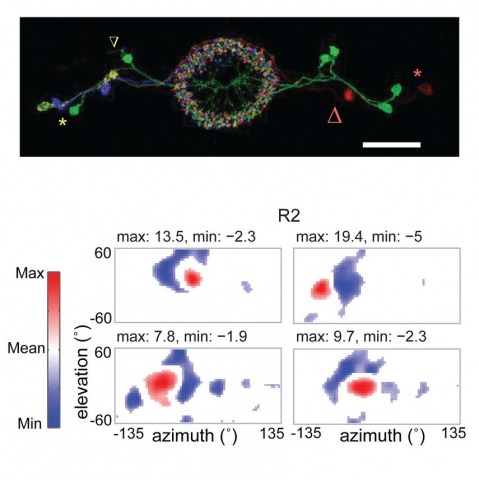
Many animals, including insects, are known to use visual landmarks to orient in their environment. In Drosophila melanogaster, behavioural genetics studies have identified a higher brain structure called the central complex as being required for the fly’s innate responses to vertical visual features and its short- and long-term memory for visual patterns. But whether and how neurons of the fly central complex represent visual features are unknown. Here we use two-photon calcium imaging in head-fixed walking and flying flies to probe visuomotor responses of ring neurons—a class of central complex neurons that have been implicated in landmark-driven spatial memory in walking flies and memory for visual patterns in tethered flying flies. We show that dendrites of ring neurons are visually responsive and arranged retinotopically. Ring neuron receptive fields comprise both excitatory and inhibitory subfields, resembling those of simple cells in the mammalian primary visual cortex. Ring neurons show strong and, in some cases, direction-selective orientation tuning, with a notable preference for vertically oriented features similar to those that evoke innate responses in flies. Visual responses were diminished during flight, but, in contrast with the hypothesized role of the central complex in the control of locomotion, not modulated during walking. Taken together, these results indicate that ring neurons represent behaviourally relevant visual features in the fly’s environment, enabling downstream central complex circuits to produce appropriate motor commands. More broadly, this study opens the door to mechanistic investigations of circuit computations underlying visually guided action selection in the Drosophila central complex.
Animals rely on dedicated sensory circuits to extract and encode environmental features. How individual neurons integrate and translate these features into behavioral responses remains a major question. Here, we identify a visual projection neuron type that conveys predator approach information to the Drosophila giant fiber (GF) escape circuit. Genetic removal of this input during looming stimuli reveals that it encodes angular expansion velocity, whereas other input cell type(s) encode angular size. Motor program selection and timing emerge from linear integration of these two features within the GF. Linear integration improves size detection invariance over prior models and appropriately biases motor selection to rapid, GF-mediated escapes during fast looms. Our findings suggest feature integration, and motor control may occur as simultaneous operations within the same neuron and establish the Drosophila escape circuit as a model system in which these computations may be further dissected at the circuit level.
Feature selection is an important problem for pattern classification systems. We study how to select good features according to the maximal statistical dependency criterion based on mutual information. Because of the difficulty in directly implementing the maximal dependency condition, we first derive an equivalent form, called minimal-redundancy-maximal-relevance criterion (mRMR), for first-order incremental feature selection. Then, we present a two-stage feature selection algorithm by combining mRMR and other more sophisticated feature selectors (e.g., wrappers). This allows us to select a compact set of superior features at very low cost. We perform extensive experimental comparison of our algorithm and other methods using three different classifiers (naive Bayes, support vector machine, and linear discriminate analysis) and four different data sets (handwritten digits, arrhythmia, NCI cancer cell lines, and lymphoma tissues). The results confirm that mRMR leads to promising improvement on feature selection and classification accuracy.
During courtship males attract females with elaborate behaviors. In mice, these displays include ultrasonic vocalizations. Ultrasonic courtship vocalizations were previously attributed to the courting male, despite evidence that both sexes produce virtually indistinguishable vocalizations. Because of this similarity, and the difficulty of assigning vocalizations to individuals, the vocal contribution of each individual during courtship is unknown. To address this question, we developed a microphone array system to localize vocalizations from socially interacting, individual adult mice. With this system, we show that female mice vocally interact with males during courtship. Males and females jointly increased their vocalization rates during chases. Furthermore, a female's participation in these vocal interactions may function as a signal that indicates a state of increased receptivity. Our results reveal a novel form of vocal communication during mouse courtship, and lay the groundwork for a mechanistic dissection of communication during social behavior.
The formation of complex but highly organized neural circuits requires interactions between neurons and glia. During the assembly of the olfactory circuit, 50 olfactory receptor neuron (ORN) classes and 50 projection neuron (PN) classes form synaptic connections in 50 glomerular compartments in the antennal lobe, each of which represents a discrete olfactory information-processing channel. Each compartment is separated from the adjacent compartments by membranous processes from ensheathing glia. Here we show that Thisbe, an FGF released from olfactory neurons, particularly from local interneurons, instructs ensheathing glia to wrap each glomerulus. The Heartless FGF receptor acts cell-autonomously in ensheathing glia to regulate process extension so as to insulate each neuropil compartment. Overexpressing Thisbe in ORNs or PNs causes overwrapping of the glomeruli their axons or dendrites target. Failure to establish the FGF-dependent glia structure disrupts precise ORN axon targeting and discrete glomerular formation.
Fiji is a distribution of the popular open-source software ImageJ focused on biological-image analysis. Fiji uses modern software engineering practices to combine powerful software libraries with a broad range of scripting languages to enable rapid prototyping of image-processing algorithms. Fiji facilitates the transformation of new algorithms into ImageJ plugins that can be shared with end users through an integrated update system. We propose Fiji as a platform for productive collaboration between computer science and biology research communities.
Intermediate filaments (IFs) play key roles in cellular mechanics, signaling, and organization, but tools for their rapid, selective disassembly remain limited. Here, we introduce FilaBuster, a photochemical approach for efficient and spatiotemporally controlled IF disassembly in living cells. FilaBuster uses a three-step strategy: (1) targeting HaloTag to IFs, (2) labeling with a covalent photosensitizer ligand, and (3) light-induced generation of localized reactive oxygen species to trigger filament disassembly. This modular strategy applies broadly across IF subtypes—including vimentin, GFAP, desmin, peripherin, and keratin 18—and is compatible with diverse dyes and imaging platforms. Using vimentin IFs as a model system, we establish a baseline implementation in which vimentin-HaloTag labeled with a photosensitizer HaloTag ligand triggers rapid and specific IF disassembly upon light activation. We then refine this approach by (i) expanding targeting strategies to include a vimentin nanobody-HaloTag fusion, (ii) broadening the range of effective photosensitizers, and (iii) optimizing irradiation parameters to enable precise spatial control over filament disassembly. Together, these findings position FilaBuster as a robust platform for acute, selective, and spatiotemporally precise disassembly of IF networks, enabling new investigations into their structural and functional roles in cell physiology and disease.