
Filter
Result Type
- Apply filter
- Apply filter
- Apply filter
- Apply filter
- Apply filter
- Apply filter
- Apply filter
- Apply filter
- Apply filter
- Area Landing Page (10) Apply Area Landing Page filter
- Collaborations (2) Apply Collaborations filter
- Conferences (256) Apply Conferences filter
- Janelia Archives (19) Apply Janelia Archives filter
- Janelia Archives Landing (1) Apply Janelia Archives Landing filter
- Lab (58) Apply Lab filter
- News Stories (285) Apply News Stories filter
- Other (533) Apply Other filter
- People (683) Apply People filter
- Project Team (15) Apply Project Team filter
- Publications (2852) Apply Publications filter
- Support Team (21) Apply Support Team filter
- Theory Fellow Landing Page (3) Apply Theory Fellow Landing Page filter
- Tool (132) Apply Tool filter
Associated Lab
- Aguilera Castrejon Lab (9) Apply Aguilera Castrejon Lab filter
- Ahrens Lab (81) Apply Ahrens Lab filter
- Aso Lab (49) Apply Aso Lab filter
- Baker Lab (20) Apply Baker Lab filter
- Betzig Lab (114) Apply Betzig Lab filter
- Beyene Lab (22) Apply Beyene Lab filter
- Bock Lab (15) Apply Bock Lab filter
- Branson Lab (65) Apply Branson Lab filter
- Card Lab (38) Apply Card Lab filter
- Cardona Lab (45) Apply Cardona Lab filter
- Chklovskii Lab (10) Apply Chklovskii Lab filter
- Clapham Lab (17) Apply Clapham Lab filter
- Cui Lab (20) Apply Cui Lab filter
- Darshan Lab (8) Apply Darshan Lab filter
- Dennis Lab (10) Apply Dennis Lab filter
- Dickson Lab (34) Apply Dickson Lab filter
- Druckmann Lab (21) Apply Druckmann Lab filter
- Dudman Lab (55) Apply Dudman Lab filter
- Eddy/Rivas Lab (30) Apply Eddy/Rivas Lab filter
- Egnor Lab (5) Apply Egnor Lab filter
- Espinosa Medina Lab (32) Apply Espinosa Medina Lab filter
- Feliciano Lab (19) Apply Feliciano Lab filter
- Fetter Lab (31) Apply Fetter Lab filter
- FIB-SEM Technology (1) Apply FIB-SEM Technology filter
- Fitzgerald Lab (17) Apply Fitzgerald Lab filter
- Freeman Lab (16) Apply Freeman Lab filter
- Funke Lab (48) Apply Funke Lab filter
- Gonen Lab (60) Apply Gonen Lab filter
- Grigorieff Lab (34) Apply Grigorieff Lab filter
- Harris Lab (66) Apply Harris Lab filter
- Heberlein Lab (15) Apply Heberlein Lab filter
- Hermundstad Lab (33) Apply Hermundstad Lab filter
- Hess Lab (88) Apply Hess Lab filter
- Ilanges Lab (10) Apply Ilanges Lab filter
- Jayaraman Lab (59) Apply Jayaraman Lab filter
- Ji Lab (34) Apply Ji Lab filter
- Johnson Lab (7) Apply Johnson Lab filter
- Kainmueller Lab (1) Apply Kainmueller Lab filter
- Karpova Lab (24) Apply Karpova Lab filter
- Keleman Lab (8) Apply Keleman Lab filter
- Keller Lab (80) Apply Keller Lab filter
- Koay Lab (10) Apply Koay Lab filter
- Lavis Lab (169) Apply Lavis Lab filter
- Lee (Albert) Lab (32) Apply Lee (Albert) Lab filter
- Leonardo Lab (19) Apply Leonardo Lab filter
- Li Lab (16) Apply Li Lab filter
- Lippincott-Schwartz Lab (122) Apply Lippincott-Schwartz Lab filter
- Liu (Yin) Lab (9) Apply Liu (Yin) Lab filter
- Liu (Zhe) Lab (68) Apply Liu (Zhe) Lab filter
- Looger Lab (144) Apply Looger Lab filter
- Magee Lab (31) Apply Magee Lab filter
- Menon Lab (12) Apply Menon Lab filter
- Murphy Lab (7) Apply Murphy Lab filter
- O'Shea Lab (14) Apply O'Shea Lab filter
- Otopalik Lab (7) Apply Otopalik Lab filter
- Pachitariu Lab (51) Apply Pachitariu Lab filter
- Pastalkova Lab (7) Apply Pastalkova Lab filter
- Pavlopoulos Lab (7) Apply Pavlopoulos Lab filter
- Pedram Lab (11) Apply Pedram Lab filter
- Podgorski Lab (18) Apply Podgorski Lab filter
- Reiser Lab (67) Apply Reiser Lab filter
- Riddiford Lab (21) Apply Riddiford Lab filter
- Romani Lab (54) Apply Romani Lab filter
- Rubin Lab (127) Apply Rubin Lab filter
- Ryan Lab (1) Apply Ryan Lab filter
- Saalfeld Lab (57) Apply Saalfeld Lab filter
- Satou Lab (9) Apply Satou Lab filter
- Scheffer Lab (39) Apply Scheffer Lab filter
- Schreiter Lab (67) Apply Schreiter Lab filter
- Schulze Lab (4) Apply Schulze Lab filter
- Sgro Lab (17) Apply Sgro Lab filter
- Shroff Lab (44) Apply Shroff Lab filter
- Simpson Lab (18) Apply Simpson Lab filter
- Singer Lab (39) Apply Singer Lab filter
- Spruston Lab (78) Apply Spruston Lab filter
- Stern Lab (86) Apply Stern Lab filter
- Sternson Lab (52) Apply Sternson Lab filter
- Stringer Lab (48) Apply Stringer Lab filter
- Svoboda Lab (146) Apply Svoboda Lab filter
- Tavakoli Lab (3) Apply Tavakoli Lab filter
- Tebo Lab (22) Apply Tebo Lab filter
- Tervo Lab (16) Apply Tervo Lab filter
- Tillberg Lab (23) Apply Tillberg Lab filter
- Tjian Lab (19) Apply Tjian Lab filter
- Truman Lab (59) Apply Truman Lab filter
- Turaga Lab (62) Apply Turaga Lab filter
- Turner Lab (33) Apply Turner Lab filter
- Vale Lab (10) Apply Vale Lab filter
- Voigts Lab (10) Apply Voigts Lab filter
- Wang (Meng) Lab (46) Apply Wang (Meng) Lab filter
- Wang (Shaohe) Lab (14) Apply Wang (Shaohe) Lab filter
- Wong-Campos Lab (6) Apply Wong-Campos Lab filter
- Wu Lab (9) Apply Wu Lab filter
- Zlatic Lab (26) Apply Zlatic Lab filter
- Zuker Lab (5) Apply Zuker Lab filter
Associated Project Team
- CellMap (30) Apply CellMap filter
- COSEM (3) Apply COSEM filter
- FIB-SEM Technology (11) Apply FIB-SEM Technology filter
- Fly Descending Interneuron (14) Apply Fly Descending Interneuron filter
- Fly Functional Connectome (15) Apply Fly Functional Connectome filter
- Fly Olympiad (5) Apply Fly Olympiad filter
- FlyEM (66) Apply FlyEM filter
- FlyLight (59) Apply FlyLight filter
- FuncEWOrm (9) Apply FuncEWOrm filter
- GENIE (68) Apply GENIE filter
- Integrative Imaging (9) Apply Integrative Imaging filter
- Larval Olympiad (2) Apply Larval Olympiad filter
- MouseLight (26) Apply MouseLight filter
- NeuroSeq (2) Apply NeuroSeq filter
- ThalamoSeq (1) Apply ThalamoSeq filter
- Tool Translation Team (T3) (38) Apply Tool Translation Team (T3) filter
- Transcription Imaging (48) Apply Transcription Imaging filter
Associated Support Team
- Project Pipeline Support (39) Apply Project Pipeline Support filter
- Anatomy and Histology (25) Apply Anatomy and Histology filter
- Cryo-Electron Microscopy (56) Apply Cryo-Electron Microscopy filter
- Electron Microscopy (24) Apply Electron Microscopy filter
- Flow Cytometry (4) Apply Flow Cytometry filter
- Gene Targeting and Transgenics (20) Apply Gene Targeting and Transgenics filter
- High Performance Computing (14) Apply High Performance Computing filter
- Immortalized Cell Line Culture (6) Apply Immortalized Cell Line Culture filter
- Integrative Imaging (39) Apply Integrative Imaging filter
- Invertebrate Shared Resource (50) Apply Invertebrate Shared Resource filter
- Janelia Experimental Technology (105) Apply Janelia Experimental Technology filter
- Management Team (1) Apply Management Team filter
- Mass Spectrometry (5) Apply Mass Spectrometry filter
- Media Facil\ (7) Apply Media Facil\ filter
- Molecular Genomics (20) Apply Molecular Genomics filter
- Project Technical Resources (71) Apply Project Technical Resources filter
- Quantitative Genomics (27) Apply Quantitative Genomics filter
- Scientific Computing (144) Apply Scientific Computing filter
- Stem Cell & Primary Culture (25) Apply Stem Cell & Primary Culture filter
- Viral Tools (22) Apply Viral Tools filter
- Vivarium (10) Apply Vivarium filter
Publication Date
- 2026 (77) Apply 2026 filter
- 2025 (247) Apply 2025 filter
- 2024 (239) Apply 2024 filter
- 2023 (187) Apply 2023 filter
- 2022 (192) Apply 2022 filter
- 2021 (187) Apply 2021 filter
- 2020 (194) Apply 2020 filter
- 2019 (201) Apply 2019 filter
- 2018 (221) Apply 2018 filter
- 2017 (202) Apply 2017 filter
- 2016 (207) Apply 2016 filter
- 2015 (222) Apply 2015 filter
- 2014 (216) Apply 2014 filter
- 2013 (152) Apply 2013 filter
- 2012 (112) Apply 2012 filter
- 2011 (98) Apply 2011 filter
- 2010 (61) Apply 2010 filter
- 2009 (56) Apply 2009 filter
- 2008 (40) Apply 2008 filter
- 2007 (21) Apply 2007 filter
- 2006 (3) Apply 2006 filter
Tool Types
- Data (9) Apply Data filter
- Data Application (7) Apply Data Application filter
- Figshare (1) Apply Figshare filter
- Human Health (2) Apply Human Health filter
- Imaging Instrumentation (11) Apply Imaging Instrumentation filter
- Laboratory Hardware (3) Apply Laboratory Hardware filter
- Laboratory Tool (6) Apply Laboratory Tool filter
- Laboratory Tools (51) Apply Laboratory Tools filter
- Medical Technology (1) Apply Medical Technology filter
- Model Organisms (9) Apply Model Organisms filter
- Reagents (29) Apply Reagents filter
- Software (20) Apply Software filter
5017 Results
Showing 4521-4530 of 5017 resultsVoltage-gated ion channels are responsible for transmitting electrochemical signals in both excitable and non-excitable cells. Structural studies of voltage-gated potassium and sodium channels by X-ray crystallography have revealed atomic details on their voltage-sensor domains (VSDs) and pore domains, and were put in context of disparate mechanistic views on the voltage-driven conformational changes in these proteins. Functional investigation of voltage-gated channels in membranes, however, showcased a mechanism of lipid-dependent gating for voltage-gated channels, suggesting that the lipids play an indispensible and critical role in the proper gating of many of these channels. Structure determination of membrane-embedded voltage-gated ion channels appears to be the next frontier in fully addressing the mechanism by which the VSDs control channel opening. Currently electron crystallography is the only structural biology method in which a membrane protein of interest is crystallized within a complete lipid-bilayer mimicking the native environment of a biological membrane. At a sufficiently high resolution, an electron crystallographic structure could reveal lipids, the channel and their mutual interactions at the atomic level. Electron crystallography is therefore a promising avenue toward understanding how lipids modulate channel activation through close association with the VSDs.
The manner in which different distributions of synaptic weights onto cortical neurons shape their spiking activity remains open. To characterize a homogeneous neuronal population, we use the master equation for generalized leaky integrate-and-fire neurons with shot-noise synapses. We develop fast semi-analytic numerical methods to solve this equation for either current or conductance synapses, with and without synaptic depression. We show that its solutions match simulations of equivalent neuronal networks better than those of the Fokker-Planck equation and we compute bounds on the network response to non-instantaneous synapses. We apply these methods to study different synaptic weight distributions in feed-forward networks. We characterize the synaptic amplitude distributions using a set of measures, called tail weight numbers, designed to quantify the preponderance of very strong synapses. Even if synaptic amplitude distributions are equated for both the total current and average synaptic weight, distributions with sparse but strong synapses produce higher responses for small inputs, leading to a larger operating range. Furthermore, despite their small number, such synapses enable the network to respond faster and with more stability in the face of external fluctuations.
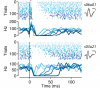
Dysfunction of the basal ganglia produces severe deficits in the timing, initiation, and vigor of movement. These diverse impairments suggest a control system gone awry. In engineered systems, feedback is critical for control. By contrast, models of the basal ganglia highlight feedforward circuitry and ignore intrinsic feedback circuits. In this study, we show that feedback via axon collaterals of substantia nigra projection neurons control the gain of the basal ganglia output. Through a combination of physiology, optogenetics, anatomy, and circuit mapping, we elaborate a general circuit mechanism for gain control in a microcircuit lacking interneurons. Our data suggest that diverse tonic firing rates, weak unitary connections and a spatially diffuse collateral circuit with distinct topography and kinetics from feedforward input is sufficient to implement divisive feedback inhibition. The importance of feedback for engineered systems implies that the intranigral microcircuit, despite its absence from canonical models, could be essential to basal ganglia function. DOI: http://dx.doi.org/10.7554/eLife.02397.001.
It is now appreciated that the brain is immunologically active. Highly conserved innate immune signaling responds to pathogen invasion and injury and promotes structural refinement of neural circuitry. However, it remains generally unknown whether innate immune signaling has a function during the day-to-day regulation of neural function in the absence of pathogens and irrespective of cellular damage or developmental change. Here we show that an innate immune receptor, a member of the peptidoglycan pattern recognition receptor family (PGRP-LC), is required for the induction and sustained expression of homeostatic synaptic plasticity. This receptor functions presynaptically, controlling the homeostatic modulation of the readily releasable pool of synaptic vesicles following inhibition of postsynaptic glutamate receptor function. Thus, PGRP-LC is a candidate receptor for retrograde, trans-synaptic signaling, a novel activity for innate immune signaling and the first known function of a PGRP-type receptor in the nervous system of any organism.
Hordes of tourists flock to Washington, D.C. every spring to see the cherry trees blossom. Once in the city, they must find their way to the Tidal Basin where the Japanese trees grow. Fortunately, a number of visual landmarks can help them to navigate. In 1910, the United States Congress passed The Height of Buildings Act, limiting the elevation of commercial and residential structures in D.C. to 130 feet. Thus, the 555-foot-tall Washington Monument often looms large against the horizon, serving as an anchor point to help set the tourists' sense of direction. Once their heading is set, they can lose sight of the monument behind buildings or groups of tall Scandinavian visitors and still use their internal compass to navigate to the Basin. This compass keeps track of their paces and turns and updates their sense of where they are and where they need to go. Yet while their heading informs their actions, it does not dictate them. Tourists who have been to D.C. in the past can, for example, use remembered views to alter their routes to avoid crowds. On an even finer scale, their leg movements also depend on their current state - they might increase the frequency and length of their strides if hunger pangs compete with their desire to see cherry blossoms, for example. The way in which these disparate cues and motivations influence exploration is a neuroscience mystery across creatures large and small.
Homology-directed repair (HDR) is a powerful tool for modifying genomes in precise ways to address many biological questions. Use of Clustered Regularly Interspersed Short Palindromic Repeats (CRISPR)-Cas9 induced targeted DNA double-strand breakage has substantially simplified use of homology-directed repair to introduce specific perturbations in Drosophila, but existing platforms for CRISPR-Cas9-mediated HDR in Drosophila involve multiple cloning steps and have low efficiency. To simplify cloning of HDR plasmids, we designed a new plasmid platform, the Janelia Atalanta (pJAT) series, that exploits recent advances in dsDNA synthesis to facilitate Gateway cloning of gRNA sequences and homology arms in one step. Surprisingly, the pJAT plasmids yielded considerably higher HDR efficiency (approximately 25%) than we have observed with other approaches. pJAT plasmids work in multiple Drosophila species and exhibited such high efficiency that previously impossible experiments in Drosophila, such as driving targeted chromosomal inversions, were made possible. We provide pJAT plasmids for a range of commonly performed experiments including targeted insertional mutagenesis, insertion of phiC31-mediated attP landing sites, generation of strains carrying a germ-line source of Cas9, and induction of chromosomal rearrangements. We also provide “empty” pJAT plasmids with multiple cloning sites to simplify construction of plasmids with new functionality. The pJAT platform is generic and may facilitate improved efficiency CRISPR-Cas9 HDR in a wide range of model and non-model organisms.

