
Filter
Associated Lab
- Branson Lab (4) Apply Branson Lab filter
- Card Lab (5) Apply Card Lab filter
- Dickson Lab (1) Apply Dickson Lab filter
- Funke Lab (2) Apply Funke Lab filter
- Hess Lab (1) Apply Hess Lab filter
- Jayaraman Lab (3) Apply Jayaraman Lab filter
- Reiser Lab (55) Apply Reiser Lab filter
- Romani Lab (6) Apply Romani Lab filter
- Rubin Lab (17) Apply Rubin Lab filter
- Saalfeld Lab (1) Apply Saalfeld Lab filter
- Scheffer Lab (1) Apply Scheffer Lab filter
- Stern Lab (1) Apply Stern Lab filter
- Turaga Lab (3) Apply Turaga Lab filter
- Zuker Lab (1) Apply Zuker Lab filter
Associated Project Team
Publication Date
- 2025 (7) Apply 2025 filter
- 2024 (2) Apply 2024 filter
- 2023 (6) Apply 2023 filter
- 2022 (3) Apply 2022 filter
- 2021 (3) Apply 2021 filter
- 2020 (2) Apply 2020 filter
- 2019 (2) Apply 2019 filter
- 2018 (4) Apply 2018 filter
- 2017 (6) Apply 2017 filter
- 2016 (3) Apply 2016 filter
- 2015 (2) Apply 2015 filter
- 2014 (2) Apply 2014 filter
- 2013 (2) Apply 2013 filter
- 2012 (1) Apply 2012 filter
- 2011 (2) Apply 2011 filter
- 2010 (3) Apply 2010 filter
- 2009 (1) Apply 2009 filter
- 2008 (1) Apply 2008 filter
- 2007 (2) Apply 2007 filter
- 2003 (1) Apply 2003 filter
Type of Publication
55 Publications
Showing 41-50 of 55 resultsColor and polarization provide complementary information about the world and are detected by specialized photoreceptors. However, the downstream neural circuits that process these distinct modalities are incompletely understood in any animal. Using electron microscopy, we have systematically reconstructed the synaptic targets of the photoreceptors specialized to detect color and skylight polarization in Drosophila, and we have used light microscopy to confirm many of our findings. We identified known and novel downstream targets that are selective for different wavelengths or polarized light, and followed their projections to other areas in the optic lobes and the central brain. Our results revealed many synapses along the photoreceptor axons between brain regions, new pathways in the optic lobes, and spatially segregated projections to central brain regions. Strikingly, photoreceptors in the polarization-sensitive dorsal rim area target fewer cell types, and lack strong connections to the lobula, a neuropil involved in color processing. Our reconstruction identifies shared wiring and modality-specific specializations for color and polarization vision, and provides a comprehensive view of the first steps of the pathways processing color and polarized light inputs.
In flies, the direction of moving ON and OFF features is computed separately. T4 (ON) and T5 (OFF) are the first neurons in their respective pathways to extract a directionally selective response from their non-selective inputs. Our recent study of T4 found that the integration of offset depolarizing and hyperpolarizing inputs is critical for the generation of directional selectivity. However, T5s lack small-field inhibitory inputs, suggesting they may use a different mechanism. Here we used whole-cell recordings of T5 neurons and found a similar receptive field structure: fast depolarization and persistent, spatially offset hyperpolarization. By assaying pairwise interactions of local stimulation across the receptive field, we found no amplifying responses, only suppressive responses to the non-preferred motion direction. We then evaluated passive, biophysical models and found that a model using direct inhibition, but not the removal of excitation, can accurately predict T5 responses to a range of moving stimuli.
The perception of visual motion is critical for animal navigation, and flies are a prominent model system for exploring this neural computation. In Drosophila, the T4 cells of the medulla are directionally selective and necessary for ON motion behavioral responses. To examine the emergence of directional selectivity, we developed genetic driver lines for the neuron types with the most synapses onto T4 cells. Using calcium imaging, we found that these neuron types are not directionally selective and that selectivity arises in the T4 dendrites. By silencing each input neuron type, we identified which neurons are necessary for T4 directional selectivity and ON motion behavioral responses. We then determined the sign of the connections between these neurons and T4 cells using neuronal photoactivation. Our results indicate a computational architecture for motion detection that is a hybrid of classic theoretical models.
Applying modern machine-vision techniques to the study of animal behavior, two groups developed systems that quantify many aspects of the complex social behaviors of Drosophila melanogaster. These software tools will enable high-throughput screens that seek to uncover the cellular and molecular underpinnings of behavior.
Visual systems across species transform photoreceptor inputs into diverse perceptual representations through hierarchical networks that extract features via parallel pathways. In Drosophila, the optic lobes are layered, retinotopic visual processing centers that contain two-thirds of the brain’s neurons and support diverse visually guided behaviors. Although this architecture has long suggested hierarchical and parallel organization, a system-wide account of how behaviorally relevant visual features are routed and integrated across a complete visual system—in any animal—has remained elusive. The new male fly connectome now provides the synapse-level wiring needed to trace visual information from photoreceptors through the optic lobes and across the central brain. Applying a network-based analysis of information flow, we reveal a multi-layered architecture organized into distinct, functionally interpretable pathways. Using this framework to propagate signals through these pathways predicts receptive-field structure and feature selectivity consistent with physiological data, enabling large-scale functional annotation of thousands of neuron types. We find that distinct visual input channels are broadly distributed throughout the brain, yet converge in focal regions of feature specificity and acute spatial vision. Together, these analyses provide a neuron-level, connectome-based view of how a brain organizes and transforms visual input.
It has long been known that many flying insects use visual cues to orient with respect to the wind and to control their groundspeed in the face of varying wind conditions. Much less explored has been the role of mechanosensory cues in orienting insects relative to the ambient air. Here we show that Drosophila melanogaster, magnetically tethered so as to be able to rotate about their yaw axis, are able to detect and orient into a wind, as would be experienced during forward flight. Further, this behavior is velocity dependent and is likely subserved, at least in part, by the Johnston’s organs, chordotonal organs in the antennae also involved in near-field sound detection. These wind-mediated responses may help to explain how flies are able to fly forward despite visual responses that might otherwise inhibit this behavior. Expanding visual stimuli, such as are encountered during forward flight, are the most potent aversive visual cues known for D. melanogaster flying in a tethered paradigm. Accordingly, tethered flies strongly orient towards a focus of contraction, a problematic situation for any animal attempting to fly forward. We show in this study that wind stimuli, transduced via mechanosensory means, can compensate for the aversion to visual expansion and thus may help to explain how these animals are indeed able to maintain forward flight.
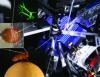
Drosophila melanogaster is a model organism rich in genetic tools to manipulate and identify neural circuits involved in specific behaviors. Here we present a technique for two-photon calcium imaging in the central brain of head-fixed Drosophila walking on an air-supported ball. The ball’s motion is tracked at high resolution and can be treated as a proxy for the fly’s own movements. We used the genetically encoded calcium sensor, GCaMP3.0, to record from important elements of the motion-processing pathway, the horizontal-system lobula plate tangential cells (LPTCs) in the fly optic lobe. We presented motion stimuli to the tethered fly and found that calcium transients in horizontal-system neurons correlated with robust optomotor behavior during walking. Our technique allows both behavior and physiology in identified neurons to be monitored in a genetic model organism with an extensive repertoire of walking behaviors.
Nervous systems combine lower-level sensory signals to detect higher-order stimulus features critical to survival, such as the visual looming motion created by an imminent collision or approaching predator. Looming-sensitive neurons have been identified in diverse animal species. Different large-scale visual features such as looming often share local cues, which means loom-detecting neurons face the challenge of rejecting confounding stimuli. Here we report the discovery of an ultra-selective looming detecting neuron, lobula plate/lobula columnar, type II (LPLC2) in Drosophila, and show how its selectivity is established by radial motion opponency. In the fly visual system, directionally selective small-field neurons called T4 and T5 form a spatial map in the lobula plate, where they each terminate in one of four retinotopic layers, such that each layer responds to motion in a different cardinal direction. Single-cell anatomical analysis reveals that each arm of the LPLC2 cross-shaped primary dendrites ramifies in one of these layers and extends along that layer's preferred motion direction. In vivo calcium imaging demonstrates that, as their shape predicts, individual LPLC2 neurons respond strongly to outward motion emanating from the centre of the neuron's receptive field. Each dendritic arm also receives local inhibitory inputs directionally selective for inward motion opposing the excitation. This radial motion opponency generates a balance of excitation and inhibition that makes LPLC2 non-responsive to related patterns of motion such as contraction, wide-field rotation or luminance change. As a population, LPLC2 neurons densely cover visual space and terminate onto the giant fibre descending neurons, which drive the jump muscle motor neuron to trigger an escape take off. Our findings provide a mechanistic description of the selective feature detection that flies use to discern and escape looming threats.
As an animal translates through the world, its eyes will experience a radiating pattern of optic flow in which there is a focus of expansion directly in front and a focus of contraction behind. For flying fruit flies, recent experiments indicate that flies actively steer away from patterns of expansion. Whereas such a reflex makes sense for avoiding obstacles, it presents a paradox of sorts because an insect could not navigate stably through a visual scene unless it tolerated flight towards a focus of expansion during episodes of forward translation. One possible solution to this paradox is that a fly’s behavior might change such that it steers away from strong expansion, but actively steers towards weak expansion. In this study, we use a tethered flight arena to investigate the influence of stimulus strength on the magnitude and direction of turning responses to visual expansion in flies. These experiments indicate that the expansion-avoidance behavior is speed dependent. At slower speeds of expansion, flies exhibit an attraction to the focus of expansion, whereas the behavior transforms to expansion avoidance at higher speeds. Open-loop experiments indicate that this inversion of the expansion-avoidance response depends on whether or not the head is fixed to the thorax. The inversion of the expansion-avoidance response with stimulus strength has a clear manifestation under closed-loop conditions. Flies will actively orient towards a focus of expansion at low temporal frequency but steer away from it at high temporal frequency. The change in the response with temporal frequency does not require motion stimuli directly in front or behind the fly. Animals in which the stimulus was presented within 120 deg sectors on each side consistently steered towards expansion at low temporal frequency and steered towards contraction at high temporal frequency. A simple model based on an array of Hassenstein-Reichardt type elementary movement detectors suggests that the inversion of the expansion-avoidance reflex can explain the spatial distribution of straight flight segments and collision-avoidance saccades when flies fly freely within an open circular arena.
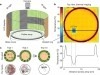
The ability of insects to learn and navigate to specific locations in the environment has fascinated naturalists for decades. The impressive navigational abilities of ants, bees, wasps and other insects demonstrate that insects are capable of visual place learning, but little is known about the underlying neural circuits that mediate these behaviours. Drosophila melanogaster (common fruit fly) is a powerful model organism for dissecting the neural circuitry underlying complex behaviours, from sensory perception to learning and memory. Drosophila can identify and remember visual features such as size, colour and contour orientation. However, the extent to which they use vision to recall specific locations remains unclear. Here we describe a visual place learning platform and demonstrate that Drosophila are capable of forming and retaining visual place memories to guide selective navigation. By targeted genetic silencing of small subsets of cells in the Drosophila brain, we show that neurons in the ellipsoid body, but not in the mushroom bodies, are necessary for visual place learning. Together, these studies reveal distinct neuroanatomical substrates for spatial versus non-spatial learning, and establish Drosophila as a powerful model for the study of spatial memories.