
Filter
Result Type
- Apply filter
- Apply filter
- Apply filter
- Apply filter
- Apply filter
- Apply filter
- Apply filter
- Apply filter
- Apply filter
- Area Landing Page (10) Apply Area Landing Page filter
- Collaborations (2) Apply Collaborations filter
- Conferences (246) Apply Conferences filter
- Janelia Archives (19) Apply Janelia Archives filter
- Janelia Archives Landing (1) Apply Janelia Archives Landing filter
- Lab (61) Apply Lab filter
- News Stories (282) Apply News Stories filter
- Other (551) Apply Other filter
- People (673) Apply People filter
- Project Team (16) Apply Project Team filter
- Publications (2785) Apply Publications filter
- Support Team (21) Apply Support Team filter
- Theory Fellow Landing Page (4) Apply Theory Fellow Landing Page filter
- Tool (132) Apply Tool filter
Associated Lab
- Aguilera Castrejon Lab (7) Apply Aguilera Castrejon Lab filter
- Ahrens Lab (77) Apply Ahrens Lab filter
- Aso Lab (50) Apply Aso Lab filter
- Baker Lab (20) Apply Baker Lab filter
- Betzig Lab (113) Apply Betzig Lab filter
- Beyene Lab (19) Apply Beyene Lab filter
- Bock Lab (15) Apply Bock Lab filter
- Branson Lab (63) Apply Branson Lab filter
- Card Lab (38) Apply Card Lab filter
- Cardona Lab (45) Apply Cardona Lab filter
- Chklovskii Lab (10) Apply Chklovskii Lab filter
- Clapham Lab (21) Apply Clapham Lab filter
- Cui Lab (20) Apply Cui Lab filter
- Darshan Lab (8) Apply Darshan Lab filter
- Dennis Lab (8) Apply Dennis Lab filter
- Dickson Lab (34) Apply Dickson Lab filter
- Druckmann Lab (21) Apply Druckmann Lab filter
- Dudman Lab (53) Apply Dudman Lab filter
- Eddy/Rivas Lab (30) Apply Eddy/Rivas Lab filter
- Egnor Lab (5) Apply Egnor Lab filter
- Espinosa Medina Lab (30) Apply Espinosa Medina Lab filter
- Feliciano Lab (16) Apply Feliciano Lab filter
- Fetter Lab (31) Apply Fetter Lab filter
- FIB-SEM Technology (1) Apply FIB-SEM Technology filter
- Fitzgerald Lab (16) Apply Fitzgerald Lab filter
- Freeman Lab (16) Apply Freeman Lab filter
- Funke Lab (49) Apply Funke Lab filter
- Gonen Lab (60) Apply Gonen Lab filter
- Grigorieff Lab (34) Apply Grigorieff Lab filter
- Harris Lab (65) Apply Harris Lab filter
- Heberlein Lab (15) Apply Heberlein Lab filter
- Hermundstad Lab (33) Apply Hermundstad Lab filter
- Hess Lab (87) Apply Hess Lab filter
- Ilanges Lab (9) Apply Ilanges Lab filter
- Jayaraman Lab (59) Apply Jayaraman Lab filter
- Ji Lab (34) Apply Ji Lab filter
- Johnson Lab (8) Apply Johnson Lab filter
- Kainmueller Lab (1) Apply Kainmueller Lab filter
- Karpova Lab (24) Apply Karpova Lab filter
- Keleman Lab (8) Apply Keleman Lab filter
- Keller Lab (80) Apply Keller Lab filter
- Koay Lab (8) Apply Koay Lab filter
- Lavis Lab (164) Apply Lavis Lab filter
- Lee (Albert) Lab (32) Apply Lee (Albert) Lab filter
- Leonardo Lab (19) Apply Leonardo Lab filter
- Li Lab (13) Apply Li Lab filter
- Lippincott-Schwartz Lab (120) Apply Lippincott-Schwartz Lab filter
- Liu (Yin) Lab (8) Apply Liu (Yin) Lab filter
- Liu (Zhe) Lab (68) Apply Liu (Zhe) Lab filter
- Looger Lab (144) Apply Looger Lab filter
- Magee Lab (31) Apply Magee Lab filter
- Menon Lab (12) Apply Menon Lab filter
- Murphy Lab (7) Apply Murphy Lab filter
- O'Shea Lab (13) Apply O'Shea Lab filter
- Otopalik Lab (8) Apply Otopalik Lab filter
- Pachitariu Lab (46) Apply Pachitariu Lab filter
- Pastalkova Lab (6) Apply Pastalkova Lab filter
- Pavlopoulos Lab (7) Apply Pavlopoulos Lab filter
- Pedram Lab (11) Apply Pedram Lab filter
- Podgorski Lab (18) Apply Podgorski Lab filter
- Reiser Lab (67) Apply Reiser Lab filter
- Riddiford Lab (21) Apply Riddiford Lab filter
- Romani Lab (52) Apply Romani Lab filter
- Rubin Lab (126) Apply Rubin Lab filter
- Ryan Lab (1) Apply Ryan Lab filter
- Saalfeld Lab (56) Apply Saalfeld Lab filter
- Satou Lab (7) Apply Satou Lab filter
- Scheffer Lab (40) Apply Scheffer Lab filter
- Schreiter Lab (66) Apply Schreiter Lab filter
- Schulze Lab (3) Apply Schulze Lab filter
- Sgro Lab (14) Apply Sgro Lab filter
- Shroff Lab (44) Apply Shroff Lab filter
- Simpson Lab (18) Apply Simpson Lab filter
- Singer Lab (39) Apply Singer Lab filter
- Spruston Lab (77) Apply Spruston Lab filter
- Stern Lab (85) Apply Stern Lab filter
- Sternson Lab (52) Apply Sternson Lab filter
- Stringer Lab (44) Apply Stringer Lab filter
- Svoboda Lab (145) Apply Svoboda Lab filter
- Tavakoli Lab (3) Apply Tavakoli Lab filter
- Tebo Lab (22) Apply Tebo Lab filter
- Tervo Lab (14) Apply Tervo Lab filter
- Tillberg Lab (22) Apply Tillberg Lab filter
- Tjian Lab (19) Apply Tjian Lab filter
- Truman Lab (59) Apply Truman Lab filter
- Turaga Lab (59) Apply Turaga Lab filter
- Turner Lab (35) Apply Turner Lab filter
- Vale Lab (11) Apply Vale Lab filter
- Voigts Lab (10) Apply Voigts Lab filter
- Wang (Meng) Lab (45) Apply Wang (Meng) Lab filter
- Wang (Shaohe) Lab (14) Apply Wang (Shaohe) Lab filter
- Wong-Campos Lab (4) Apply Wong-Campos Lab filter
- Wu Lab (9) Apply Wu Lab filter
- Zlatic Lab (26) Apply Zlatic Lab filter
- Zuker Lab (5) Apply Zuker Lab filter
Associated Project Team
- CellMap (30) Apply CellMap filter
- COSEM (3) Apply COSEM filter
- FIB-SEM Technology (11) Apply FIB-SEM Technology filter
- Fly Descending Interneuron (14) Apply Fly Descending Interneuron filter
- Fly Functional Connectome (15) Apply Fly Functional Connectome filter
- Fly Olympiad (5) Apply Fly Olympiad filter
- FlyEM (66) Apply FlyEM filter
- FlyLight (59) Apply FlyLight filter
- FuncEWOrm (10) Apply FuncEWOrm filter
- GENIE (68) Apply GENIE filter
- Integrative Imaging (7) Apply Integrative Imaging filter
- Larval Olympiad (2) Apply Larval Olympiad filter
- MouseLight (26) Apply MouseLight filter
- NeuroSeq (2) Apply NeuroSeq filter
- ThalamoSeq (1) Apply ThalamoSeq filter
- Tool Translation Team (T3) (37) Apply Tool Translation Team (T3) filter
- Transcription Imaging (48) Apply Transcription Imaging filter
Associated Support Team
- Project Pipeline Support (39) Apply Project Pipeline Support filter
- Anatomy and Histology (25) Apply Anatomy and Histology filter
- Cryo-Electron Microscopy (51) Apply Cryo-Electron Microscopy filter
- Electron Microscopy (24) Apply Electron Microscopy filter
- Flow Cytometry (4) Apply Flow Cytometry filter
- Gene Targeting and Transgenics (20) Apply Gene Targeting and Transgenics filter
- High Performance Computing (14) Apply High Performance Computing filter
- Immortalized Cell Line Culture (6) Apply Immortalized Cell Line Culture filter
- Integrative Imaging (34) Apply Integrative Imaging filter
- Invertebrate Shared Resource (50) Apply Invertebrate Shared Resource filter
- Janelia Experimental Technology (103) Apply Janelia Experimental Technology filter
- Management Team (1) Apply Management Team filter
- Mass Spectrometry (5) Apply Mass Spectrometry filter
- Media Facil\ (7) Apply Media Facil\ filter
- Molecular Genomics (20) Apply Molecular Genomics filter
- Primary & iPS Cell Culture (25) Apply Primary & iPS Cell Culture filter
- Project Technical Resources (68) Apply Project Technical Resources filter
- Quantitative Genomics (27) Apply Quantitative Genomics filter
- Scientific Computing (140) Apply Scientific Computing filter
- Viral Tools (22) Apply Viral Tools filter
- Vivarium (10) Apply Vivarium filter
Publication Date
- 2025 (252) Apply 2025 filter
- 2024 (241) Apply 2024 filter
- 2023 (187) Apply 2023 filter
- 2022 (192) Apply 2022 filter
- 2021 (187) Apply 2021 filter
- 2020 (194) Apply 2020 filter
- 2019 (201) Apply 2019 filter
- 2018 (221) Apply 2018 filter
- 2017 (202) Apply 2017 filter
- 2016 (207) Apply 2016 filter
- 2015 (222) Apply 2015 filter
- 2014 (216) Apply 2014 filter
- 2013 (152) Apply 2013 filter
- 2012 (112) Apply 2012 filter
- 2011 (98) Apply 2011 filter
- 2010 (61) Apply 2010 filter
- 2009 (56) Apply 2009 filter
- 2008 (40) Apply 2008 filter
- 2007 (21) Apply 2007 filter
- 2006 (3) Apply 2006 filter
Tool Types
- Data (9) Apply Data filter
- Data Application (7) Apply Data Application filter
- Figshare (1) Apply Figshare filter
- Human Health (2) Apply Human Health filter
- Imaging Instrumentation (11) Apply Imaging Instrumentation filter
- Laboratory Hardware (3) Apply Laboratory Hardware filter
- Laboratory Tool (6) Apply Laboratory Tool filter
- Laboratory Tools (51) Apply Laboratory Tools filter
- Medical Technology (1) Apply Medical Technology filter
- Model Organisms (9) Apply Model Organisms filter
- Reagents (29) Apply Reagents filter
- Software (20) Apply Software filter
4960 Results
Showing 141-150 of 4960 resultsL-Lactate, traditionally considered a metabolic waste product, is increasingly recognized as an important intercellular energy currency in mammals. To enable investigations of the emerging roles of intercellular shuttling of L-lactate, we now report an intensiometric green fluorescent genetically encoded biosensor for extracellular L-lactate. This biosensor, designated eLACCO1.1, enables cellular resolution imaging of extracellular L-lactate in cultured mammalian cells and brain tissue.
Since the original identification of GFP from jellyfish and corals, the genetically encoded fluorescent proteins have become mainstream indicators for imaging. Functionally homologous candidates exist in more highly evolved bioluminescent invertebrates, including echinoderms. For example, in brittlestars, stimulus-evoked bioluminescence is transient, lasting seconds, and emanates from specialized cells (photocytes). Prior to light emission, we observe little or no green fluorescence. However, concurrent with light emission, an intense green, calcium-dependent fluorescence develops that persists indefinitely.
Current techniques for monitoring GABA (γ-aminobutyric acid), the primary inhibitory neurotransmitter in vertebrates, cannot follow transients in intact neural circuits. To develop a GABA sensor, we applied the design principles used to create the fluorescent glutamate receptor iGluSnFR. We used a protein derived from a previously unsequenced Pseudomonas fluorescens strain and performed structure-guided mutagenesis and library screening to obtain intensity-based GABA sensing fluorescence reporter (iGABASnFR) variants. iGABASnFR is genetically encoded, detects GABA release evoked by electric stimulation of afferent fibers in acute brain slices and produces readily detectable fluorescence increases in vivo in mice and zebrafish. We applied iGABASnFR to track mitochondrial GABA content and its modulation by an anticonvulsant, swimming-evoked, GABA-mediated transmission in zebrafish cerebellum, GABA release events during interictal spikes and seizures in awake mice, and found that GABA-mediated tone decreases during isoflurane anesthesia.
The activity of the ERK has complex spatial and temporal dynamics that are important for the specificity of downstream effects. However, current biochemical techniques do not allow for the measurement of ERK signaling with fine spatiotemporal resolution. We developed a genetically encoded, FRET-based sensor of ERK activity (the extracellular signal-regulated kinase activity reporter, EKAR), optimized for signal-to-noise ratio and fluorescence lifetime imaging. EKAR selectively and reversibly reported ERK activation in HEK293 cells after epidermal growth factor stimulation. EKAR signals were correlated with ERK phosphorylation, required ERK activity, and did not report the activities of JNK or p38. EKAR reported ERK activation in the dendrites and nucleus of hippocampal pyramidal neurons in brain slices after theta-burst stimuli or trains of back-propagating action potentials. EKAR therefore permits the measurement of spatiotemporal ERK signaling dynamics in living cells, including in neuronal compartments in intact tissues.
We report an intensiometric, near-infrared fluorescent, genetically encoded calcium ion (Ca) indicator (GECI) with excitation and emission maxima at 678 and 704 nm, respectively. This GECI, designated NIR-GECO1, enables imaging of Ca transients in cultured mammalian cells and brain tissue with sensitivity comparable to that of currently available visible-wavelength GECIs. We demonstrate that NIR-GECO1 opens up new vistas for multicolor Ca imaging in combination with other optogenetic indicators and actuators.
Adenosine 5' triphosphate (ATP) is a universal intracellular energy source and an evolutionarily ancient, ubiquitous extracellular signal in diverse species. Here, we report the generation and characterization of single-wavelength genetically encoded fluorescent sensors (iATPSnFRs) for imaging extracellular and cytosolic ATP from insertion of circularly permuted superfolder GFP into the epsilon subunit of FF-ATPase from Bacillus PS3. On the cell surface and within the cytosol, iATPSnFR responds to relevant ATP concentrations (30 μM to 3 mM) with fast increases in fluorescence. iATPSnFRs can be genetically targeted to specific cell types and sub-cellular compartments, imaged with standard light microscopes, do not respond to other nucleotides and nucleosides, and when fused with a red fluorescent protein function as ratiometric indicators. After careful consideration of their modest pH sensitivity, iATPSnFRs represent promising reagents for imaging ATP in the extracellular space and within cells during a variety of settings, and for further application-specific refinements.
We describe the generation of a family of high-signal-to-noise single-wavelength genetically encoded indicators for maltose. This was achieved by insertion of circularly permuted fluorescent proteins into a bacterial periplasmic binding protein (PBP), Escherichia coli maltodextrin-binding protein, resulting in a four-color family of maltose indicators. The sensors were iteratively optimized to have sufficient brightness and maltose-dependent fluorescence increases for imaging, under both one- and two-photon illumination. We demonstrate that maltose affinity of the sensors can be tuned in a fashion largely independent of the fluorescent readout mechanism. Using literature mutations, the binding specificity could be altered to moderate sucrose preference, but with a significant loss of affinity. We use the soluble sensors in individual E. coli bacteria to observe rapid maltose transport across the plasma membrane, and membrane fusion versions of the sensors on mammalian cells to visualize the addition of maltose to extracellular media. The PBP superfamily includes scaffolds specific for a number of analytes whose visualization would be critical to the reverse engineering of complex systems such as neural networks, biosynthetic pathways, and signal transduction cascades. We expect the methodology outlined here to be useful in the development of indicators for many such analytes.
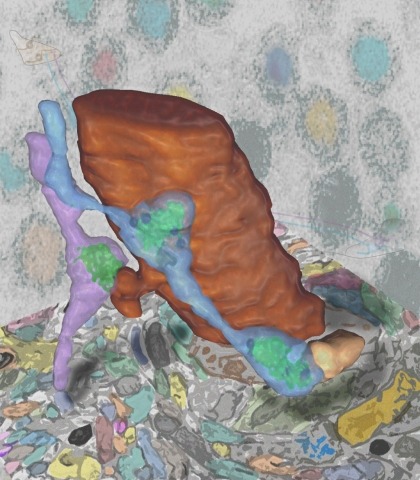
Synaptic connectivity and molecular composition provide a blueprint for information processing in neural circuits. Detailed structural analysis of neural circuits requires nanometer resolution, which can be obtained with serial-section electron microscopy. However, this technique remains challenging for reconstructing molecularly defined synapses. We used a genetically encoded synaptic marker for electron microscopy (GESEM) based on intra-vesicular generation of electron-dense labeling in axonal boutons. This approach allowed the identification of synapses from Cre recombinase-expressing or GAL4-expressing neurons in the mouse and fly with excellent preservation of ultrastructure. We applied this tool to visualize long-range connectivity of AGRP and POMC neurons in the mouse, two molecularly defined hypothalamic populations that are important for feeding behavior. Combining selective ultrastructural reconstruction of neuropil with functional and viral circuit mapping, we characterized some basic features of circuit organization for axon projections of these cell types. Our findings demonstrate that GESEM labeling enables long-range connectomics with molecularly defined cell types.
Neural computation in biological and artificial networks relies on nonlinear synaptic integration. The structural connectivity matrix of synaptic weights between neurons is a critical determinant of overall network function. However, quantitative links between neural network structure and function are complex and subtle. For example, many networks can give rise to similar functional responses, and the same network can function differently depending on context. Whether certain patterns of synaptic connectivity are required to generate specific network-level computations is largely unknown. Here we introduce a geometric framework for identifying synaptic connections required by steady-state responses in recurrent networks of rectified-linear neurons. Assuming that the number of specified response patterns does not exceed the number of input synapses, we analytically calculate all feedforward and recurrent connectivity matrices that can generate the specified responses from the network inputs. We then use this analytical characterization to rigorously analyze the solution space geometry and derive certainty conditions guaranteeing a non-zero synapse between neurons. Numerical simulations of feedforward and recurrent networks verify our analytical results. Our theoretical framework could be applied to neural activity data to make anatomical predictions that follow generally from the model architecture. It thus provides novel opportunities for discerning what model features are required to accurately relate neural network structure and function.